Ministry of Statistics releases Q3 2026 household trend survey
Average monthly non-consumption expenditure reaches 1.17 million won per household
Non-consumption spending rises 11%, far outpacing income growth
Pension contributions up 7.8%, social insurance premiums up 3.4%
Transport and housing costs climb while clothing and education spending fall
Korean households spent an average of more than 1.17 million won ($871) a month on non-consumption items — taxes, interest payments and pension contributions — in the third quarter of this year.
While household income grew just 0.8 percent from a year earlier, non-consumption expenditure rose 11.0 percent over the same period, squeezing the share of earnings available for actual spending or saving.
According to the Ministry of Statistics' Q3 2026 household trend survey released Thursday, average monthly non-consumption expenditure per household reached 1.174 million won in the third quarter, up 11.0 percent from a year earlier — a sharp acceleration from the 1.9 percent growth recorded in the second quarter.
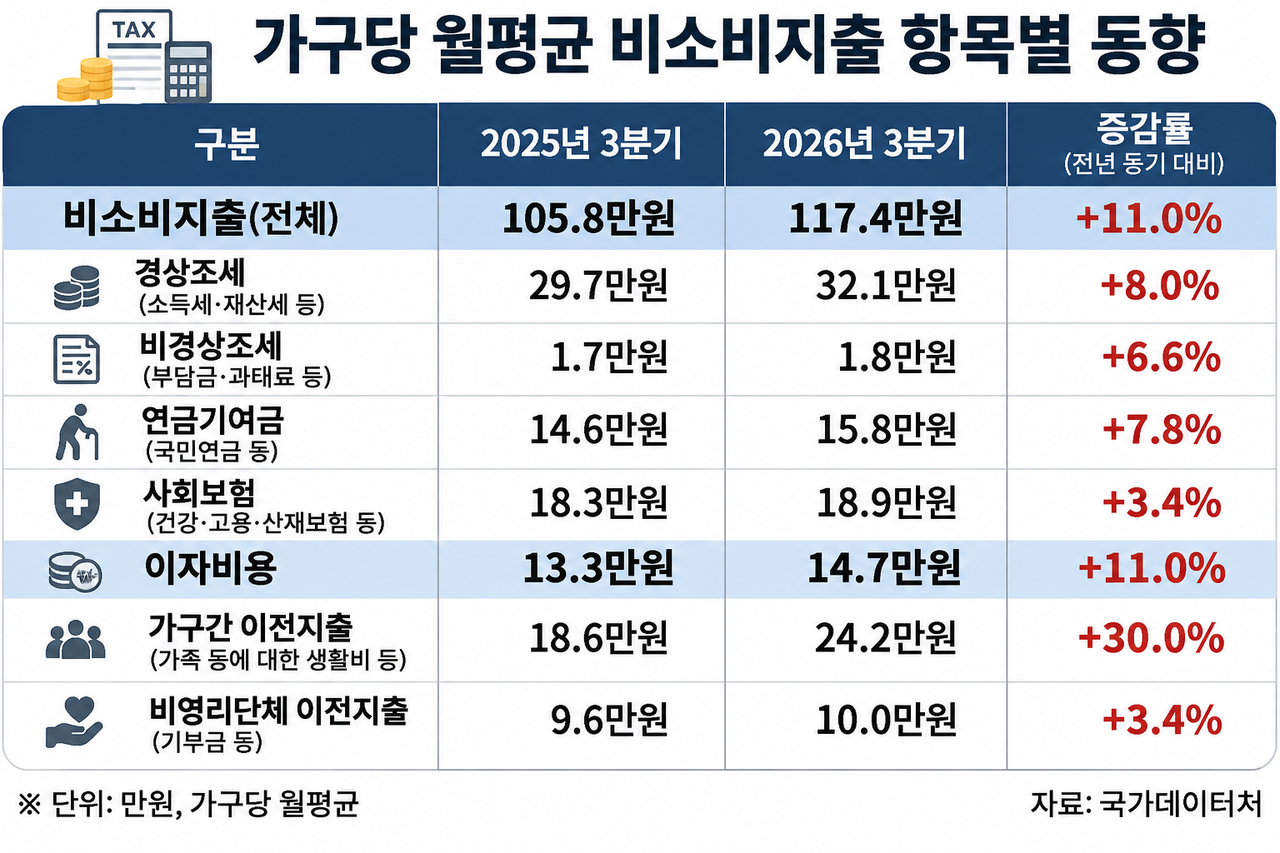
Non-consumption expenditure covers outlays that are not payments for goods or services — including taxes, pension contributions, social insurance premiums, interest costs and inter-household transfers.
Breaking down the components, regular tax payments such as income and property taxes averaged 321,000 won a month, up 8.0 percent from a year earlier. Pension contributions rose 7.8 percent to 158,000 won, while social insurance premiums increased 3.4 percent to 189,000 won.
Interest payments to financial institutions also continued to climb. Monthly interest costs per household averaged 147,000 won, up 11.0 percent year on year — the third consecutive quarter of double-digit growth, following increases of 14.3 percent in the third quarter of last year and 12.1 percent in the second quarter of this year.
Inter-household transfers — money sent to parents, children or other relatives for living expenses — surged 30.0 percent to 242,000 won. Transfers to nonprofit organizations rose 3.4 percent to 100,000 won.
As non-consumption spending expanded rapidly, its share of total household expenditure rose 1.5 percentage points, from 26.4 percent in the third quarter of last year to 27.9 percent in the third quarter of this year. In effect, about 280,000 won of every 1 million won households spent went to purposes other than buying goods or services.
Even as discretionary spending capacity shrank, the cost of everyday necessities grew. Transport spending rose 9.6 percent, information and communications 7.5 percent, housing, water and utilities 4.9 percent, and food and non-alcoholic beverages 3.3 percent. Clothing and footwear spending fell 4.6 percent, while education expenditure declined 2.4 percent.
In real terms, after stripping out inflation, spending on clothing and footwear fell 7.2 percent, recreation and culture 4.0 percent, education 3.7 percent, and food and accommodation 2.0 percent. Nominal consumption expenditure rose 2.9 percent overall, but real consumption growth was limited to 0.0 percent.
Disposable income — household income minus non-consumption expenditure — averaged 4.306 million won a month, down 1.7 percent from a year earlier. The household surplus after subtracting consumption expenditure fell 11.2 percent to 1.276 million won.
With income growth slowing and the burden of taxes, interest and other non-consumption costs rising alongside everyday living expenses, households are left with less room for additional spending or saving.
fact0514@heraldcorp.com