Analysis of 177,652 monthly price disclosures on Opinet finds over 2,300 cases of budget stations charging more than major-brand rivals since price cap took effect
Budget stations pricier in 492 cases in North Gyeongsang Province, 332 in South Chungcheong — just 1 case in Seoul
Industry calls for exit strategy as government remains cautious
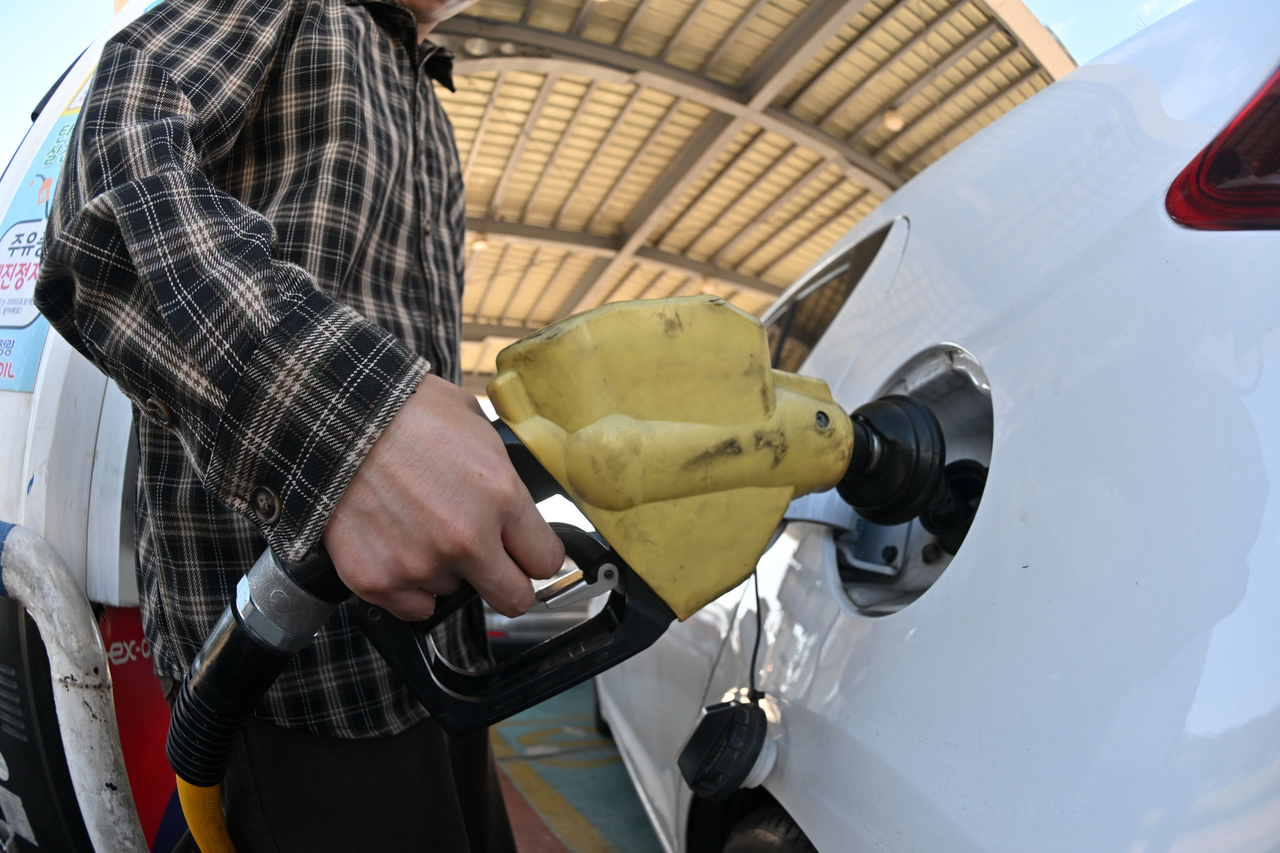
Since the government introduced a maximum price cap on petroleum products, the number of cases in which budget gas stations — known as "altteuljuyuso" — charge more than regular stations has more than doubled, a new analysis shows. The phenomenon is concentrated in rural regions outside major cities such as Seoul and Busan. As the price cap enters its ninth month, disputes between refiners and budget station operators over settlement payments are intensifying, and industry voices are growing louder in calling for an exit strategy.
Budget stations charging more: Cases double to over 2,000 this year
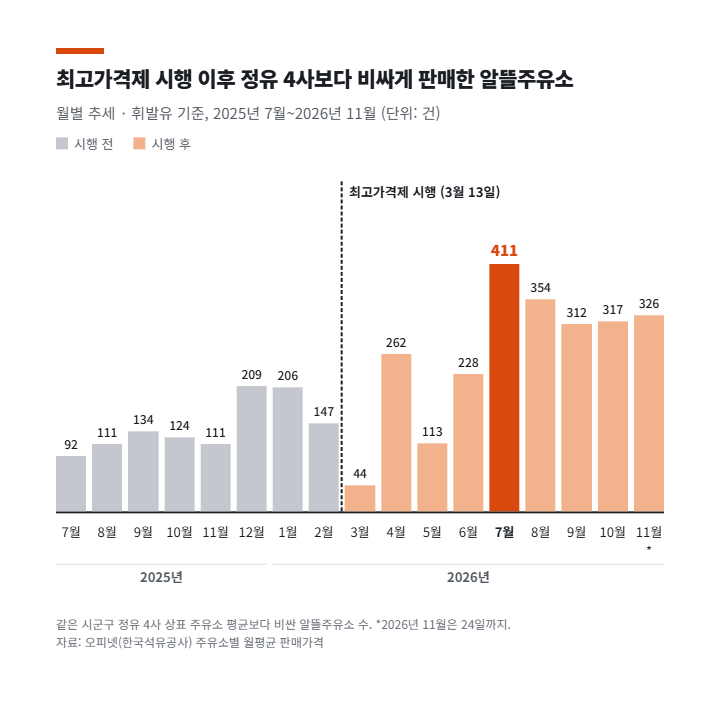
An analysis of 177,652 monthly gas station price disclosures published on Opinet, the Korea National Oil Corporation's fuel price information system, found that budget stations sold gasoline at higher prices than the four major refiners' stations in the same district on 2,323 occasions during the eight months following the introduction of the price cap (April through November 2026). That is more than double the 1,134 cases recorded in the preceding eight months (July 2025 through February 2026).
The comparison matched the retail prices of stations operated by the four major refiners against those run by the three budget station operators — NH Agri Business Holdings, the Korea National Oil Corporation and Korea Expressway Corporation — within the same city or county. Those operators bulk-purchase petroleum products from refiners through joint procurement and are designed to sell fuel more cheaply than ordinary stations. However, after the government imposed a price ceiling on petroleum products following the outbreak of war in the Middle East, that cost advantage has effectively disappeared.
Rural budget stations hit harder — Seoul largely unaffected
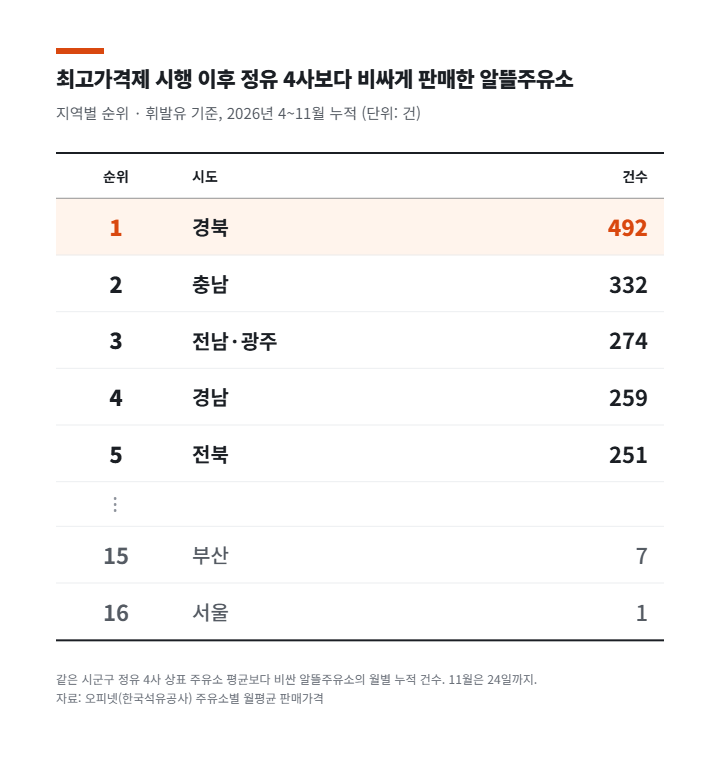
The price-reversal effect is far more pronounced outside the greater Seoul area. Since the price cap took effect, the regions recording the most cases of budget stations charging more than regular ones were North Gyeongsang Province (492 cases), South Chungcheong Province (332 cases), South Jeolla Province and Gwangju (274 cases combined) and South Gyeongsang Province (259 cases). Seoul recorded just one such case, and Busan seven. The two largest cities have largely retained the budget-station advantage, while rural areas have borne the brunt of the distortion.
Industry officials attribute this to the price cap eroding the budget-station edge while a gap in gas station infrastructure between urban and rural areas compounds the problem. "Stations in remote island and mountain areas face far less competition among themselves than those in the greater Seoul area, so there is less pressure to keep prices low," an industry official said.
The prolonged price cap is also deepening tensions between refiners and their dealers. Budget station operators argue that the cap is causing losses not only for refiners but for themselves as well.
Acting on that grievance, budget stations under Korea Expressway Corporation recently filed a lawsuit against GS Caltex demanding the return of what they described as unjust enrichment, claiming GS Caltex had settled payments at pre-cap prices and caused losses running into the tens of billions of won.
The Korea Independent Budget Gas Station Council separately filed a complaint with the Korea Fair Trade Commission in August, alleging that the four major refiners had offered discount benefits exclusively to their own affiliated stations while maintaining existing terms for budget stations, constituting discriminatory trading conditions.
'Time to find an exit strategy for the price cap'

As the price cap enters its ninth month, industry calls for an exit strategy are growing. Proponents argue that the artificial price controls have produced a range of side effects and that the mounting losses for refiners can no longer be ignored.
The Korea Energy Economics Institute, a state-funded energy research body, has added its voice to those concerns. At a breakfast forum the institute hosted Tuesday, senior researcher Jang Tae-hun of the petroleum policy research division said the cap had kept supply prices to refiners uniformly low, shrinking the volume of discounted product that had previously flowed into the spot market. "The burden has fallen disproportionately on smaller gas stations that already struggle to secure product," he said.
The government, however, remains cautious about ending the cap. Yang Jeong-hwa, director of the petroleum industry division at the Ministry of Trade, Industry and Energy, said at the same forum that international oil prices had stabilized rapidly in June only to nearly double again shortly afterward. "With oil prices swinging according to the intensity of the Middle East war, it is difficult to judge whether we are in a period of genuine stability or whether the market has simply priced in the current situation," Yang said.
Asked whether the government should announce in advance the criteria and timing for ending the cap to improve predictability, Yang drew a line, saying such a move "could have advantages in terms of predictability, but could also trigger hoarding and other disruptions in the retail market."
klee@heraldcorp.com