Shin Jong-woo: below-ground enrichment facility appears to be expanding with denser centrifuge installations
Hong Min: production increase reflects a multi-year program, not a one-time breakthrough
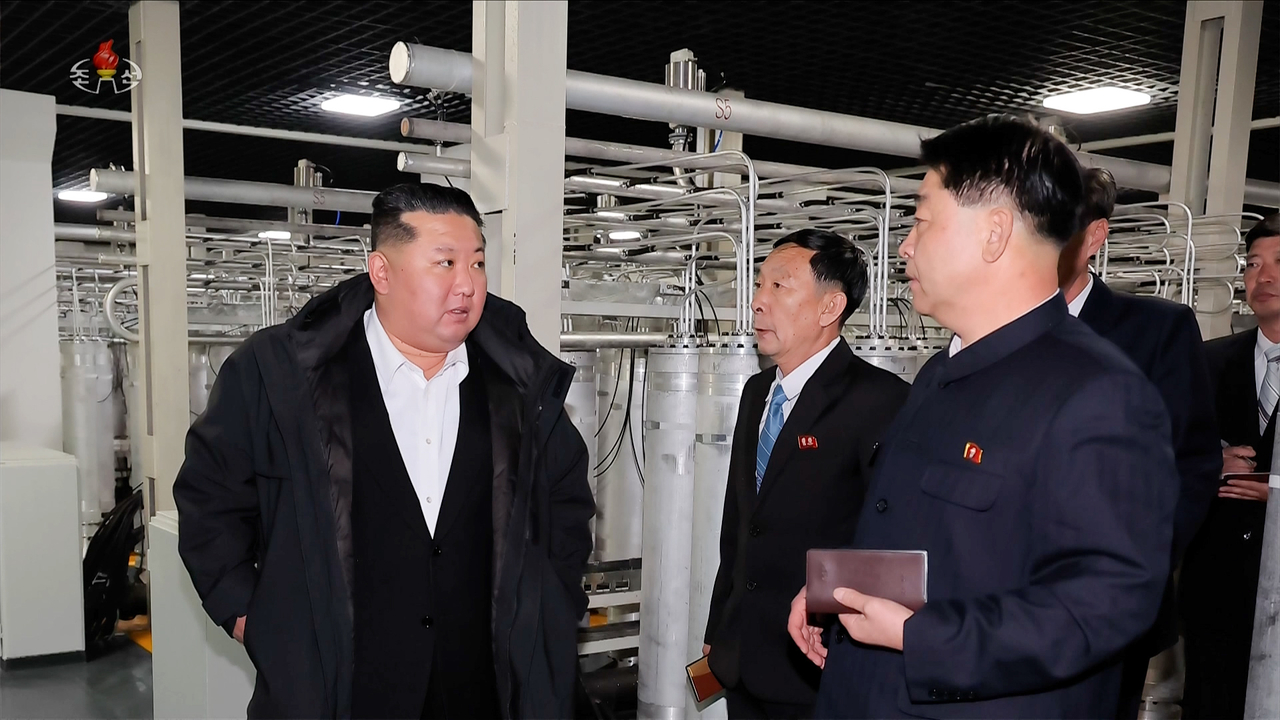
The uranium enrichment facility North Korea revealed this week is believed to be a different site from those disclosed in September 2024 and June this year, analysts said. Shin Jong-woo, secretary general of the Korea Defense and Security Forum, cited differences in ceiling height, corridor dimensions and the height and width of centrifuge structures as the basis for that assessment.
KCNA reported Thursday that Kim Jong-un had inspected the nuclear material production and nuclear weapons research sectors. North Korea described the facility as a "newly constructed important material production factory." Nine photographs were released, three of which show the centrifuge cascade hall.
Hong Min, a senior research fellow at the Korea Institute for National Unification, offered a more cautious reading of the newly built facility. He said the equipment specifications most closely resemble those seen in the June disclosure, but the finishing differs — suggesting it could be either a different hall within the same factory or a separately constructed factory built to the same design. He said the wording of the report leans toward the latter. The location cannot be determined from interior photographs alone, he added, and the facility could be an additional site within Yongbyon or somewhere else entirely.
Shin said North Korea appears to be expanding its below-ground uranium enrichment facility and increasing the density of centrifuge installations to boost enrichment capacity. He also assessed that Pyongyang is attempting to accumulate a significant stockpile of highly enriched uranium while raising its overall production capability.
KCNA said only that Kim inspected the state of infrastructure construction at a factory currently under expansion, and released no photographs of that site.
Hong said the Korean term used — "ryohae" — can refer to both an on-site visit and a briefing, so whether Kim physically visited that location cannot be confirmed from the report alone.
Noting that Kim assessed the systematic and sustained expansion of nuclear material production capacity in highly positive terms, Hong said the disclosure amounts to "a declaration that the production increase is not a one-time breakthrough but a multi-year program running on a permanent basis."
Analysts diverged on the nuclear-power-related equipment. North Korea described it only as newly produced equipment and devices related to nuclear power, without specifying its purpose. Shin assessed it as a facility manufacturing reactors and components for a nuclear-powered submarine, and said it is likely intended for an 8,000-ton nuclear-powered submarine scheduled for launch in mid-2027.
Hong, however, raised the possibility that the equipment could be for a reactor used in nuclear material production. He said the two possibilities are not mutually exclusive, since the same production base could supply both, and that the report alone is insufficient to determine which purpose it serves. The function, he said, cannot be determined from the appearance of the equipment alone.
Multiple warheads in the Hwasan series were displayed at the nuclear weapons research institute. Hong identified the large silver warheads as Hwasan-14, 21, 22, 24 and 25.
The tactical nuclear disclosure came six days after the APEC summit in Shenzhen, China concluded. Hong said the latest revelation confirms a recurring pattern in which North Korea discloses nuclear material facilities in conjunction with major-power diplomatic events.
rimsclub@heraldcorp.com