Accessibility facility compliance rate in major cities reaches 86.1%, up 12.9 percentage points from 2014
One in three South Koreans is classified as a person with mobility difficulties, according to a new government survey, with the number of elderly people and pregnant women rising while those accompanying infants and children fell.
The Ministry of Land, Infrastructure and Transport released Thursday the results of its "2025 Survey on Mobility Convenience for People with Mobility Difficulties," which covers the country's eight special and metropolitan cities.
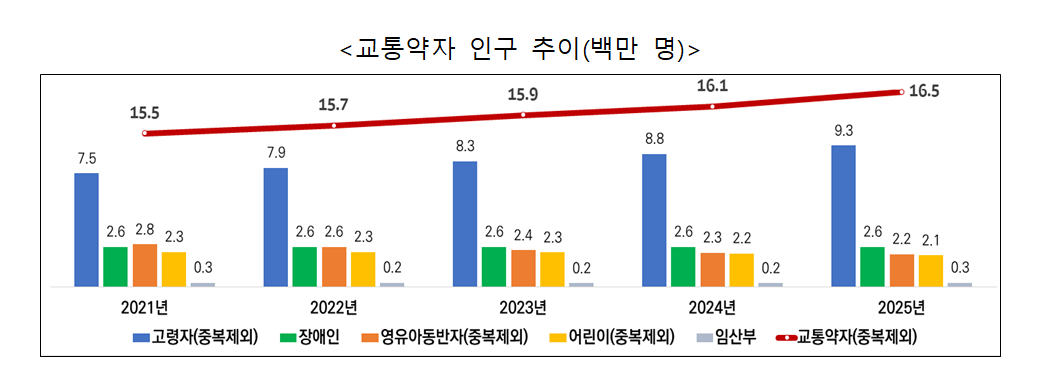
The survey found that as of the end of 2025, about 16.46 million people — or 32.2 percent of the total population of about 51.12 million — are classified as having mobility difficulties, up roughly 330,000 from about 16.13 million in 2024.
The category includes people with disabilities, those aged 65 and older, pregnant women, those accompanying children aged 7 or younger, and children aged 12 or younger — broadly defined as anyone who experiences difficulty moving around.
Breaking down the figures by type, the number of elderly people rose by 584,000 and pregnant women by 16,000 compared with 2024, in line with the country's aging trend. Meanwhile, those accompanying infants and young children fell by 101,000, and children in the category dropped by 125,000.
The compliance rate for accessibility facilities — covering transportation, passenger terminals and roads — across the eight special and metropolitan cities stood at 86.1 percent last year.
Among transportation modes, the compliance rate for buses averaged 95.3 percent, down 0.6 percentage points from 2023. The ministry attributed the decline to a drop in automated guidance systems, from 91 percent to 85.4 percent, and a fall in disability-accessible markings, from 99.5 percent to 94.7 percent. By city, Daegu recorded the highest rate at 99.4 percent, while Gwangju, Ulsan and Sejong all fell below 90 percent compared with 2023.
The compliance rate for urban and metropolitan rail vehicles came in at 97.2 percent, down 0.2 percentage points from 2024, driven by declines in destination displays and disability-accessible markings. All sections operated by Korail and the Daegu, Gwangju and Daejeon transit corporations, as well as the Ui-Sinseol Line, met the installation standards.
Among all transportation modes, conventional rail vehicles posted the highest compliance rate at 99.5 percent, though destination displays on Mugunghwa-ho trains were found to be partially inadequate. The compliance rate for aircraft stood at 75.2 percent, with the improvement attributed to upgrades such as wheelchair storage units on Asiana Airlines and the designation of priority seats for passengers with mobility difficulties on Trinity Airways, among others.
The compliance rate for coastal passenger ferries nationwide was 72.3 percent. Disability-accessible markings (88.7 percent) and boarding passageways (83.6 percent) fared relatively well, while destination displays scored just 49.1 percent, dragged down by failures to meet nighttime visibility requirements.
Maglev trains, monorails and cable cars were surveyed for the first time across the eight special and metropolitan cities, recording a compliance rate of 60.7 percent. Incheon posted the highest rate at 68.3 percent, while Busan and Daegu each came in at 16.7 percent.
The compliance rate for airport passenger terminals in the eight special and metropolitan cities rose 0.4 percentage points from 2023 to 94.1 percent last year. All nine airports surveyed recorded rates above 90 percent, with Ulsan Airport topping the list at 99.0 percent.
A separate survey on how people with mobility difficulties use transportation across the eight cities found that for short local trips, walking was the most common mode at 35.9 percent, followed by bus at 24.1 percent and subway at 21.8 percent. For travel within a metropolitan area, subway led at 36.2 percent, followed by bus at 29.7 percent and private car at 17 percent. For inter-regional travel, private car was the top choice at 41.9 percent, followed by train at 21.1 percent and express or intercity bus at 11.7 percent.
The nationwide deployment rate of low-floor buses — which have no steps and a lowered chassis to ease boarding for wheelchair users and the elderly — reached 51.8 percent in 2025, up 2,417 vehicles, or 7.4 percentage points, from 2024. Special transportation services for people with mobility difficulties were operating at about 107.5 percent of the legally mandated fleet size.
The number of special transportation vehicles grew from 4,896 in 2024 to 5,070 in 2025, an increase of 174. Annual trips totaled about 9.14 million, up roughly 440,000 from the previous year. Including alternative services such as voucher taxis and rental taxis, a total of about 20.4 million mobility service trips were provided.
Jang Gu-jung, the ministry's director general for comprehensive transportation policy, said the compliance rate for accessibility facilities in the eight special and metropolitan cities had risen consistently from 73.2 percent in 2014 to 86.1 percent in 2025, thanks to sustained efforts by local governments and transport operators, adding that the deployment rate for low-floor city buses had also surpassed 50 percent. "We will push ahead with introducing low-floor buses on metropolitan routes and establish a five-year mobility improvement plan that sets the policy direction for people with mobility difficulties, so that they can feel real improvements in their daily lives," Jang said.
hss@heraldcorp.com