Taiwan weighing limit expansion; China deploys state funds
Korea's fund relies on private capital, shifting risk burden
Existing pledge of 10.76 trillion won roughly matches a week of foreign net selling
Analysts say market must know firepower, even without a playbook
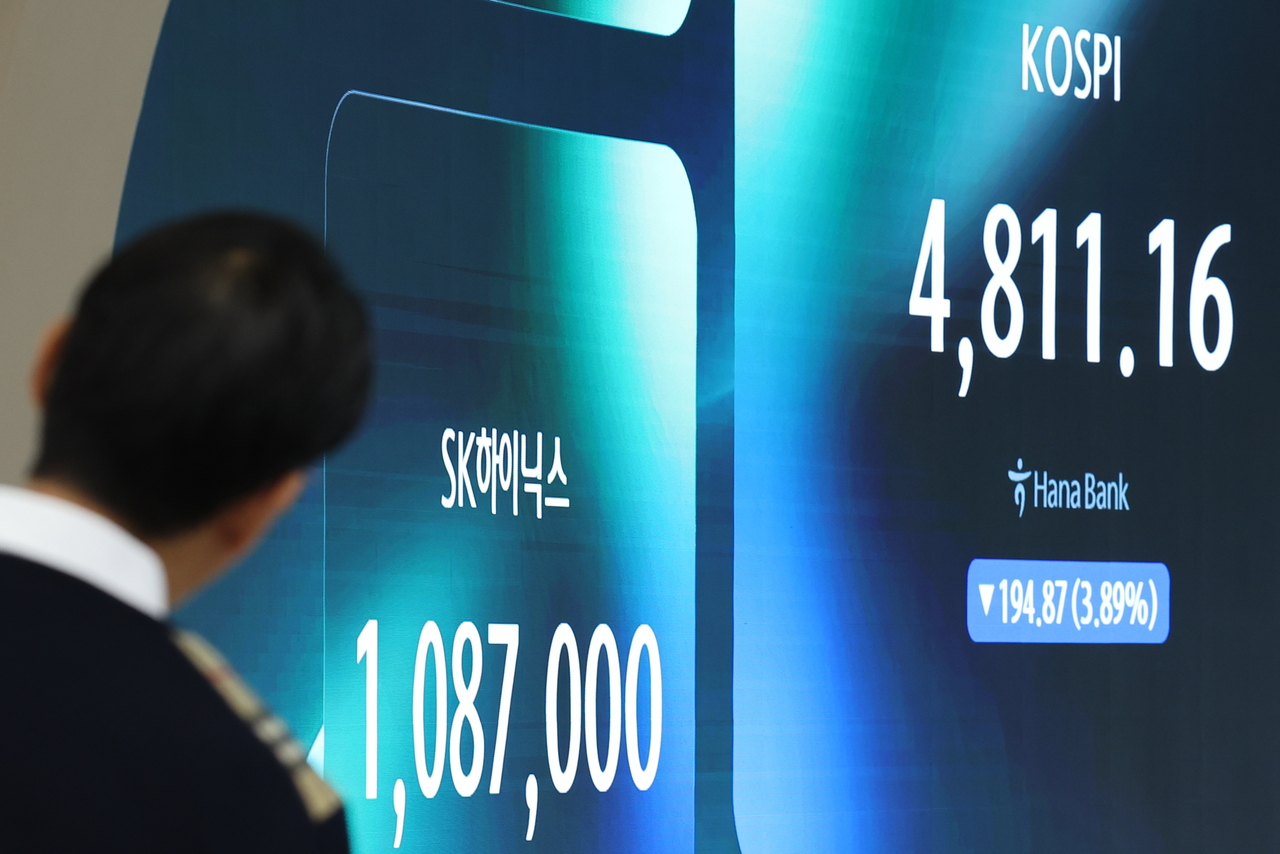
While Korea is still preparing to reactivate its stock market stabilization fund, China and Taiwan have already stepped in to buy shares and steady their markets. Taiwan deployed its National Stabilization Fund, a government vehicle, while China expanded equity and ETF purchases through state-owned and government-linked investment institutions. Korea, by contrast, is discussing a stabilization fund built on private capital from financial firms and securities-related organizations — not government money — and both the timing and scale of any deployment remain under review. Analysts say strategic ambiguity about the fund's investment approach is essential, but a stronger signal is needed to thaw frozen investor sentiment.
Taiwan intervened through its National Stabilization Fund, which carries an operating limit of around 500 billion New Taiwan dollars (about 20 trillion won). Authorities approved the fund's deployment on Nov. 6, when the Taiex index plunged, and stabilization measures began Nov. 9. The government officially confirmed actual share purchases on Saturday.
In China, state-owned and government-linked investment institutions — including Central Huijin Investment, China Chengtong and China Reform Holdings — have been stabilizing the market through what is known as the "national team," buying equities and ETFs. On Friday, nine ETFs identified as conduits for state-linked capital recorded a single-day net inflow of 90 billion yuan ($13.5 billion), the largest one-day net inflow for those funds ever tracked by Bloomberg.
Both Taiwan and China have moved swiftly to deploy government-led capital when markets deteriorate sharply. Korea's proposed stabilization fund works differently. Rather than drawing on government funds or state investment institutions, it would be assembled from capital commitments made by financial companies and securities-related organizations. As a result, any gains or losses from the fund's operation would in effect accrue to private parties. The fund may look like a government market-stabilization measure, but the financial burden and risk sit with the private sector.
Industry observers argue that, because the fund is essentially private capital, market principles should govern its operation. The concern is that the controversy over the National Pension Service — which drew criticism over the transparency and rationale of its fund management committee after a decision to delay rebalancing — should not be repeated.
Lee Hyo-seop, a senior researcher at the Korea Capital Market Institute, said the government's role should be limited to supporting operational readiness, with actual purchase decisions left to an investment management committee based on market conditions. "The roles must be clearly separated," Lee said. "Repeated buying at specific index levels should be avoided, and there needs to be active management of the risk that resources are depleted too quickly."
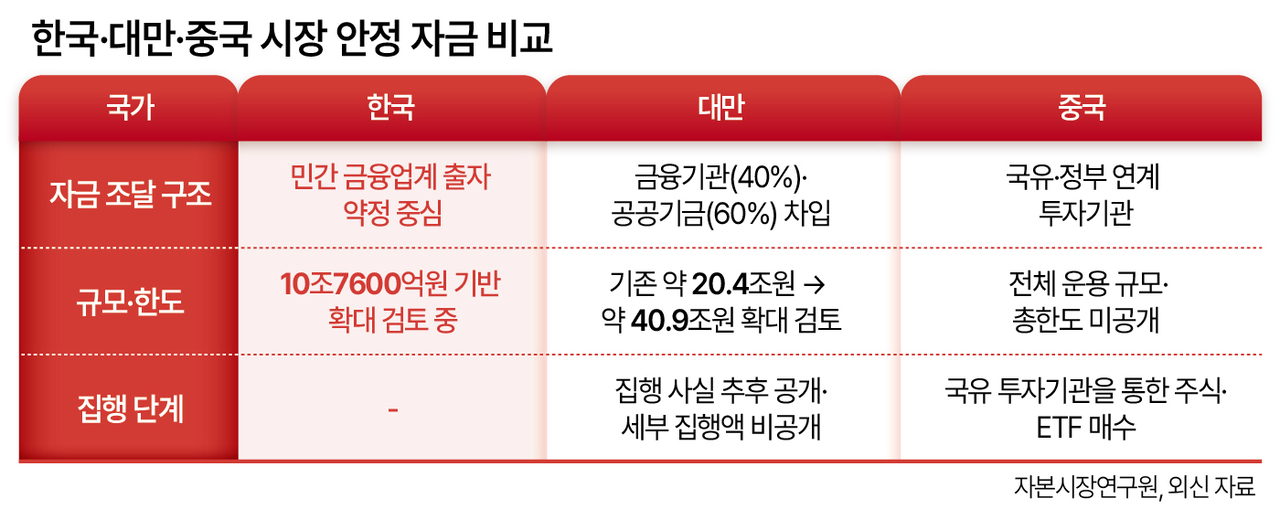
Even as Korea's stabilization fund discussions lag behind those of Taiwan and China, Taiwan announced Tuesday that it is considering raising the National Stabilization Fund's operating limit — from the current 500 billion New Taiwan dollars to 1 trillion New Taiwan dollars, equivalent to about 40 trillion won. With Taiwan's stock market capitalization at roughly 5,800 trillion won ($4.32 trillion), the expanded ceiling would represent about 0.7 percent of the total market. Analysts described the move as a signal of additional resolve — raising the ceiling on deployable funds to demonstrate readiness, separate from how much has actually been spent.
In Korea, strategic ambiguity has been the watchword throughout the stabilization fund discussions, with officials disclosing little beyond the fact that specifics are under review. On Monday, Deputy Prime Minister Lee Hyung-il said the scale "will need to be reviewed as the situation develops" and that the timing of any deployment "will be determined as we assess conditions."
However, expectations that the fund — with its limited resources — can actually arrest a sharp decline and restore investor confidence are not high. The existing capital commitment base being discussed for the fund stands at 10.76 trillion won, which is less than 0.3 percent of the Kospi's total market capitalization and smaller than SK hynix's announced 20 trillion won share buyback plan. It is also roughly comparable to the 10.4 trillion won in net selling by foreign investors during the week of Nov. 2 to Nov. 6.
How to maintain strategic ambiguity while still steadying investor sentiment remains an open question for the fund's future operation. In Taiwan's case, the maximum amount actually deployed across the nine previous activations of the National Stabilization Fund was less than about 5 trillion won — well within the current 20 trillion won limit. Yet authorities chose Tuesday to publicly signal their willingness to raise the ceiling further, independent of actual deployment. Analysts say that by disclosing the scale of available firepower and the capacity for additional action — as Taiwan has done — Korea could convey its commitment to market stability without revealing a specific buying strategy.
Industry observers also stress the importance of maintaining strategic ambiguity in how the fund is run. Lee said that if a pattern emerges — such as repeated buying at a particular index level — market participants will anticipate that threshold and accelerate their selling. "If the share price falls even after the first deployment, calls for additional capital contributions will follow," Lee said. "Concentrating firepower in a short period that exposes remaining resources and response capacity must not be allowed to undermine the effectiveness of follow-up action."
kacew@heraldcorp.com