This year's surplus outlook raised from $450 billion to $500 billion
Next year's growth forecast lifted from 2.9% to 4.1%
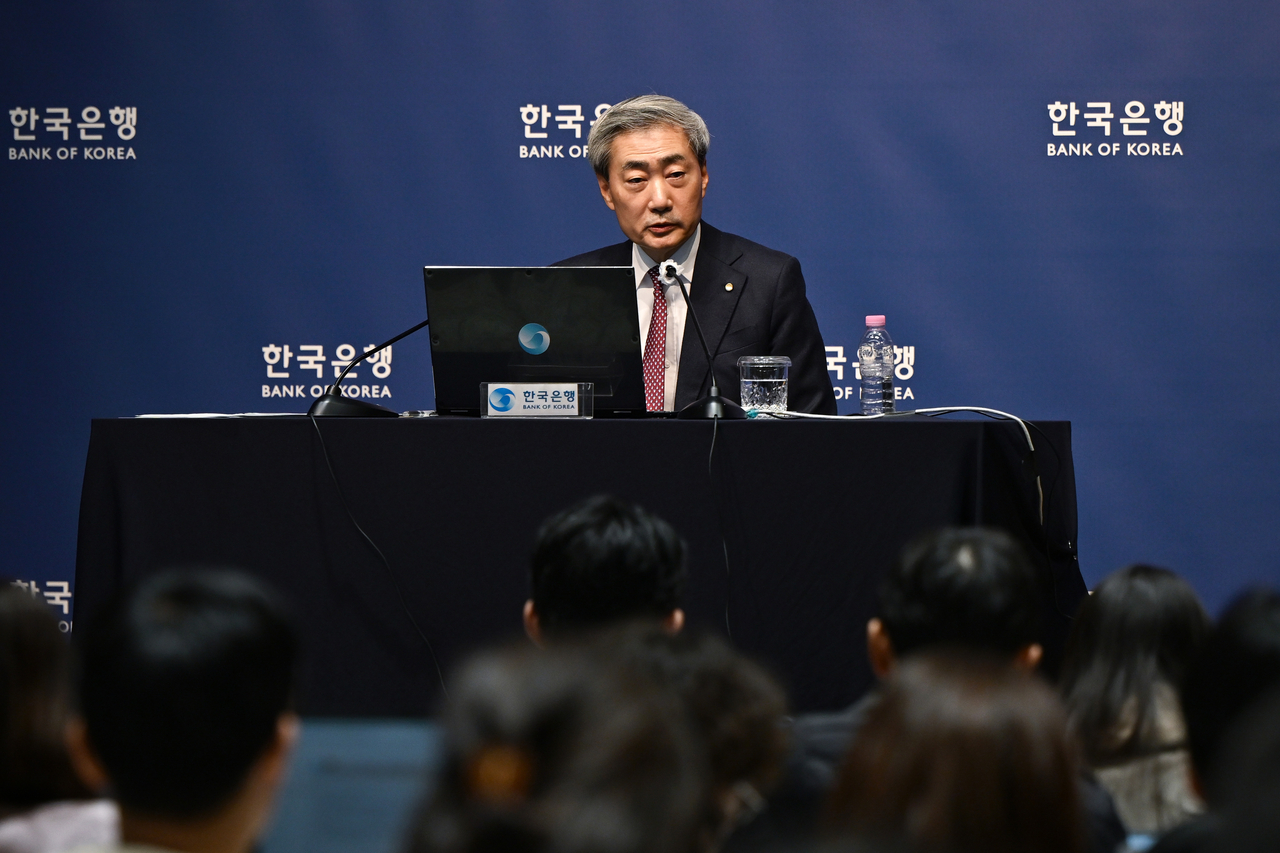
The Bank of Korea projected Thursday that the country's current account surplus will reach $540 billion next year — $40 billion more than this year's forecast of $500 billion. The central bank also said growth would remain in the mid-3 percent range next year even if semiconductor headwinds, including a delay in AI investment, were to materialize all at once.
In its revised economic outlook released Thursday, the BOK raised its growth forecast for next year to 4.1% from 2.9%, a 1.2 percentage point increase. It would mark the first time South Korea has posted growth above 4% since 2021, when the economy expanded 4.7%.
The BOK first set its next-year growth forecast at 1.9% in November last year, then trimmed it to 1.8% in February before raising it to 2.1% in May and 2.9% in August. This week's jump to above 4% represents the largest single upward revision since the central bank began issuing annual growth forecasts in December 2008.
The BOK's research department said exports and investment would continue to grow strongly next year on the back of robust AI investment demand, while private consumption was expected to gradually recover as income conditions improve and fiscal spending expands. "The growth-enhancing effect from the expanding share of the IT sector in the economy will add further momentum, sustaining high annual growth of 4.1%," the department said.
Among the factors driving the upward revision, a semiconductor boom and its broader spillover effects contributed 1.2 percentage points, an expanded budget added 0.05 percentage point, and a delay in the timing of semiconductor tariffs added another 0.05 percentage point. Persistent geopolitical uncertainty weighed on the outlook by 0.1 percentage point.
In a separate report titled "AI-Driven Semiconductor Boom: Distinctive Features and Outlook," BOK research department official Lee Taek-min and colleagues analyzed a downside scenario in which the semiconductor cycle turns on three simultaneous shocks: a delay in AI investment, a deterioration in financial conditions, and an expansion of China's supply of commodity memory chips.
Under that combined shock scenario, memory chip prices would fall 15% below the baseline forecast next year and 51% below it by 2028, the report found. Semiconductor export revenue would decline by $129.4 billion next year and by $307.5 billion by 2028. Even so, the report noted that South Korea's customs-basis exports would exceed $1 trillion next year and remain at around $900 billion in 2028.
When indirect effects through financial markets and economic sentiment are factored in, real GDP growth would fall 0.7 percentage point below the baseline of 4.1% next year and 0.9 percentage point below the 3% baseline in 2028.
In an optimistic scenario — where global AI investment remains stronger than the baseline and domestic chipmakers expand production capacity more quickly — growth could come in 0.5 percentage point above the baseline next year and 0.6 percentage point above it the year after.
The report said AI applications would broaden from agentic AI and on-device AI in the consumer segment to physical AI in the industrial segment. "Memory demand may temporarily slow depending on financial conditions and political factors, but intense competition among AI companies to secure market position and memory supply is likely to continue," it said. The report added that demand for products from Korean companies with lower power consumption could also strengthen.
The BOK's next-year growth forecast is the highest among major domestic and international institutions. The IMF earlier raised its forecast for South Korea's growth next year to 3.3% from 2.8%, while the Korea Development Institute lifted its projection to 3.9% from 2.2% in its second-half 2026 economic outlook.
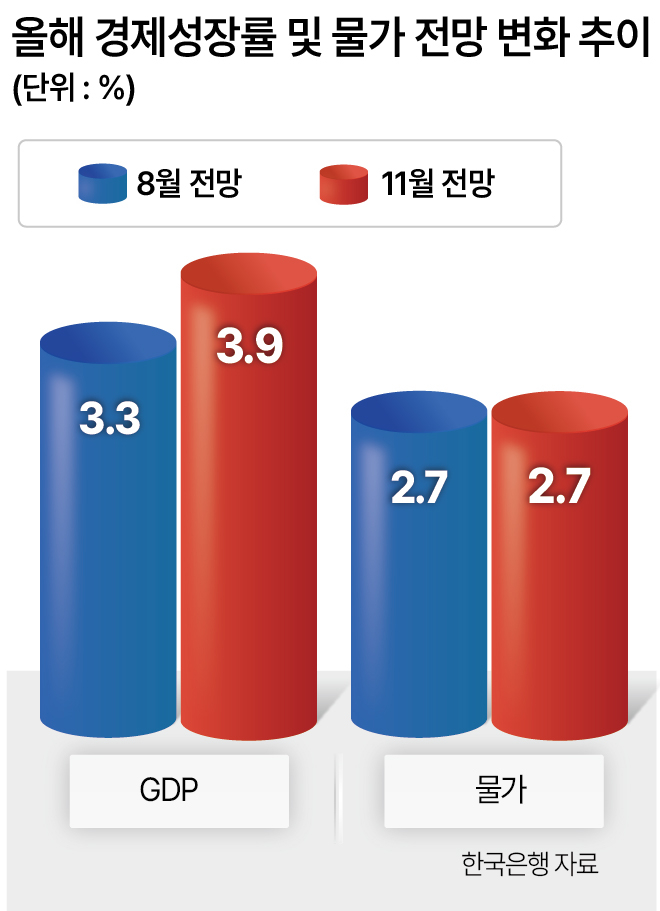
For this year, the BOK raised its real GDP growth forecast to 3.9%, up 0.6 percentage point from its August projection. A renewed rise in Middle East tensions subtracted 0.05 percentage point and a stock market correction weighed by 0.1 percentage point, but a semiconductor boom that far exceeded expectations added 0.75 percentage point.
In the fourth quarter, consumer spending is recovering slowly due to the stock market correction, but IT-led export and investment strength is expected to continue, with quarter-on-quarter growth projected at 1.2%.
The BOK first set its 2026 annual growth forecast at 1.8% in November 2024, then cut it to 1.6% in May last year before raising it consecutively to 1.8% in November last year, 2.0% in February, 2.6% in May and 3.3% in August.
The BOK's current-year forecast of 3.9% is higher than projections from the KDI (3.8%) and the OECD (3.7%), and matches the IMF's forecast of 3.9%. It also exceeds the average forecast of 3.7% from eight major investment banks as of the end of last month.
The BOK projected that growth will slow to 3% in 2028 as the pace of semiconductor export gains gradually moderates.
The BOK also raised its current account surplus forecast for this year to $500 billion from $450 billion. Next year's surplus is projected at $540 billion.
The BOK kept its consumer price inflation forecast for this year unchanged at 2.7%, while raising next year's projection by 0.1 percentage point to 2.4% from 2.3%. The 2028 inflation forecast was set at 2.1%.
"As the pass-through of accumulated cost shocks continues and demand-side pressure gradually builds, consumer prices are expected to rise 2.7% this year and 2.4% next year," the BOK said, adding that next year's inflation would be slightly lower than this year's, partly reflecting oil price movements.
At an afternoon press briefing on the economic outlook Thursday, the BOK said the growth boost from adopting a chain-weighting method for calculating GDP was not a statistical illusion. The chain-weighting method calculates GDP by applying the previous year's nominal share of each industry as a weight to that industry's real growth rate. Under this approach, even if a sector's real growth rate stays the same, its contribution to overall GDP growth rises as its nominal share of the economy expands.
BOK research department director Lee Dong-ryeol said applying fixed past weights would risk underestimating economic growth. Deputy Governor Lee Ji-ho pointed to the early 2000s, when large-scale IT investment and the buildout of high-speed internet infrastructure took place, and said "the growing importance of AI-related industries going forward should be seen as reflected in the numbers."
However, with growth remaining heavily concentrated in semiconductors, the public may still not feel the headline figures in their daily lives. Director Lee said the spillover effects of the semiconductor boom to other industries remain limited for now, meaning the improvement may not yet be felt on the ground. "The ripple effects into private consumption and employment are expected to strengthen from next year," he said.
The BOK also pushed back on concerns that a future semiconductor downturn could cause a sharp drop in overall growth given the sector's expanded share of the economy. Research team head Park Chang-hyeon said a sudden slowdown in semiconductor export growth was unlikely given global demand trends, and that even if the sector's nominal share were to decline, structural demand driven by AI diffusion would keep it at a mid-teens percentage — higher than in the past.
kimstar@heraldcorp.com