
Heads of insurance and medical unions shave heads in protest
Union chief: 'We're not asking for more — just fair pay for the work we do'
Democratic Party's Lee Su-jin, Progressive Party's Jeong Hye-gyeong join rally
Unions prepare to transfer hospital inpatients if demands go unmet
Workers urge revision of this year's fund management plan and budget increase for next year
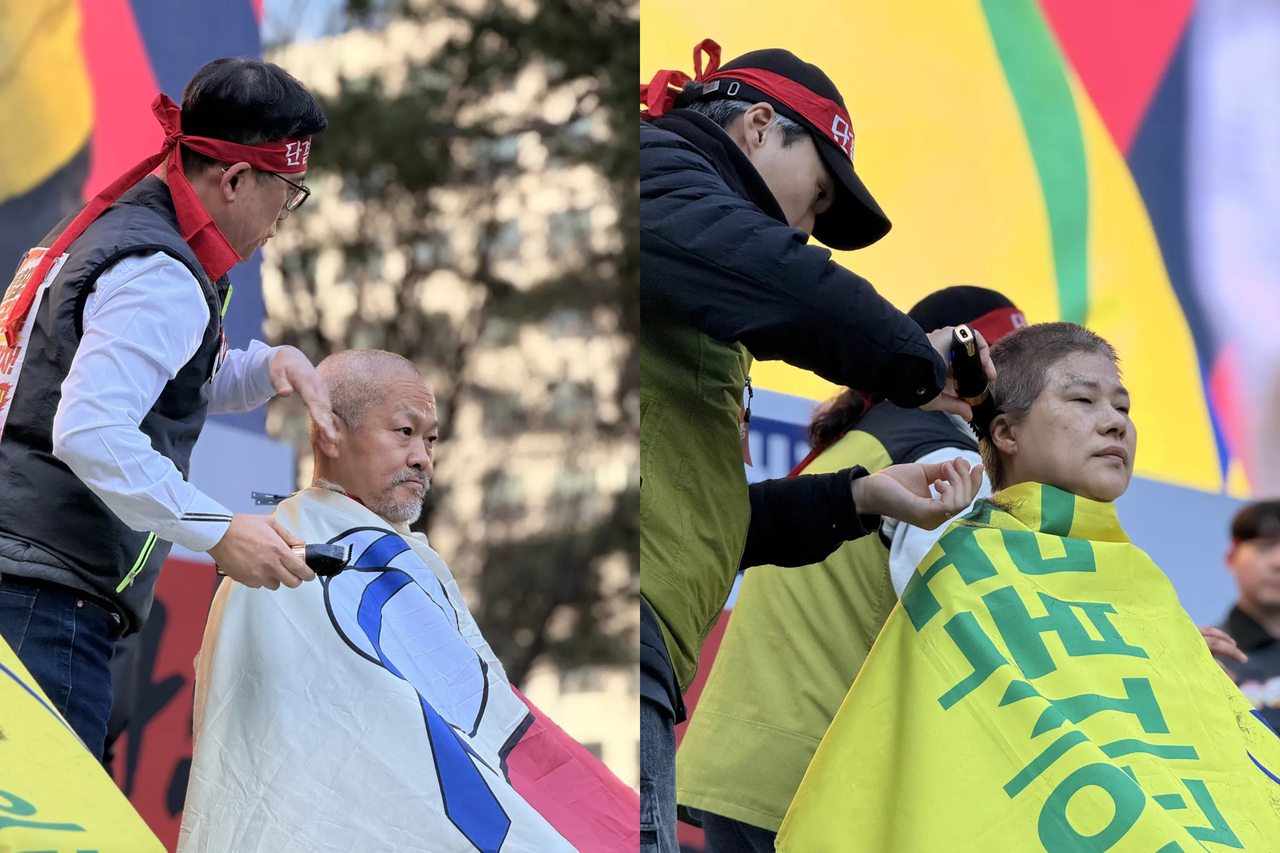
Seven labor unions at the Korea Workers' Compensation and Welfare Service mobilized some 8,000 members nationwide Thursday for a mass rally and formally resolved to launch a general strike.
The chairs of the insurance and medical workers' unions shaved their heads in a joint act of protest, urging the government and National Assembly to revise this year's fund management plan and increase next year's budget. The unions said they would launch a general strike on Dec. 8 if their demands are not met. The medical sector is also preparing to transfer inpatients at industrial accident hospitals to other facilities should a walkout begin.
The unions' joint struggle committee held the "mass rally to resolve a general strike" at 2 p.m. Thursday in front of the National Assembly in Yeouido, Seoul. The turnout marked a sharp escalation from two earlier rallies — held Nov. 12 and Nov. 17 — that drew a combined 5,000 participants. Democratic Party lawmaker Lee Su-jin and Progressive Party lawmaker Jeong Hye-gyeong also attended Thursday's rally in a show of solidarity.
Insurance union Chair Shin Hyeon-u and medical union Chair Kim Yeong-ja shaved their heads together to signal their resolve to carry out a full strike.
"The Korea Workers' Compensation and Welfare Service is the frontline public institution that responds to the risks workers face throughout their lives — industrial accidents, unemployment, wage theft, retirement," Shin said. "We have run for more than 30 years with our eyes fixed solely on the people." Shin added: "We are absolutely not asking for more. We are asking to be fairly compensated for the work we do."
Behind the unions' collective action lies the government's rigid total labor cost management system and a recurring failure to reflect budget needs. When the government approved an increase of 71 positions following a 2008 revision to the Industrial Accident Compensation Insurance Act, the associated personnel costs were never incorporated into the total labor cost calculation — forcing the agency to cover those costs out of its own pocket for the past 18 years. The unions estimate the accumulated burden has reached 98.5 billion won ($73.3 million).
According to the joint struggle committee, the average annual salary of full-time Korea Workers' Compensation and Welfare Service employees — excluding physicians — was 62.69 million won last year, ranking 79th out of 88 public enterprises and quasi-government agencies. That figure trails the National Health Insurance Service at 70.41 million won by 7.72 million won and the National Pension Service at 76.46 million won by 13.77 million won.
Over the past five years, the agency requested a total of 115.5 billion won in budget increases from the government, but only 3.9 billion won was reflected. Poor working conditions have also driven staff attrition: 640 of the 2,367 new employees hired over the past five years — 27 percent — have since left the agency.
The workload is expected to grow further as the agency takes on more national policy tasks. Of the 123 state agenda items under the Lee Jae Myung administration, 24 are directly related to the agency's work. A planned overhaul of the employment insurance contribution system next year — shifting to an income-based model — is projected to increase consultation demand by about 2.18 million cases and expand related workloads by as much as 13.6 times.
Yet of the 37.01 billion won in budget increases the agency requested for next year, only 1.69 billion won — 4.6 percent — was included in the government's budget proposal.
Yun Jeong-hyang, the unions' senior deputy chair, said the government has managed public institutions by a uniform standard since introducing the total labor cost system in 2007, ignoring the distinct nature of each agency's work. "Our struggle is not just for ourselves," Yun said. "It is a struggle to protect the quality of public services and the future of the Korea Workers' Compensation and Welfare Service."
Some progress has been made during the National Assembly's budget review. At a meeting of the National Assembly's Budget and Accounts Special Committee on Nov. 10, Employment and Labor Minister Kim Young-hoon said extraordinary measures were needed to address the agency's compensation issues. On Nov. 17, the unions' budget increase request was reflected in a subcommittee review of the Climate, Energy, Environment and Labor Committee's budget, and the full committee passed the increase on Nov. 19.
The increase must still clear the budget special committee and a full Assembly vote before it can take effect. The government has also yet to revise this year's fund management plan to secure 16.12 billion won in personnel costs that remain unfunded.
At Thursday's rally, Democratic Party lawmaker Lee Su-jin said the Korea Workers' Compensation and Welfare Service handles the heaviest workload of any public agency, yet its workers are treated far too poorly. "The struggle of the union members is just and right," Lee said. Progressive Party lawmaker Jeong Hye-gyeong said she understands the difficulties of the workers as a fellow laborer. "As a member of the climate, energy and labor committee, I will work to improve conditions at the Korea Workers' Compensation and Welfare Service," Jeong said.
The joint struggle committee had originally planned to launch a general strike Thursday but pushed the date back to Dec. 8 out of concern for the safety and continuity of care for inpatients at industrial accident hospitals. A simultaneous walkout by both the insurance and medical sectors could significantly disrupt not only employment and industrial accident insurance services but also the treatment and rehabilitation of injured workers.
Having secured a 94.93 percent approval rate in a strike authorization vote held Oct. 27 to 28, the joint struggle committee reaffirmed Thursday that it will proceed with a general strike if its demands are not met. The medical sector plans to prepare for the safe transfer of inpatients, taking into account patient protection requirements and essential service obligations.
"There is still time to prevent the social disruption a general strike would cause," the joint struggle committee said, urging the government and National Assembly to stop ignoring urgent calls from workers on the ground and make a responsible decision by revising the fund management plan and reflecting the demands in the 2027 budget.
fact0514@heraldcorp.com





