- 28-km fiber-optic cable turned into 7,000 seismic monitoring points
- Even small quakes rupture in two stages, offering new clues to earthquake mechanics

South Korean researchers have succeeded in capturing the rupture process of a small earthquake — one that lasts just 0.1 seconds — with millisecond precision, using telecommunications fiber-optic cables buried underground. The achievement turns existing communications infrastructure into thousands of virtual seismometers, opening new possibilities for understanding how earthquakes occur and reducing the damage they cause.
The Ministry of Science and ICT announced Friday that the feat was accomplished by a research team led by Kim Young-hee, a professor in the Department of Earth and Environmental Sciences at Seoul National University.
Earthquakes occur when rock suddenly slips along an underground fault. Where the rupture begins, how far it spreads and where it stops are key factors that determine the magnitude of a quake.
However, small earthquakes of around magnitude 2 are over in roughly 0.1 seconds. Their seismic waves are so faint that conventional seismometers have struggled to capture the fault-breaking process in precise detail.
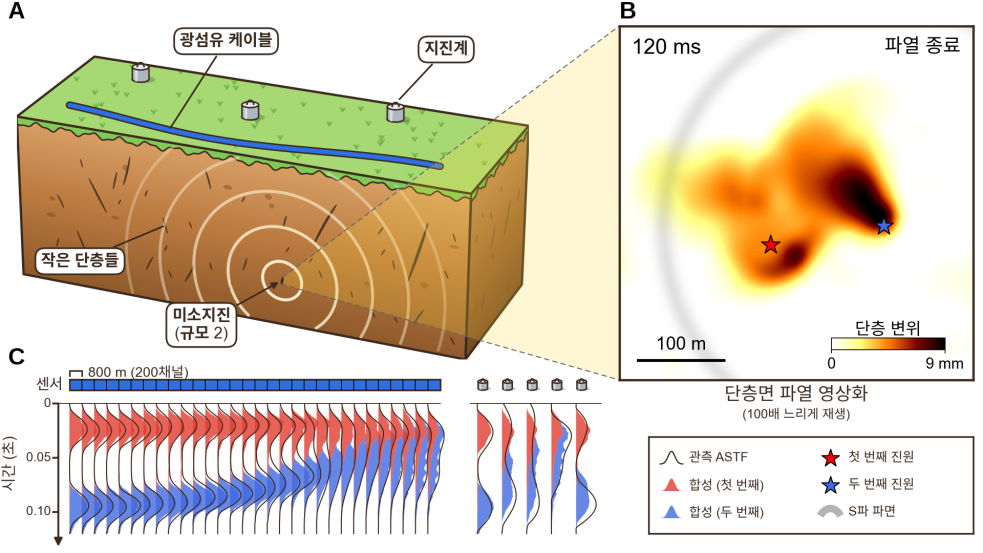
To overcome this limitation, the research team used a 28-kilometer telecommunications fiber-optic cable buried in the Brawley Seismic Zone in Southern California.
The key technology is distributed acoustic sensing, or DAS. It works by firing a laser through the fiber-optic cable and analyzing changes in the returning light to detect minute vibrations in the ground.
The team measured seismic waves at roughly 7,000 points spaced about 4 meters apart along the cable, effectively turning a single communications cable into an ultra-dense seismic monitoring network with more than 7,000 observation points.
Using this setup, the researchers reconstructed the rupture process of a magnitude-2 earthquake that struck in May 2021, down to the millisecond.
The analysis revealed that the quake did not propagate uniformly from a single point, as had been assumed. Instead, ruptures occurred in two adjacent fault segments with a time lag between them. About 0.042 seconds after the first rupture began, a second rupture broke out in a neighboring segment. Notably, the moment the seismic waves from the first rupture reached the second rupture site corresponded almost exactly to when the new rupture began, leading the team to conclude that the first rupture most likely triggered the second.
The research team expects the findings to provide important clues for understanding the conditions that determine how large an earthquake can grow.
Particularly notable is the potential to build dense seismic monitoring networks by repurposing already-installed telecommunications fiber-optic cables, without deploying large numbers of dedicated seismometers.
If applied to South Korea's domestic communications networks in the future, the technology could supplement existing seismic monitoring infrastructure and enable more precise surveillance of microearthquakes near major cities and key fault lines.
However, the research did not develop a technology for predicting earthquakes before they occur. Its significance lies in strengthening the scientific foundation for long-term seismic risk assessment by precisely analyzing the physical processes behind earthquake generation.
"Even in a common magnitude-2 earthquake, there was a complex process hidden inside — rupture stopping and starting again," Kim said. "Telecommunications fiber-optic cables can serve as a new window for looking into how faults work, even through small earthquakes." Kim added that the research could be expanded to systematically compare how rupture patterns differ by region.
The findings were published Friday in the journal Science.
nbgkoo@heraldcorp.com