Network slicing technology verified in live operating environment
5G SA commercialization set for this year, with expansion to industrial robots planned
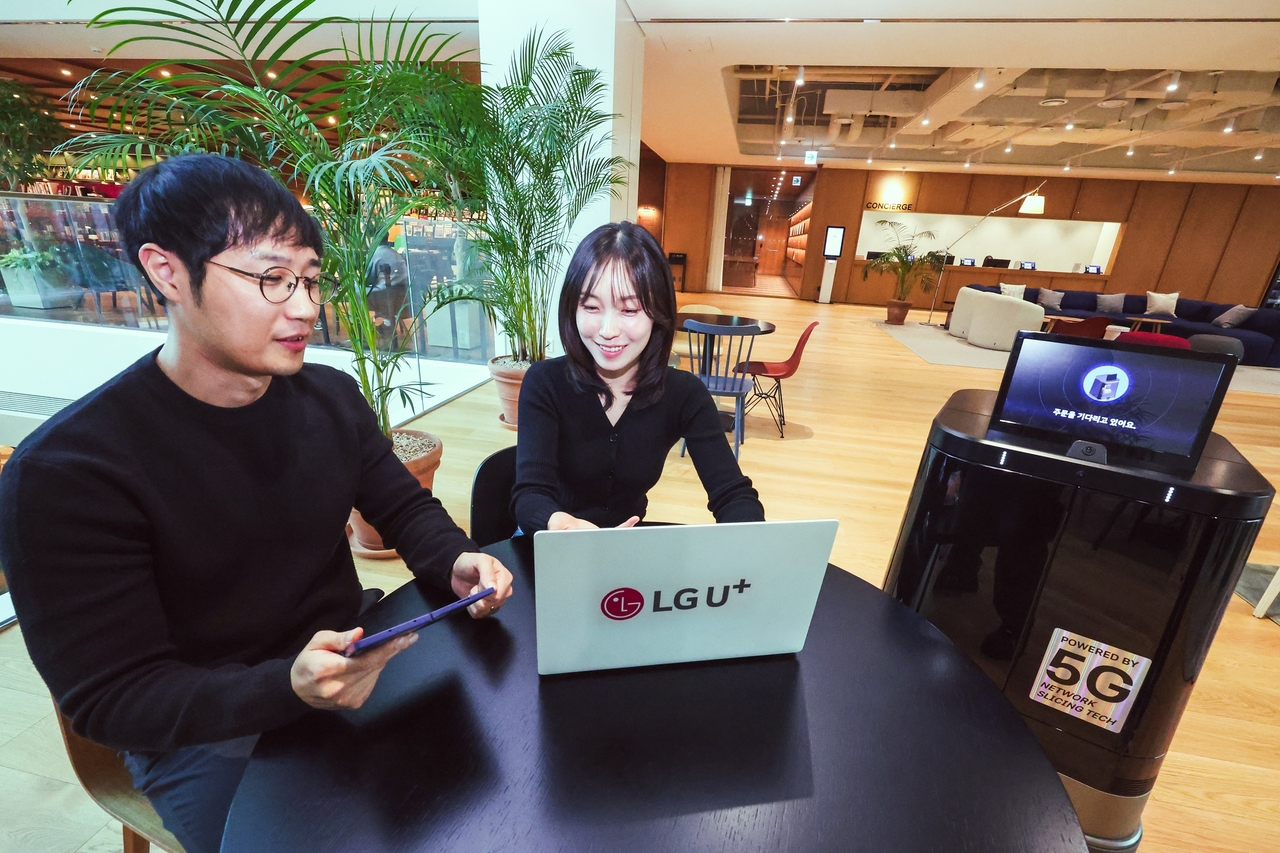
LG Uplus said Friday it has completed a verification test of 5G standalone communications technology on delivery robots operated jointly with Hyundai Motor and Kia's Robotics Lab.
The test was conducted Nov. 19 at Hyundai Motor and Kia's Yangjae-dong headquarters, using the companies' DAL-e Delivery robot. The two companies set up a 5G SA communications environment on the robot and verified network quality during actual operation.
Unlike conventional 5G non-standalone mode, which relies on LTE infrastructure, 5G SA communicates solely through 5G base stations and a 5G core network. This enables the use of network slicing, a technology that divides a single physical network into multiple virtual networks tailored to specific service requirements.
The key challenge is maintaining stable communications for robot operation. Robots must continuously exchange data to control core functions such as movement and stopping, and any delay or interruption in connectivity can affect normal operation.
During the test, the two companies allocated dedicated network resources to data controlling the robot's movement and stopping, while camera footage and sensor data were handled on a separate network slice.
The companies confirmed that the setup maintained the communications quality needed for robot operation even when network traffic was congested or the environment became unstable during movement.
LG Uplus plans to commercialize 5G SA by the end of this year based on the test results. The company also intends to expand the technology beyond robots to industrial settings where reliable connectivity is critical, including smart factories and mobility applications.
Hyundai Motor and Kia's Robotics Lab is also reviewing whether the 5G communications module applied to the delivery robot can be used in other types of robots. The two companies plan to strengthen security technology against external threats such as distributed denial-of-service attacks as robots become permanently connected to communications networks.
"Through this verification, we confirmed the potential of 5G SA and network slicing in a real robot operating environment," said Kim Sung-won, head of wireless business at LG Uplus. "We will expand cooperation with Hyundai Motor and Kia's Robotics Lab to advance the communications technology needed for various physical AI applications and introduce communications and security services tailored to the characteristics of robots."
LG Uplus is set to launch nationwide 5G SA commercial service on Monday. According to a plan announced Thursday by South Korea's Ministry of Science and ICT and the three mobile carriers, LG Uplus will also apply 5G SA technology to a baseball game at Seoul's Gocheok Sky Dome on Dec. 5.
woo@heraldcorp.com