Tenants pushed out by rising prices, tighter lending
Owner-occupancy policies deepen rental market imbalance
Gyeonggi-to-Seoul migration hits year low in October
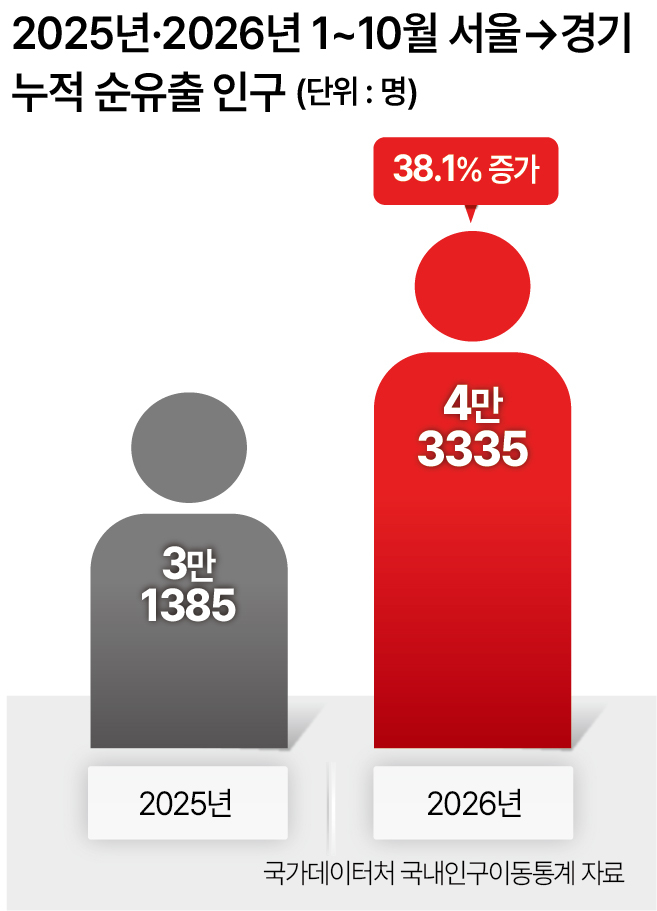
The net population outflow from Seoul to Gyeonggi Province has surged nearly 40 percent compared with last year, surpassing the full-year 2025 total in just 10 months. Rising home prices and successive lending restrictions have made homeownership in Seoul increasingly out of reach, while government policies favoring owner-occupancy have disrupted the rental market and pushed residents beyond the city limits.
According to domestic migration statistics from the Ministry of Statistics, the net outflow from Seoul to Gyeonggi Province in the first 10 months of this year stood at 43,335 — up 38.1 percent from 31,385 during the same period last year. The figure already exceeds last year's full-year net outflow of 41,199.
A total of 245,678 people relocated from Seoul to Gyeonggi Province during the period, an increase of 13,026, or 5.6 percent, from a year earlier. By contrast, 202,343 people moved in the opposite direction — from Gyeonggi Province to Seoul — a rise of just 1,076, or 0.5 percent, over the same period.
Experts point to owner-occupancy-centered policies as one of the key drivers of the accelerating exodus from Seoul. The government's June 27 measures last year imposed a requirement to move in within six months on mortgage loans for home purchases in the greater Seoul area, and the Oct. 15 measures placed all of Seoul under land transaction permit zones.
This year, the owner-occupancy policy stance has extended across financial and tax measures. In August, the government announced a tax reform package that shifted the long-term holding special deduction to a residency-based calculation. Starting next year, jeonse loans will in principle be restricted for non-resident single homeowners who have made gap investments.
The growing number of homeowners choosing to move into their own properties under government pressure is deepening supply-demand imbalances in the rental market. "Homeowners in Seoul who had been living elsewhere are now moving into their properties in line with government policy," said Seo Gwang-chae, a real estate professor at Hanyang Cyber University. "As a result, existing tenants appear to be getting pushed to the outskirts."
Rising Seoul apartment prices are also cited as a factor driving residents out of the city. According to KB Real Estate, the average sale price of a Seoul apartment last month was 1.64 billion won ($1.22 million), up 174.14 million won from the same month last year, when it stood at 1.46 billion won. Analysts say the affordability gap is redirecting residential demand toward areas where prices are comparatively lower.
"Seoul home prices have shot up sharply, and there are no jeonse units left — tenants simply cannot hold on any longer," said Choi Won-cheol, a lead professor in the advanced real estate development program at Yonsei University. "People are turning to nearby areas like Gwangmyeong and Hanam, which are relatively affordable and well connected by transit."
The trend has recently sharpened: departures from Seoul are accelerating while arrivals are declining. In October, 22,262 people moved from Seoul to Gyeonggi Province, up 779, or 3.6 percent, from the previous month. Meanwhile, 17,321 people moved from Gyeonggi Province to Seoul — a drop of 1,451, or 7.7 percent. The October figure for Gyeonggi-to-Seoul migration was the lowest recorded this year.
Gyeonggi Province residents' appetite for buying Seoul properties is also cooling. According to the Supreme Court's registry information portal, the number of Gyeonggi Province residents who purchased collective buildings in Seoul fell 23.0 percent, from 2,823 in August to 2,175 in October.
The Oct. 15 measures last year tightened lending limits — capping loans at 400 million won for homes priced between 1.5 billion won and 2.5 billion won, and at 200 million won for homes above 2.5 billion won — raising the bar for those looking to trade up to a Seoul property. Analysts say demand to enter Seoul is now concentrating in parts of Gyeonggi Province where home prices have risen the most.
"Apartment prices rose very steeply this year, particularly in semiconductor belt areas such as Bundang and Dongtan," Choi said. "It appears that trade-up demand has flowed into areas where prices have climbed to levels that overlap with higher-tier Seoul neighborhoods."
shy@heraldcorp.com