Samsung, SK, Hyundai Motor and LG retain key executives
Global management risks drive decision to preserve existing leadership
Strong business results this year reinforce confidence in incumbents
New talent tapped selectively to sharpen core competitiveness
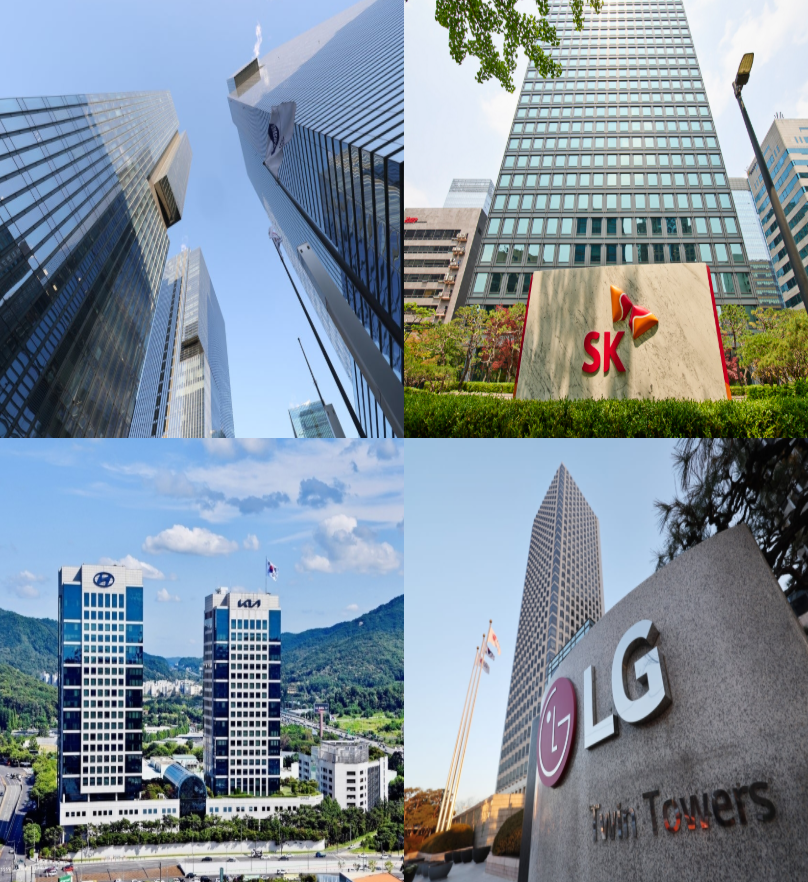
Korea's four largest conglomerates — Samsung Electronics, SK Group, Hyundai Motor and LG Group — have each chosen "stability with renewal" as the guiding theme of their year-end executive reshuffles. The approach is widely seen as a strategy to shore up fundamentals and preserve competitive strength amid a punishing global business environment shaped by US tariffs and an intensifying challenge from Chinese rivals.
Industry sources said Friday that the four groups retained the chief executives of their major affiliates in personnel decisions for 2027. Samsung Electronics kept its dual-leadership structure intact, with Jeon Young-hyun, vice chairman and head of the Device Solutions (DS) division, and Roh Tae-moon, president and head of the Device Experience (DX) division, both staying on. SK Group reaffirmed its confidence in Chey Chang-won — vice chairman of the Supex Council and a cousin of SK Group Chairman Chey Tae-won — as well as SK hynix President Kwak Noh-jung.
At Hyundai Motor Group, Vice Chairman Jang Jae-hoon was retained, and the group preserved its leadership lineup of Jose Munoz as president and CEO of Hyundai Motor and Song Ho-sung as president and CEO of Kia. LG Group likewise kept all of its major affiliate chiefs in place, including the heads of LG Electronics, LG Display, LG Innotek, LG Chem and LG Energy Solution.
The four groups' preference for stability reflects a global risk environment that has rarely been more daunting. Conflicts in the Middle East continue to flare, and deepening US-China tensions are complicating the structure of the global economy. Chinese manufacturers are also pressing harder on price competitiveness across major industries, including finished vehicles. Against that backdrop, the groups appear to have concluded that sustaining business continuity and innovation through proven leadership — rather than attempting sweeping change — is the more prudent course.
The scale of personnel moves over the past two years also appears to have tempered this year's reshuffle. Samsung Electronics elevated Jeon Young-hyun to head of the DS division in 2024. SK Group last year promoted Lee Hyung-hee, chair of the Supex Council's communications committee, to vice chairman while simultaneously naming Jeong Jae-heon president and CEO of SK Telecom.
Hyundai Motor Group produced five new presidential promotions last year, and in 2024 it named Jose Munoz as the group's first foreign CEO while elevating Jang Jae-hoon from president to vice chairman. LG appointed Ryu Jae-cheol as president of LG Electronics and Kim Dong-chun as president of LG Chem.
Strong business results from flagship operations this year provided further justification for the stability-first approach. Samsung Electronics' DS division posted a record quarterly operating profit of 106.5 trillion won ($79.2 billion) in the third quarter, riding a surge in memory chip demand driven by the expansion of AI infrastructure. SK hynix, which leads the global HBM market, also set a quarterly operating profit record in the third quarter at 83.33 trillion won.
Hyundai Motor has faced headwinds from the rise of Chinese automakers and sluggish domestic sales, but it has held its ground in its core North American market. Hyundai Motor and Kia together captured a record US market share of 12.9 percent in August. Their combined US sales in October reached 153,460 units, up 10.3 percent from 139,120 units in the same month a year earlier — with Hyundai Motor selling 73,452 units and Kia selling 80,008, both setting all-time October sales records.
LG Electronics surpassed 70 trillion won in cumulative sales and 4 trillion won in cumulative operating profit through the first three quarters of this year, both for the first time in the company's history. Growth in the Global South and strong performance in its business-to-business operations drove the results, even as its core businesses maintained firm market positions.
Even within the conservative overall tone, all four groups moved decisively to bring in talent capable of sharpening their most critical businesses. Samsung Electronics named Hwang Sang-jun, who led memory development across the DS division, as president and head of the memory business unit — the division behind the company's record earnings. Cho Sang-yeon, appointed president and head of the System LSI division, previously led Samsung Electronics' semiconductor operations in the United States. Choi Won-jun, the new head of the Mobile Experience (MX) division, has a track record of back-to-back successes with the Galaxy S26 and Z Fold 8.
SK Group named Jeong Seung-il as the new CEO of SK Innovation. Jeong previously served as vice minister of the Ministry of Trade, Industry and Energy, president of Korea Electric Power Corporation and president of Korea Gas Corporation, making him a seasoned energy-sector veteran. His broad experience across the energy industry is seen as well-suited to leading SK Innovation's transformation into a comprehensive energy solutions company.
Hyundai Motor Group appointed domain specialists to lead its parts and construction affiliates, including Hyundai Mobis, Hyundai Transys, Hyundai Engineering and Hyundai Kefico. LG Group brought in a wave of talent to accelerate execution in AI, its most critical competitive battleground. A notable example is the promotion of Song Si-yong, born in 1979 and head of LG Electronics' robotics business center, to executive vice president.
"Uncertainty is one of the things companies fear most," a business community official said. "It appears that major companies, facing heightened uncertainty, have focused their personnel decisions on pursuing sustainable innovation grounded in existing leadership, rather than opting for sweeping personnel overhauls."

yeongdai@heraldcorp.com
joze@heraldcorp.com
eyre@heraldcorp.com