
About 500 local government officials and experts from South Korea, China and Japan gather to chart shared prosperity around the Yellow Sea
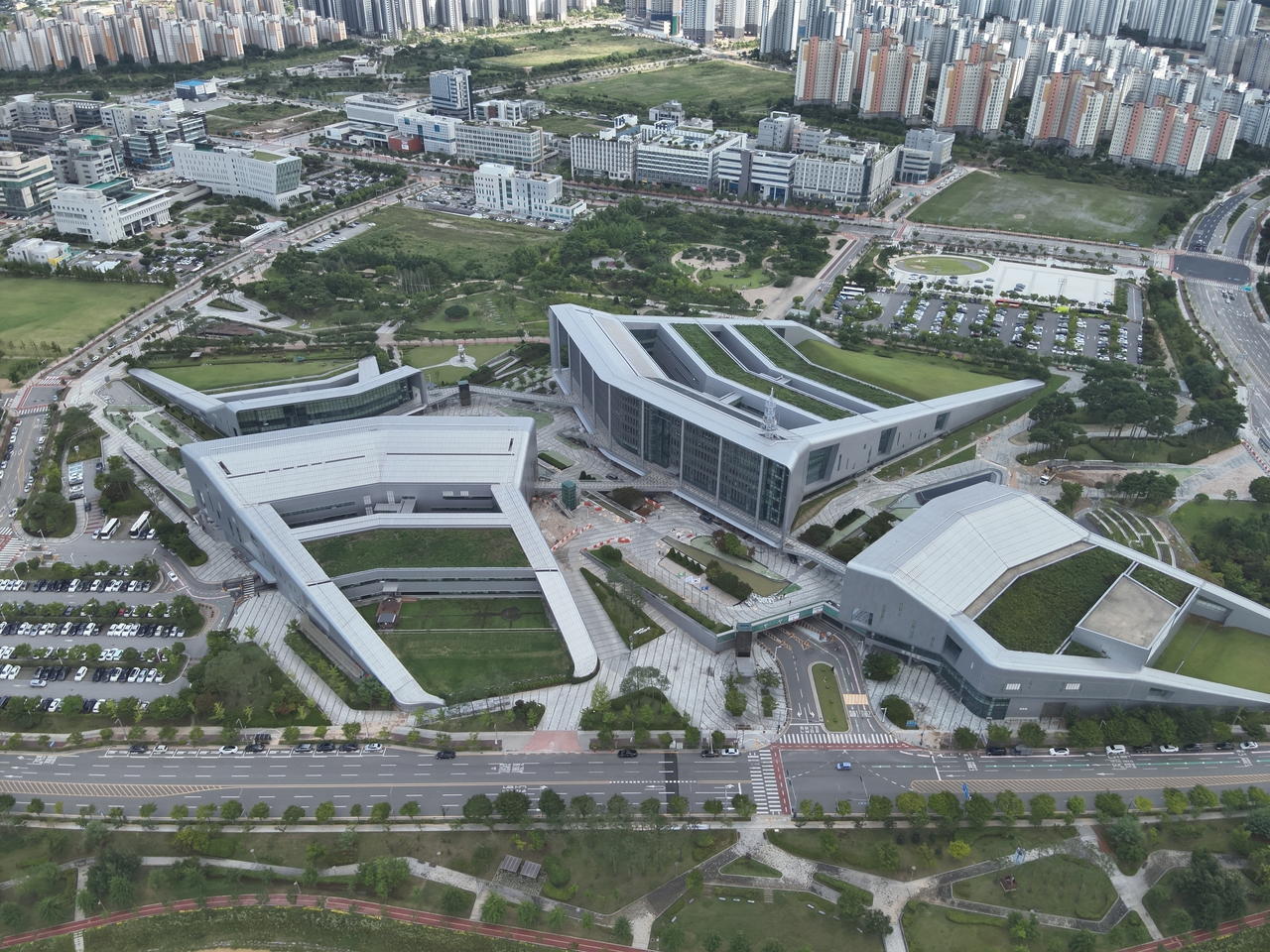
Local government officials and experts from South Korea, China and Japan gathered in South Chungcheong Province to discuss shared prosperity around the Yellow Sea.
South Chungcheong Province hosted the 11th Yellow Sea Rim Forum on Friday at Splash Risom in Yesan-gun, under the theme "A Connected Yellow Sea, Together Opening an Era of Great Transformation."
The annual forum brings together local governments and experts from the three countries to discuss issues including peace, the economy, marine affairs and population. This year's event was sponsored by the National AI Strategy Committee, the Office for Government Policy Coordination, the Ministry of Science and ICT, the Ministry of Foreign Affairs, the Ministry of Interior and Safety and the Ministry of Oceans and Fisheries.
About 500 people attended, including South Chungcheong Governor Park Soo-hyun, provincial assembly Speaker Jo Cheol-gi, Seosan Mayor Lee Wan-seop — who chairs the South Chungcheong Yellow Sea Rim Administrative Council — Yesan-gun County Chief Choi Jae-gu, National AI Strategy Committee Vice Chairman Ha Jung-woo, delegations from Japan's Nara and Shizuoka prefectures, and experts from China and Japan.
The program opened with Governor Park's welcoming remarks, followed by a keynote address by Joo Young-seop, a special professor at Seoul National University's Graduate School of Engineering Practice and a former head of the Small and Medium Business Administration, and three sessions on prosperity, coexistence and peace.
In his opening remarks, Park introduced a jacket bearing the Korean character for "connection" on each sleeve, describing it as "South Chungcheong's resolve to connect with its residents, connect with the nation, and connect across generations, classes, ideologies and religions."
Park then said the province was extending that spirit to its neighbors in China and Japan, adding that the forum's theme was chosen to reflect that vision.
Park also cited a passage from the I Ching, a classic shared across East Asia: "Change opens the way; connection makes it last." He said the forum would use three topics — AI, spotted seals and sustainable development — to chart a Yellow Sea region that changes, connects and prospers together.
"The Yellow Sea is not a sea that divides us but one that connects us," Park said. "The concerns of neighbors across the water touch our own, and the solutions one region finds can become another region's hope. That is why we talk and learn from each other."
Park added that he hoped the wisdom shared at the forum would grow into joint research and concrete policies and projects in each region, pledging that South Chungcheong would work to bind South Korea, China and Japan together through "a thread of coexistence, prosperity and peace."
Joo's keynote was titled "Region-Led Global Cooperation in an Era of Great Transformation: From the Yellow Sea to the World."
Session 1, on "Prosperity," focused on "The AI Transformation and a Basic Society." Moon Myung-jae of Yonsei University chaired the session, and Kim Yun-young of Jeonbuk National University presented the main paper.
The discussion panel included Governor Park, Vice Chairman Ha, Lee Song-taek, chief representative of the Zhongguancun Enterprise Korea Service Office, and Hishida Matsuhiro, a standing director of Japan's National Institute of Information and Communications Technology.
Park outlined his "AI Capital of South Korea, South Chungcheong" initiative and the province's "AI Basic Society" policy direction, stressing that "people are at the center of South Chungcheong's AI transformation." He said the province would build an AI-based society in which industry and people, advanced and traditional industries, and large companies and small and medium-sized enterprises are kept in balance.
Ha discussed the role of regions in the national AI strategy and avenues for central-local cooperation, while Lee and Hishida introduced their respective countries' AI policies — China's "AI Plus" initiative and Japan's "trustworthy AI" framework — along with examples of international cooperation.
Session 2, on "Coexistence," took up the theme of protecting marine life in the Yellow Sea. Ahn Yong-rak, head of the marine biotech industrialization division at the National Marine Biodiversity Institute of Korea, chaired the session, and Park Gyeom-jun, a researcher at the Cetacean Research Institute of the National Institute of Fisheries Science, delivered the main presentation.
The panel — featuring Lee Sang-heon of Pusan National University, Park Jeong-un of the Incheon Green Coalition's Yellow Sea Seal Citizens Project, Li Xuejie, deputy director of the Spotted Seal Research Institute at China's Dalian Ocean University, and Mari Kobayashi, a professor at Tokyo University of Agriculture — discussed ways to jointly protect spotted seals that breed in China's Liaodong Bay and inhabit South Korea's Garorim Bay in Seosan and Baengnyeongdo island.
In his earlier opening remarks, Park had said "the spotted seal holds citizenship in all three countries" and pledged to build a shared Yellow Sea marine life protection network by exchanging research experience among the three nations.
Session 3, on "Peace," addressed international cooperation for sustainable development. Oh Su-gil, a professor at Korea Cyber University and president of the Korean Society for Sustainable Development, chaired the session, and Park Yeon-hee, head of the ICLEI Korea office, gave the main presentation. Panelists — Gu Gyeong-wan, chair of the South Chungcheong Sustainable Development Council, Nakagawa Toshio, head of the environment and forestry division of Japan's Nara Prefecture, and Agata Takahiro, planning chief of Shizuoka Prefecture's environmental policy division — shared the policy progress and strategies of their respective local governments on sustainable development.
kwonhl@heraldcorp.com





