Korea Institute for Industrial Economics and Trade analyzes 2,144 involuntary job separations
Workers with 10-plus years at one employer see wage cuts four times larger than shorter-tenured peers
Manufacturing workers face wage losses 2.4 times the overall estimate

Workers who lose their jobs through business closures or forced resignations face steeper wage cuts upon reemployment the more their new duties differ from their old ones, a new study shows. Workers with 10 or more years at a single employer suffer wage losses roughly four times larger than those with shorter tenures when they make the same degree of occupational shift — a finding that researchers say points to the need to focus reemployment support not just on landing a job, but on putting accumulated experience to use.
The findings come from a report released Friday by the Korea Institute for Industrial Economics and Trade titled "Occupational Change in Reemployment Jobs and Wages of Experienced Workers." Researchers analyzed 2,144 cases in which workers who left jobs involuntarily were reemployed as wage earners within 36 months, drawing on Korea Labor Panel data from 2009 to 2023. The study compared the final hourly real wage at the previous job with the starting hourly real wage at the new one.
The analysis used a measure called "occupational distance" to capture differences in the cognitive, interpersonal and physical demands of a job. A move from general management to accounting registers as a short distance, while a shift to driving or construction labor registers as a long one.
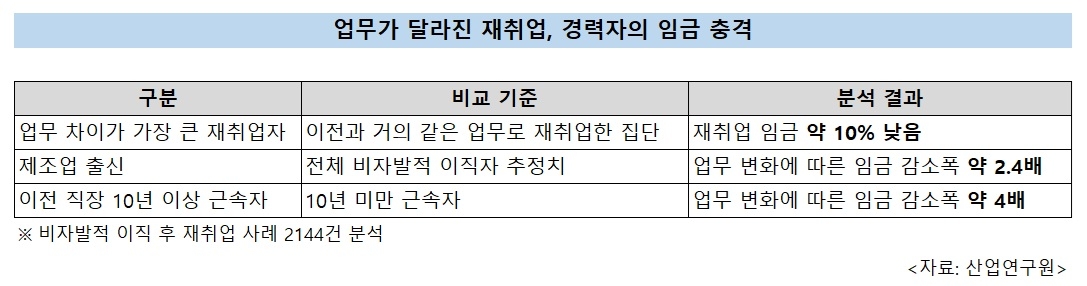
Even after controlling for industry, employment type and the length of unemployment, workers in the group with the greatest occupational distance earned about 10 percent less than those whose duties barely changed. The researchers note this is not a statement about average wage cuts relative to previous pay, but a comparison between two groups with different degrees of occupational change. Among workers who left jobs voluntarily, no clear relationship emerged between occupational distance and wage loss.
The impact was sharper for workers from manufacturing and for long-tenured employees. The wage loss tied to occupational change among manufacturing workers was about 2.4 times the estimate for all involuntary job leavers — a pattern that held even when those workers found new jobs in manufacturing. The researchers say this likely reflects how hard it is to transfer skills built around specific equipment or production processes to a new role.
The larger wage losses among workers with 10 or more years of tenure point to a similar dynamic: job- and organization-specific skills built over time, along with seniority-based pay, are not readily recognized at a new employer. Even when workers moved to occupations with higher average wages, those from manufacturing or with long tenures saw smaller wage gains — or larger losses — compared with other groups as occupational distance increased.
Job security also deteriorated. Among involuntary job leavers who had held permanent positions, about 25 percent ended up in non-permanent roles when their new duties were similar to their old ones. That share rose to roughly 40 to 44 percent when the duties changed significantly.
The report calls for policy adjustments, noting that labor shortages and reemployment difficulties exist side by side. The unfilled vacancy rate for experienced workers in industrial technology stood at 10.8 percent, above the 8.4 percent rate for entry-level positions. The report recommends identifying and matching workers with jobs where their experience can be applied, and strengthening training and on-site support for those making large occupational shifts. It also flags temporary income supplements as a potential measure if wage losses persist.
"Even when workers find reemployment in fields that need labor, a large change in duties can bring a wage cut," said Lee Ju-hyun, an associate research fellow at the institute. "There is a need to combine efforts to find and match jobs where workers can use their experience with support for acquiring and adapting to new skills."
fact0514@heraldcorp.com