
Chinese ethylene imports jump 78-fold in two years
Coal-based Chinese output fills gap left by NCC shutdowns amid Middle East war
Regional financial sector urges shift away from short-term capacity cuts
Chinese ethylene imports into South Korea have surged to a record high this year, driven in part by the fallout from the Middle East war. With the domestic petrochemical industry losing ground to China in global markets for the first time in history — and now ceding the home market as well — industry voices are calling for a shift away from a restructuring strategy centered on cutting naphtha cracking center (NCC) capacity, urging a broader search for solutions.
Chinese ethylene imports hit record $200m this year
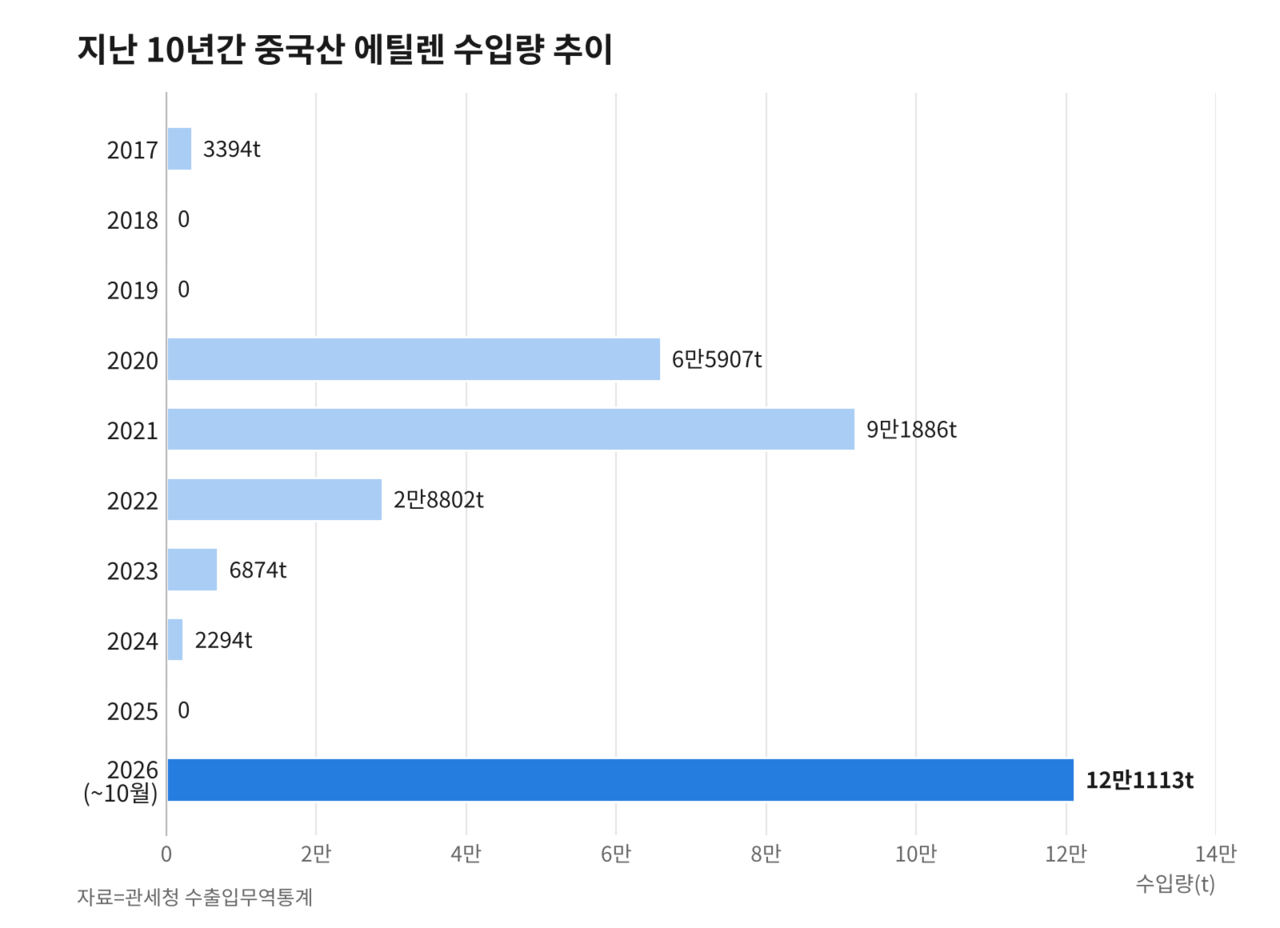
South Korea imported $170 million worth of ethylene from China in the January–October period this year, according to Korea Customs Service trade statistics released Friday. Excluding 2025, when Chinese imports were in effect nonexistent, the figure represents a roughly 78-fold surge compared with 2024, when imports stood at $2.18 million.
South Korea holds roughly the world's fourth-largest ethylene production capacity, a position that had made imports largely unnecessary. Chinese ethylene imports were indeed extremely rare over the past decade — standing at $2.54 million in 2016, $3.8 million in 2017, and zero in both 2018 and 2019.
The shift began in the 2020s, when China built out petrochemical complexes on a massive scale and began flooding the market with low-cost supply. Chinese ethylene imports surged sharply over two years, reaching $56.19 million in 2020 and $93.85 million in 2021. They then pulled back, settling at $35.89 million in 2022, $6.47 million in 2023, $2.18 million in 2024 and $50,000 in 2025.
Middle East war compounds domestic industry restructuring
The more pressing concern is that this year the domestic petrochemical industry has lost ground to China not only in global markets but at home as well. Industry officials attribute the shift to a combination of factors: China's longstanding low-price offensive, the ripple effects of the Middle East war, and ongoing domestic restructuring.
The Middle East conflict prompted South Korean producers to cut ethylene output all at once, while China continued to pour supply into the market. Ethylene is produced from two main feedstocks — naphtha and coal. South Korean facilities rely primarily on NCCs, which crack naphtha to produce ethylene, whereas Chinese producers also use coal-based processes.
"Even as domestic producers have cut NCC operating rates to around 50 percent, China has maintained rates of about 80 percent, leaving it with a de facto ethylene surplus," a petrochemical industry official said.
The restructuring that accelerated in earnest this year has further hastened NCC shutdowns. Yeochun NCC halted its No. 3 plant — with annual capacity of 470,000 tons — in August last year, and its No. 2 plant, with capacity of 920,000 tons, is also slated for shutdown. In the second half of this year, LG Chem, with annual capacity of 1.2 million tons, and Korea Petro Chemical IND, with capacity of 900,000 tons, also suspended operations for scheduled maintenance.
'Foster high-value businesses rather than cut capacity'
Some voices are calling for a rethink of the industry's restructuring approach, which has centered on reducing NCC capacity. The government has directed the industry to cut total domestic NCC capacity by up to 3.7 million tons from the current 14.7 million tons. However, beyond the Yeosu industrial complex — which includes Yeochun NCC — talks on consolidating facilities in Ulsan and Daesan have dragged on for two years without resolution.
In a report released Tuesday titled "Recent Conditions in the Petrochemical Industry and the Impact of Industrial Restructuring on the Ulsan Economy," the Bank of Korea estimated that the petrochemical sector accounts for roughly 1.2 percent of gross domestic product. It warned that NCC capacity cuts carry "a negative dimension in which the contraction of economic activity — in production, employment and capital investment — spreads beyond the petrochemical industry to upstream and downstream related industries in the region."
Reducing NCC capacity could directly erode export competitiveness, making it all the more important to focus on developing high-value-added products. The warning is widely seen as directed at the stalled consolidation talks among SK Geo Centric, Korea Petro Chemical IND and S-Oil at the Ulsan petrochemical complex. Those companies have yet to conclude discussions on whether to include S-Oil's Shaheen Project — scheduled to begin commercial operation next year — among the assets targeted for reduction.
The Bank of Korea added that "rather than focusing on short-term excess capacity cuts, channeling energy into fostering high-value-added businesses over the long term would allow industrial restructuring in the region to proceed swiftly while minimizing conflicts of interest among companies."

klee@heraldcorp.com





