Funding costs for credit finance firms up more than 1 percentage point year on year
Mid-rate loan ceiling unchanged for four years
Doubts over effectiveness of 'inclusive on-lending' scheme
Non-bank-affiliated savings banks risk being left out
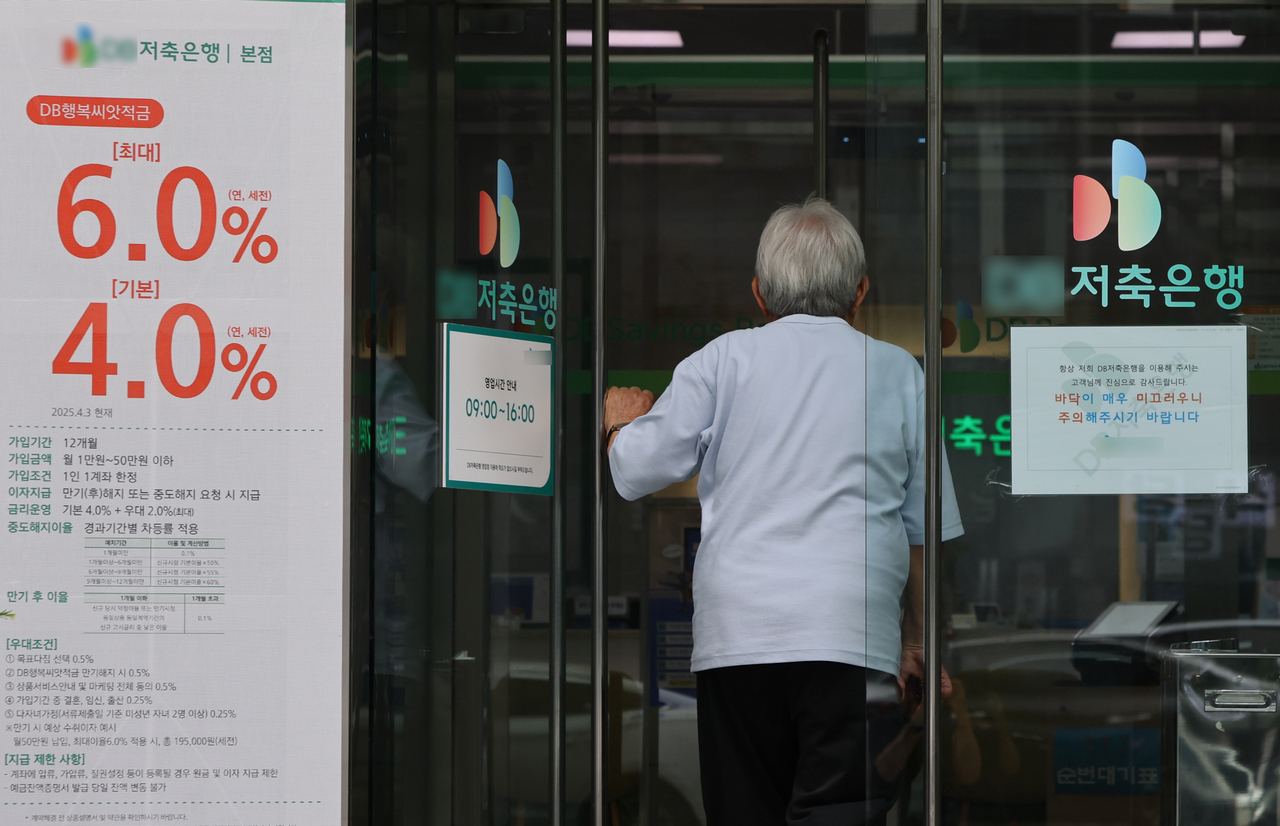
As the Bank of Korea raises its benchmark interest rate further, financial regulators are pressing ahead with efforts to expand inclusive finance for low- and mid-credit borrowers. For secondary financial institutions already struggling with rising funding costs and deteriorating borrower creditworthiness, being asked to extend more low-rate loans is a significant burden. The Financial Services Commission has put forward measures to ease savings banks' funding costs, but the industry is questioning whether the policies will work in practice.
According to financial industry sources, the Bank of Korea's Monetary Policy Board raised the benchmark interest rate by 0.25 percentage points Thursday, lifting it from 3 percent to 3.25 percent. The FSC held its eighth Inclusive Financial Transformation meeting the same day, announcing plans to rationalize prudential regulations to sustain the expansion of inclusive finance.
The problem is that funding conditions for secondary lenders are worsening. According to the credit finance industry, funding rates have risen more than 1 percentage point from a year earlier. Savings banks, which raise funds through deposits, estimate that their average funding costs in the second half of the year are running about 0.7 to 0.8 percentage points higher than in the first half.
"When the everyday economy is struggling, it means the creditworthiness of low- and mid-income households, the self-employed and businesses is deteriorating," an official at the Korea Federation of Savings Banks said. "We need to take a conservative approach as risk grows, but costs keep rising on top of that — it's a real burden."
Mid-rate loan ceiling stuck at maximum for four years despite rising funding costs
The industry is watching closely how much of the rise in funding costs will be reflected in the adjustment of the mid-rate loan ceiling for the first half of next year, scheduled for next month. Financial regulators grant regulatory incentives to unsecured loans extended to borrowers in the bottom 50 percent of credit scores that fall within sector-specific rate ceilings. The ceilings are adjusted every six months to reflect changes in funding rates. For the second half of this year, the ceilings stand at 8.97 percent for mutual finance, 12.26 percent for credit card companies, 14.37 percent for capital firms and 15.27 percent for savings banks.
However, the maximum cap regulators apply when adjusting the ceiling each half-year has remained unchanged for more than four years since the system was introduced in the second half of 2022. The caps are set at 10.5 percent for mutual finance, 13 percent for card companies, 15.5 percent for capital firms and 17.5 percent for savings banks — meaning the ceiling cannot be raised beyond these levels even if funding costs surge sharply. For financial institutions already accepting thin margins to supply mid-rate loans, this structure could make profitability pressures even more acute.
"The regulator calculates the ceiling and notifies us without any separate process for the industry to submit its views," an official in the credit finance industry said. "We are already handling mid-rate loans with minimal margins, and with a hard cap in place, it is difficult for the full increase in funding costs to be passed through."
There are also concerns that expanding inclusive finance will be difficult if mid-rate loan rates stay flat while funding costs rise. "There may be policy resistance to raising rates, but some portion of the increase in funding costs needs to be reflected," another industry official said. "If financial institutions shrink their asset base or scale back operations due to deteriorating profitability, the supply of inclusive finance could contract as well," the official added.
Low-cost funding for savings banks — but non-affiliates fear being left behind
Financial regulators are also pursuing measures to secure capacity for inclusive finance by lowering funding costs. A key initiative is the "inclusive on-lending" scheme being introduced to ease savings banks' funding burden. Under the arrangement, commercial banks provide funds to savings banks at low rates, and savings banks use those funds to extend loans to low- and mid-credit borrowers. The FSC expects the scheme to reduce loan rates by 3 to 5 percentage points compared with existing savings bank loans.
The key question, however, is whether commercial banks — themselves facing rising funding costs — can supply the volume of funds savings banks need at sufficiently low rates.
"During peak lending seasons in the past, we processed 300 billion to 400 billion won in loans in a single month," an official at a large savings bank said. "I have doubts about whether banks can provide funds at the scale we need." The official added that even a 0.1 percentage point reduction in funding costs would be meaningful for savings banks.
Concerns have also been raised that policy benefits could be unevenly distributed depending on whether a savings bank is affiliated with a banking group. Woori Bank has drawn up a plan to supply 50 billion to 100 billion won ($37.2 million-$74.5 million) to its affiliate Woori Financial Group's savings bank, but non-bank-affiliated savings banks must independently secure partner banks and negotiate funding rates on their own.
"There is a possibility that financial holding group affiliates will be the first to participate, with gradual expansion to follow," a Korea Federation of Savings Banks official said. "Not every savings bank that applies will necessarily receive funding."
The industry has raised concerns that if funding is concentrated among bank-affiliated savings banks, the inclusive finance expansion effect originally envisioned could prove limited.
"Bank-affiliated savings banks tend to serve relatively higher-quality customers and do not handle large loan volumes," an official at a large savings bank said. "Non-bank-affiliated savings banks account for a far greater share of lending to low- and mid-credit borrowers, so if funding is concentrated among bank affiliates, it may be difficult to achieve the original policy goal," the official warned.
The FSC will accept applications from on-lending loan providers from Friday through Dec. 18. To encourage participation, it plans to count banks' on-lending performance toward their Saeheuimang Holssi supply record and exempt participating banks from contributions to guarantee institutions.
"Recognition of Saeheuimang Holssi supply performance will serve as an incentive, particularly for branches that actively manage their track records," an official at a commercial bank said. "But even with reduced contribution burdens, it is realistically difficult for banks to supply funds at low rates to savings banks outside their own group in the current high-rate environment," the official added.
snsd@heraldcorp.com