KASA opens South Korea's largest civilian drone test facility in Wonju
South Korea has built its largest civilian drone test facility, capable of reproducing extreme conditions indoors — from temperatures as low as minus 40 degrees Celsius and heavy snowfall to the powerful gusts that form between city high-rises — to verify the flight performance of drones.
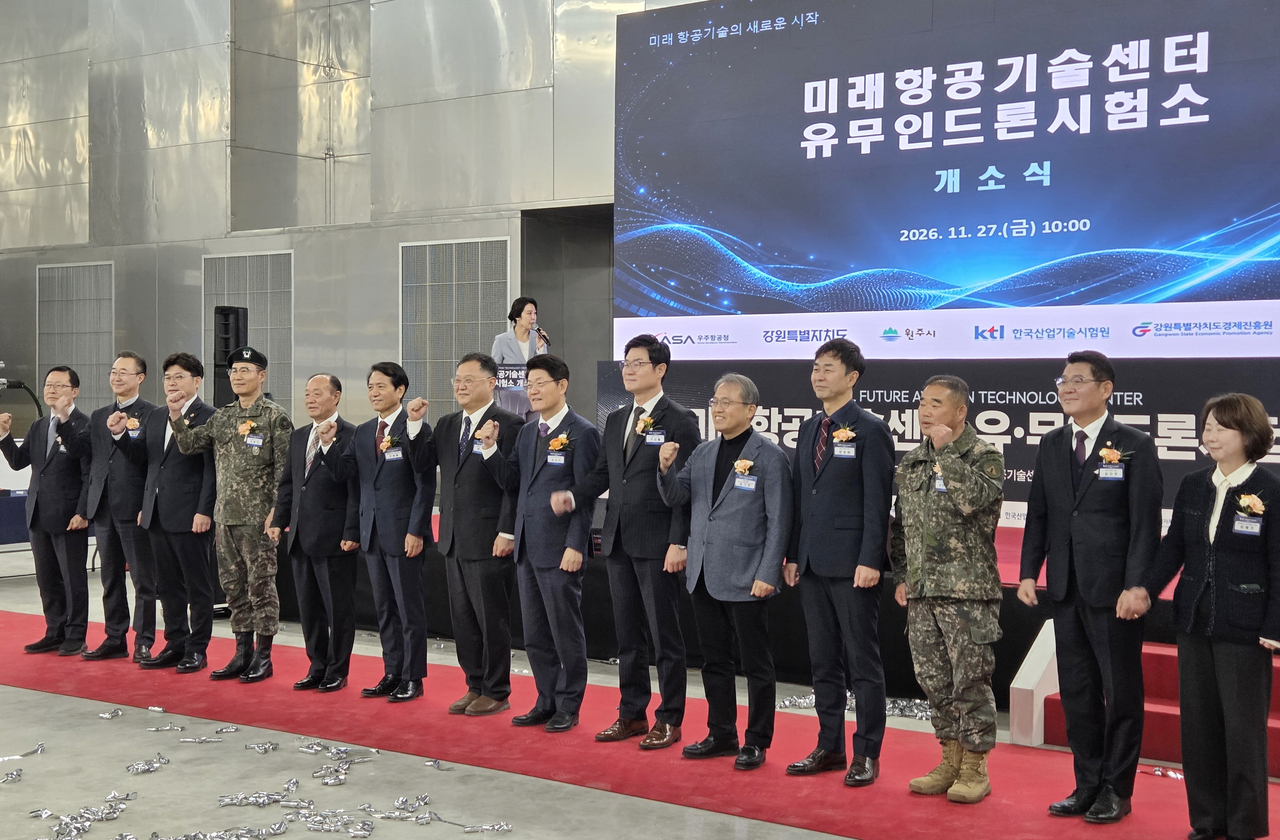
The Korea AeroSpace Administration said Friday it opened a manned and unmanned drone test center in the Buron General Industrial Complex in Wonju, Gangwon Province, to support the development of medium- and large-sized manned and unmanned drones for disaster relief, military missions and other applications.
Built under the Korea Testing Laboratory in partnership with Gangwon Province and Wonju, the facility houses a combined-environment test and evaluation chamber measuring 32 meters long, 25 meters wide and 18 meters tall, with a total volume of 14,400 cubic meters — the largest of its kind in the civilian sector.
A key feature is the ability to fly medium- and large-sized manned and unmanned drones indoors, allowing engineers to verify the performance not only of individual components but of the entire airframe.
The combined-environment test system can regulate temperatures from minus 40 to plus 85 degrees Celsius and simulate a range of adverse weather conditions, including rain, snow and icing.
Particularly notable is the flight-control stability evaluation system, which independently controls more than 2,000 blowers to recreate complex wind environments — including strong crosswinds and the sudden gusts that arise between urban buildings.
The facility is expected to allow engineers to verify drone flight stability and handling performance under extreme weather conditions, and to help domestic companies obtain the necessary certifications.
The center also features mobile noise-measurement equipment for recording takeoff, landing and in-flight noise at actual flight sites. The equipment will be used not only to evaluate noise from drones and rotary-wing aircraft but also to develop technology for tracking drone positions through acoustic signatures.
Korea Testing Laboratory plans to run a pilot operation before launching full-scale test and evaluation services in 2027.
"The opening of this facility lays the groundwork for verifying drone performance across a wide range of weather conditions," KASA Deputy Administrator Kwon Hyeon-jun said. "We will continue to expand the aerospace test and evaluation infrastructure to meet industry demand on the ground, so that our companies can refine their products through the necessary testing and enter the market."
nbgkoo@heraldcorp.com