- New 'MemLLM' technology performs core AI computations inside storage drives
- Advance expected to enable personalized AI assistants without transmitting sensitive data to external servers
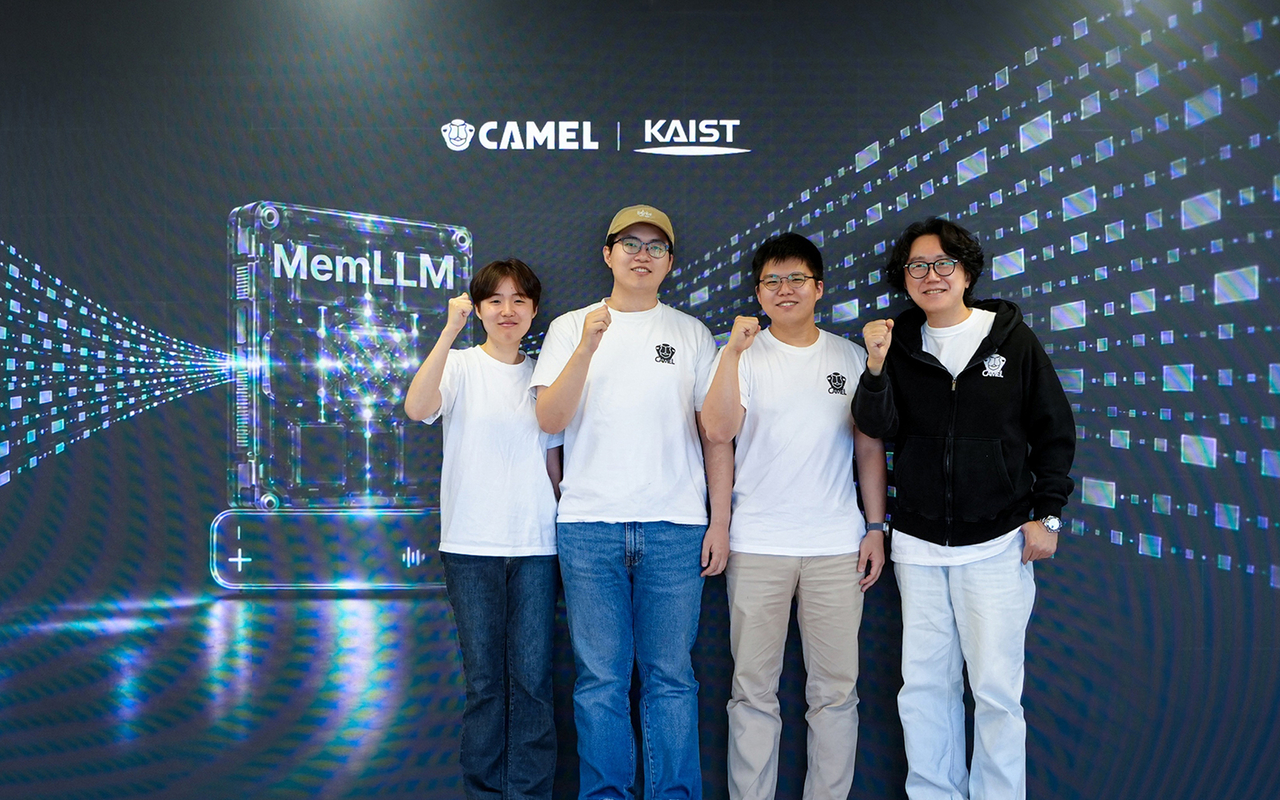
Researchers have developed an AI technology that can rapidly analyze personal medical records and financial information on a smartphone or other personal device without sending the data to an external server. By having the storage drive itself perform AI computations directly, the system delivers response speeds more than four times faster than conventional GPU-based systems.
KAIST announced Monday that a research team led by Professor Jeong Myung-soo of the School of Electrical Engineering has developed MemLLM, a technology that performs the core computations of document-based AI inside a solid-state drive (SSD).
For AI to analyze a user's health checkup records or financial documents and generate a response, it must search through relevant files and synthesize the necessary information. The technique of generating answers by referencing external documents in this way is known as retrieval-augmented generation, or RAG.
Running RAG on a personal device eliminates the need to transmit sensitive private information to external servers. However, as the number of reference documents grows, large volumes of data must be repeatedly shuttled between the SSD and the GPU, slowing response times.
The research team overcame this bottleneck by performing computations directly where the data is stored.
The team designed the system so that the "attention" operation — which helps AI focus on the key information needed to generate a response — runs inside the SSD itself, dramatically reducing the volume of data that must be sent to the GPU.
The researchers also consolidated document-refinement and query-processing operations that previously required multiple data reads into a single step, and applied a custom architecture that makes efficient use of the multiple data channels and computational resources within the SSD.

In simulations combining an FPGA (field-programmable gate array) prototype with actual GPU measurements, the research team evaluated the system across eight question-answering datasets and six on-device language models. The results showed an average response speed 4.06 times faster than conventional GPU-based systems.
The accelerator's estimated power consumption averaged 2.12 watts, falling below the 3-watt threshold the team set for the study — demonstrating the technology's potential for use in mobile environments where power is constrained.
The technology is expected to contribute to the development of personalized AI assistants capable of handling sensitive personal information in medical, financial and legal domains without transmitting it to external servers.
However, integrating a computational unit inside an SSD and verifying its performance will require additional work before the technology can be applied to commercial products.
"For personal AI to make use of large numbers of documents, we need to reduce not only computational demands but also the latency involved in moving data," Jeong said. "We hope this becomes the foundation for personal AI services that can work quickly on-device without sending sensitive information outside."
The findings were presented at MICRO 2026, an international conference on computer architecture.
nbgkoo@heraldcorp.com