
Only 50 of more than 20,000 grade-5-and-below civil servants set for special promotion based solely on performance
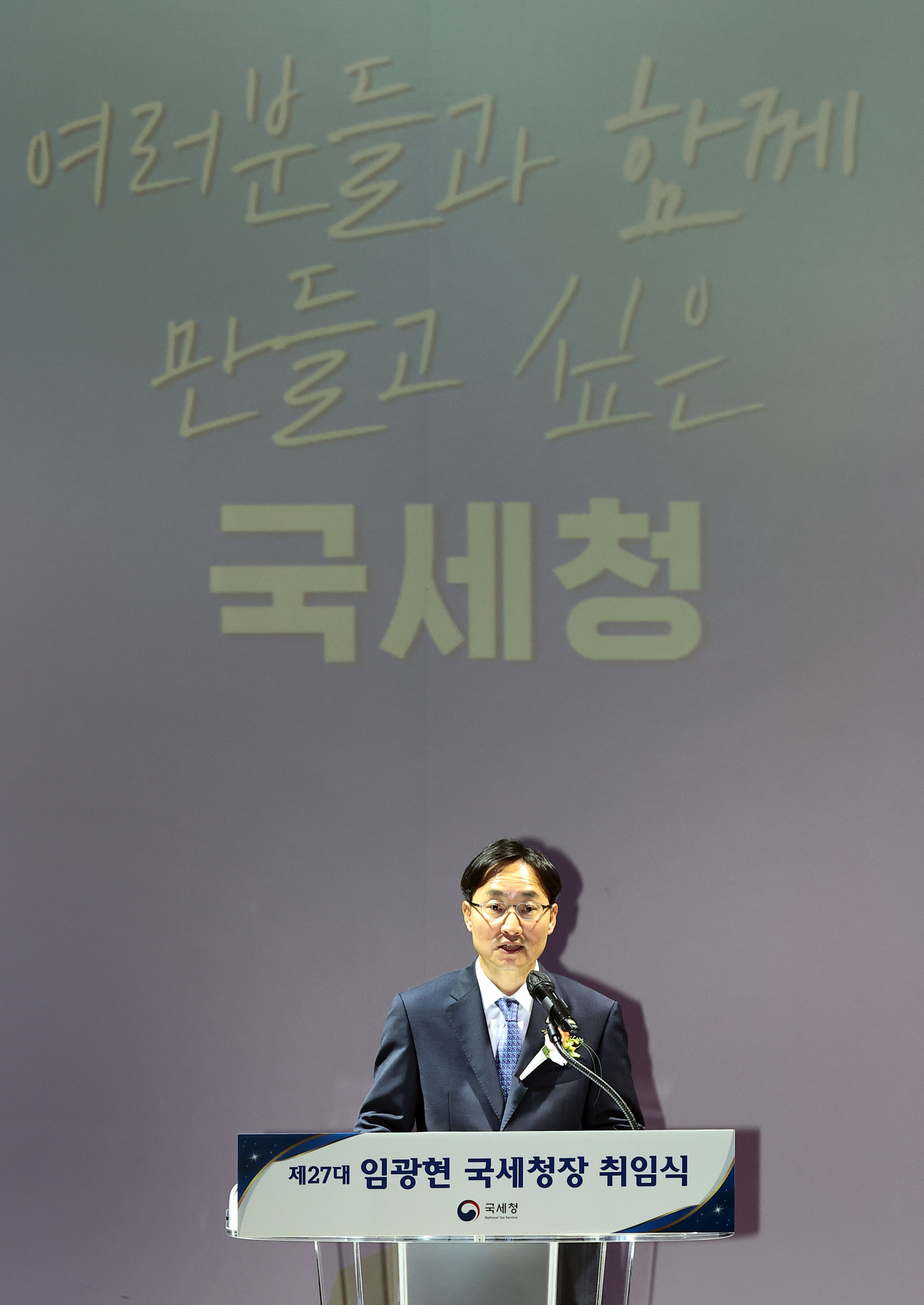
About 50 National Tax Service employees at grade 5 and below are set to receive special promotions based entirely on job performance — a break from six decades of seniority-based practice that sources say reflects Commissioner Lim Gwang-hyeon's deliberate decision to relinquish his own personnel authority.
Unlike some ministry heads who use appointment power to consolidate control over their organizations, Lim has directed that candidates be selected through a rigorous, transparent vetting process that rank-and-file staff can accept as fair, according to sources familiar with the matter. Officials say the approach reflects Lim's confidence in his ability to manage the agency without relying on patronage.
According to government sources in Sejong on Saturday, the NTS plans to announce the roughly 50 recipients this month — the first time in the agency's 60-year history that special promotions at grade 5 and below have been awarded purely on merit, rather than allocated as a fixed share of regular promotion slots distributed partly by seniority.
Lim and the heads of regional tax offices, who normally hold appointment authority, are said to have played no role in the selection. Sources say Lim reportedly penalized staff who approached him seeking to influence appointments on behalf of others. Internal sources describe it as a clear signal that connections will count for nothing — only results.
Lim's personnel philosophy aligns with the governing priorities of President Lee Jae Myung, who since taking office in June last year has repeatedly directed agencies to reinvigorate the civil service through bold promotions for high-performing officials.
The selection process runs through three successive screening stages — tax office and investigation bureau level, regional NTS level, and finally NTS headquarters — with candidates advancing only by clearing each gate. Sources say the final list of roughly 50 names was compiled through this nationwide, multi-stage screening, which insiders liken to the grueling trials used to select short-track speed skating national team members.
Under the previous system, a set proportion of regular promotion slots were distributed as special promotions, partly based on seniority. This month's announcement, by contrast, was decided entirely on individual performance, with no other factors considered, according to NTS insiders.
The reform generated the most intense competition within Investigation Bureau 4 of the Seoul Regional Tax Office, where more than 20 elite investigators each submitted detailed performance summaries to enter the first round of evaluation.
Bureau 4 chief Lee Seong-geul also stepped back from his appointment authority, instead convening an open assessment in which a panel of 85 peers directly evaluated their colleagues' records. Lim had earlier appointed Lee to lead Bureau 4 — the NTS's most powerful investigative unit, which handles non-routine special tax audits and is known among business circles as the "grim reaper" of the tax world.
Other tax offices and investigation bureaus conducted blind evaluations in which candidates were assessed solely on their performance records, with names and affiliations withheld.
"This special promotion felt like watching the short-track national team trials — which people say are harder to clear than winning an international championship," one Bureau 4 employee said.
A Sejong government official said Lim was the first agency head across all ministries and affiliated offices to voluntarily surrender personnel authority and apply a purely performance-based system. "The fact that he also penalized third-party lobbying for appointments — that, too, is unprecedented," the official said. "It sends an unmistakable message that results, not relationships, will determine who gets ahead."
Meanwhile, Lim has also moved to curtail the longstanding practice of tax investigators spending months stationed inside corporate offices. Since last year, the NTS has required investigators to minimize on-site presence at companies, limiting it to cases where it is strictly necessary — another break with entrenched convention.
oskymoon@heraldcorp.com





