A new preferential tax regime introduced this year allows high-dividend income to be taxed separately from other earnings, delivering significant savings for investors in higher income brackets. Those with comprehensive income tax rates above 35% stand to benefit most, but the relief is not automatic — a separate application must be filed. National health insurance premiums add another layer of complexity, and experts recommend spreading financial income below the 10 million won threshold. Strategies include ISA accounts and staggering fund redemptions and interest maturities.
A new preferential separate taxation regime for high-dividend income took effect this year, offering investors a way to significantly reduce their tax burden on dividends received from qualifying companies.


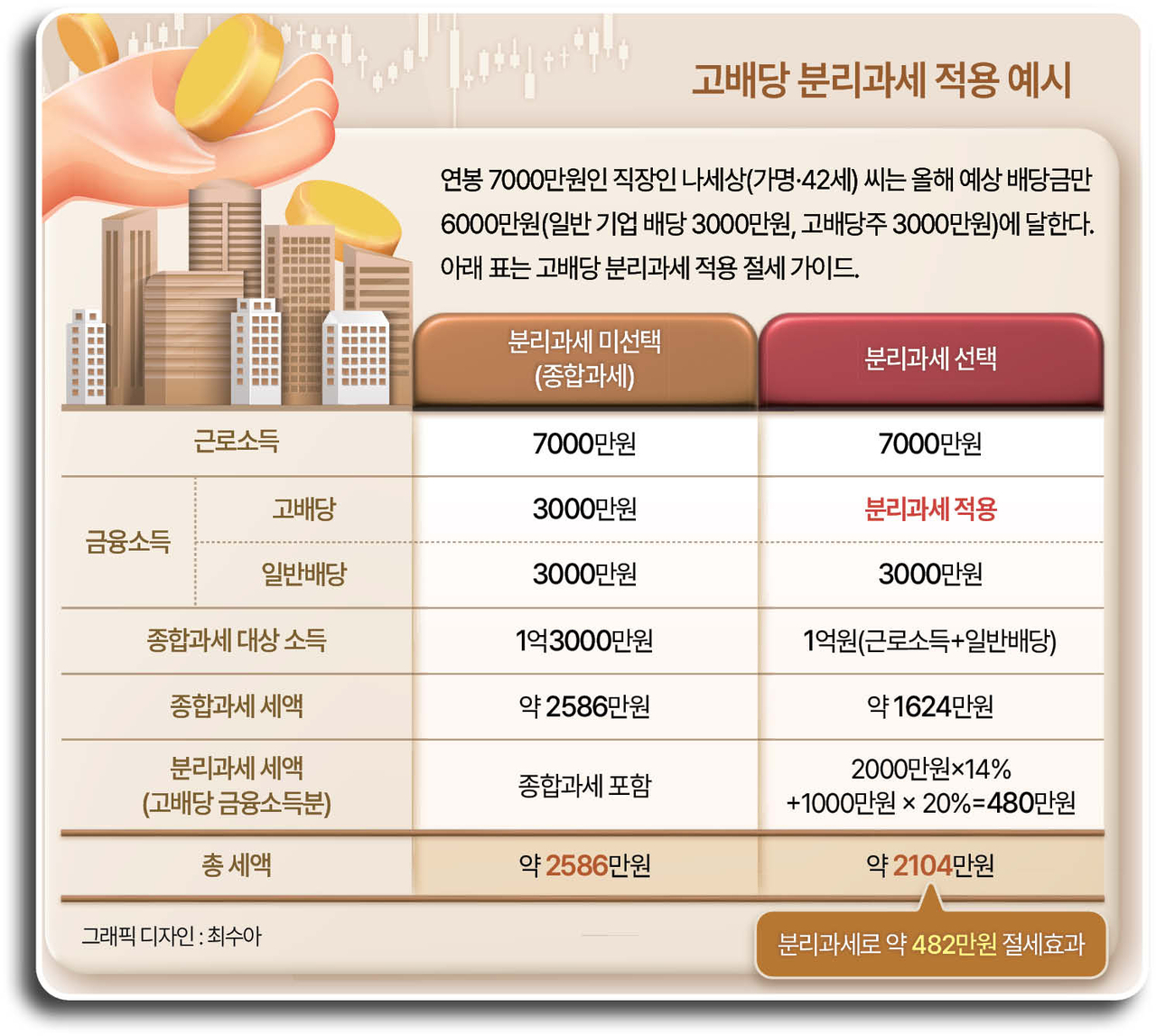
Na Se-sang (a pseudonym), a 42-year-old salaried worker, has consistently invested in blue-chip stocks such as Samsung Electronics and high-dividend shares. His projected dividend income for 2026 alone reaches 60 million won (about $40,700) — 30 million won (about $20,300) from general corporate dividends and another 30 million won (about $20,300) from high-dividend stocks. The problem is that this figure far exceeds the 20 million won (about $13,600) threshold that triggers comprehensive financial income taxation.
When combined with his annual salary of 70 million won (about $47,400), the applicable tax rate jumps sharply, and national health insurance premium costs could pile on top. Na built his dividend portfolio to generate steady cash flow, but he worries that what he actually takes home may fall well short of expectations. The new preferential separate taxation regime introduced this year has raised his hopes, however. A tax accountant known as "National Tax Sister," a former National Tax Service official, walks through how much of the burden can be reduced.
Q. What tax benefits does the new high-dividend separate taxation regime offer?
A. The "special tax treatment for dividend income from high-dividend company shares" — or high-dividend separate taxation — is a regime designed to ease the tax burden on dividend income. For investors, it offers the prospect of lower taxes while also encouraging more capital to flow into the market.
Dividend income received on or after Jan. 1, 2026 from qualifying high-dividend companies can be excluded from comprehensive taxation even when total financial income — interest plus dividends — exceeds 20 million won (about $13,600). Instead, when filing the comprehensive income tax return the following year, that dividend income is taxed separately at a relatively low rate of roughly 14 to 30% (local income tax additional), rather than being aggregated with other income. This can substantially reduce the tax burden compared with the high progressive rates that previously applied.
The regime is temporary, covering dividends paid through 2029 and tax filings through May 2030. Importantly, it is not applied automatically — taxpayers must choose between comprehensive taxation and separate taxation and submit an application accordingly.
Q. How does this differ from the existing comprehensive financial income tax?
A. The key difference is whether income is aggregated or assessed separately.
Under the existing system, when combined financial income from interest and dividends exceeds 20 million won (about $13,600) a year, the entire amount above that threshold is added to wages, business income and other earnings, and taxed at progressive rates of up to 49.5% including local income tax.
Under the high-dividend separate taxation option, the structure changes. Dividends received from qualifying high-dividend companies are excluded from the 20 million won (about $13,600) threshold calculation for comprehensive financial income taxation, and are taxed at a separate rate applied only to those dividends — with no aggregation with other income.
The applicable rates are relatively straightforward: 14% on amounts up to 20 million won (about $13,600), 20% on amounts up to 300 million won (about $203,000), 25% on amounts up to 5 billion won (about $3,390,000), and 30% on amounts above 5 billion won (about $3,390,000) — all lower than the existing progressive rates. This makes the savings particularly tangible for investors with large dividend portfolios. For example, an investor receiving a total of 20 million won (about $13,600) in dividends — 4 million won (about $2,710) each from three high-dividend companies and two general companies — would have the entire amount taxed at 14%, keeping the burden modest.
If total dividends rise to 40 million won (about $27,100), however, with 30 million won (about $20,300) coming from high-dividend companies, the separate 20% rate applies to that portion. The remaining 10 million won (about $6,780) from general companies is taxed at 14%, meaning the effective rate varies depending on the composition of income.
When dividends reach around 70 million won (about $47,400), the gap widens further. The 45 million won (about $30,500) from high-dividend companies is taxed at 20%, but the 25 million won (about $16,900) from general companies exceeds the 20 million won (about $13,600) threshold and becomes subject to comprehensive taxation, where progressive rates of up to 45% may apply.
Ultimately, for the next four years, the tax burden on identical dividend amounts can differ significantly depending on which companies pay them and how much.
Q. Does this apply to shares purchased this year? When exactly does the benefit take effect?
A. Yes, it does. Both existing shareholders and investors who acquire shares for the first time in 2026 are eligible, as long as the dividend was received on or after Jan. 1, 2026. The determining factor is not when the shares were purchased, but when the dividend was received.
The timing of the benefit also matters. Dividends received in 2026 do not generate an immediate tax reduction — the savings are realized when the investor elects separate taxation on the comprehensive income tax return filed in May 2027. Dividends received this year translate into tax savings when the separate taxation option is chosen at next year's May filing.
Q. Is high-dividend separate taxation always the better choice?
A. Not necessarily — it depends on the individual's income level. For those already in the 35 to 45% comprehensive income tax bracket due to a high salary, electing separate taxation and keeping dividend income out of the aggregation is clearly advantageous.
For someone like Na, whose high earned income means a steep progressive rate would apply under comprehensive taxation, choosing separate taxation means the high-dividend portion is taxed at a preferential rate of 14 to 20% (local income tax additional) — a meaningful reduction.
The calculus is different, however, for someone with little other income who would face a rate as low as 6% under comprehensive taxation. In that case, even if financial income exceeds 20 million won (about $13,600), sticking with comprehensive taxation can actually reduce the tax bill by roughly 500,000 won (about $339).
Q. How much can I actually save in my situation?
A. Taking Na's case as a baseline — 70 million won (about $47,400) in employment income, 30 million won (about $20,300) in high-dividend income and 30 million won (about $20,300) in general dividend income — the comparison works out as follows (local income tax not included). Without separate taxation, all 60 million won (about $40,700) in financial income is aggregated with employment income, pushing the taxable base to 130 million won (about $88,100). Total tax in that scenario comes to approximately 25.86 million won (about $17,500).
Electing high-dividend separate taxation changes the picture. The 30 million won (about $20,300) in high-dividend income is taxed separately: 14% on the first 20 million won (about $13,600) and 20% on the remaining 10 million won (about $6,780), for a combined tax of 4.8 million won (about $3,250). Comprehensive taxation then applies only to the remaining 70 million won (about $47,400) in employment income and 30 million won (about $20,300) in general dividends — a combined 100 million won (about $67,800).
Under this approach, the final tax bill falls to approximately 21.04 million won (about $14,300). Na saves roughly 4.82 million won by choosing separate taxation.
Q. This sounds like a four-year window worth taking advantage of. Do investors need to handle the verification and application themselves?
A. Yes, investors need to take certain steps on their own. To check whether a company qualifies as a high-dividend company, investors can look up the company's "high-dividend company disclosure" through the Korea Exchange's listed company disclosure system, KIND. It is also important to remember that the regime does not apply automatically. A separate "separate taxation application form" must be submitted when filing the comprehensive income tax return — without it, the benefit is not granted. Investors should assess their own income structure and decide which option — comprehensive or separate taxation — works in their favor before filing.
Q. More high-dividend opportunities are welcome, but I'm worried about rising national health insurance premiums.
A. That concern is valid. National health insurance operates on a different basis from taxation, so different rules apply.
Under the current system, financial income exceeding 10 million won (about $6,780) a year is factored into health insurance premium calculations. This means premiums can rise even when financial income stays below the 20 million won (about $13,600) comprehensive taxation threshold. That is why the advice to "watch the 10 million won line for health insurance, even if you're saving on taxes" is commonly heard.
Even for employees covered through their workplace, additional premiums apply when non-wage income exceeds 20 million won (about $13,600) a year. A "monthly income premium" of 7.09% is levied on the excess, calculated as: (non-wage income minus 20 million won) divided by 12, multiplied by 7.09%.
For someone like Na, with 60 million won (about $40,700) in dividends, the additional premium applies to the 40 million won (about $27,100) above the 20 million won (about $13,600) threshold. Separate taxation can reduce the income tax bill, but health insurance premiums must be managed separately.
Q. Do health insurance premiums rise immediately when dividends are received?
A. No, they do not.
Health insurance premiums are adjusted with a lag. Dividend income generated in 2026, for example, flows through the comprehensive income tax filing in May 2027, and the results are then reflected in premiums from November 2027 through October 2028.
Q. Keeping financial income below 10 million won (about $6,780) or 20 million won (about $13,600) in a given year seems like a viable strategy. What approaches are available?
A. The first is spreading financial income itself. Staggering dividend timing and distributing fund redemptions and interest maturities prevents income from concentrating in a single year.
Actively using products with tax-exempt or separate-taxation benefits — such as ISA (individual savings account) accounts — can also help keep taxable income below the 10 million won (about $6,780) or 20 million won (about $13,600) thresholds. Direct bond investment is another option: capital gains from bond trading are excluded from the taxable base, which can be advantageous when health insurance premiums are calculated.
The second strategy is spreading income through intra-family gifts. Using the gift tax exemption limits — up to 600 million won (about $407,000) for a spouse and 50 million won (about $33,900) for adult children (20 million won, or about $13,600, for minors) — to transfer financial assets distributes income across multiple taxpayers, reducing both comprehensive tax liability and health insurance premiums at the same time.
Third, run a simulation to compare the two options. From 2026 onward, investors must compare full comprehensive taxation against electing high-dividend separate taxation before filing, as the better outcome varies with income level. Calculating in advance is essential.
Yu Hye-rim
forest@heraldcorp.com