13,945 recipients received an average of 1.43 million won ($946) over the pilot period; the share seeking timely treatment rose from 59.9 percent to 70.2 percent, while working while sick fell from 33.0 percent to 17.8 percent; experts say benefit levels and coverage duration still lag international standards
South Korea's pilot sick pay program — which compensates workers who cannot work due to non-occupational illness or injury — has significantly improved treatment rates since its launch, but experts say its income-replacement function remains limited because benefit levels and coverage periods are still insufficient.
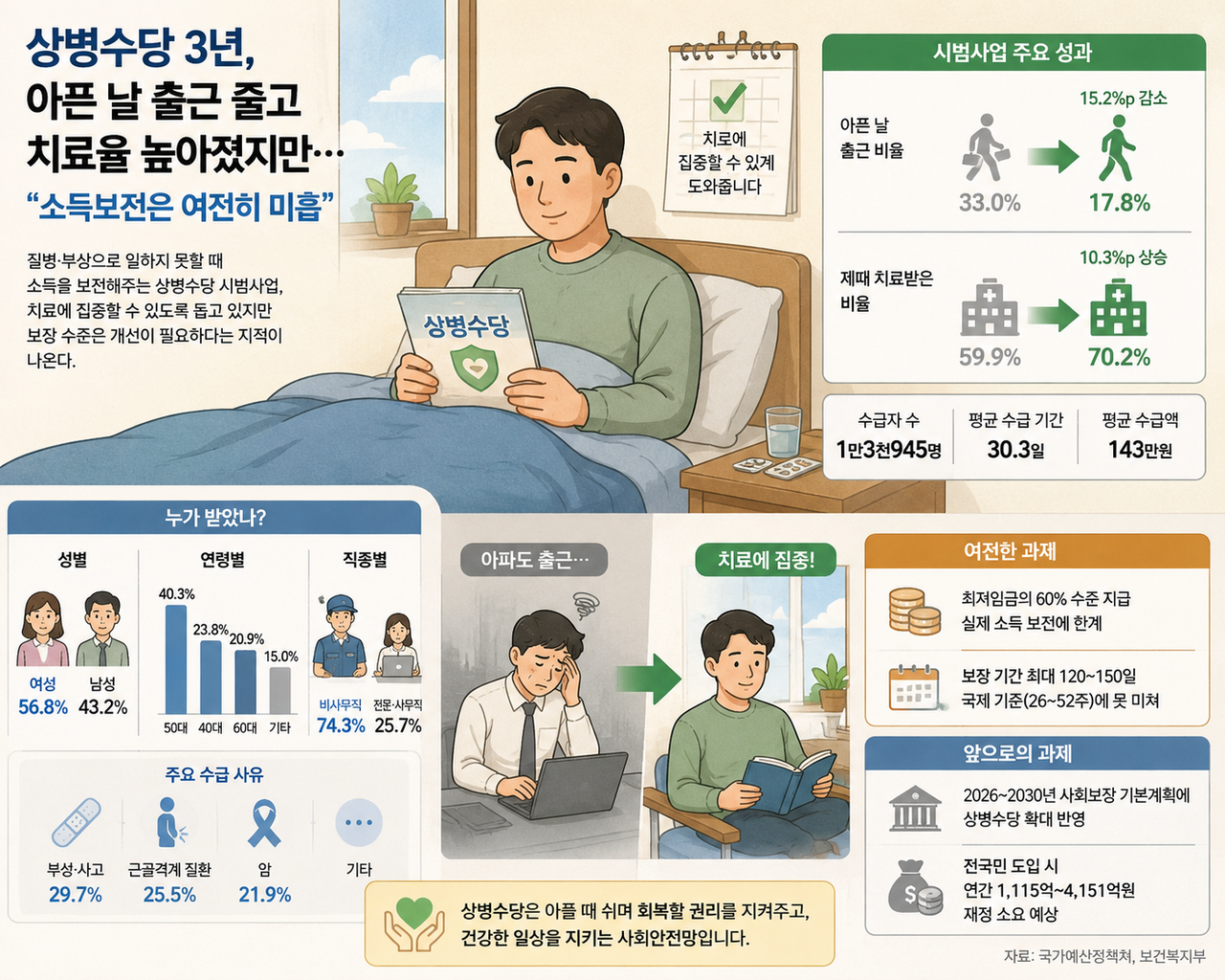
According to an analysis of Ministry of Health and Welfare data released Tuesday by the National Assembly Budget Office, a total of 13,945 people received sick pay benefits during the pilot program, which ran from July 2022 through March 2025. Recipients received an average of 1.43 million won ($946) over an average of 30.3 days.
The sick pay system is designed to replace a portion of income for workers who cannot engage in economic activity due to non-occupational illness or injury, allowing them to focus on treatment. Most OECD member countries — with the exception of South Korea and the United States — already operate such a system. South Korea has been running the pilot in three phases since 2022.
Fewer workers showing up sick, more getting treatment
The health outcomes from the pilot program were relatively clear-cut.
The share of recipients who said they had gone to work while sick fell from 33.0 percent to 17.8 percent, a drop of 15.2 percentage points. The share who said they received timely treatment rose 10.3 percentage points, from 59.9 percent to 70.2 percent, and those who said they received adequate treatment increased from 48.1 percent to 55.9 percent.
Among recipients, women accounted for 56.8 percent, outnumbering men at 43.2 percent. By age group, those in their 50s made up the largest share at 40.3 percent, followed by those in their 40s at 23.8 percent and those in their 60s at 20.9 percent, with older workers showing higher rates of program use.
By occupation, non-office workers accounted for 74.3 percent of recipients, far outnumbering professional and office workers at 25.7 percent. The most common reasons for claiming sick pay were injuries and accidents (29.7 percent), musculoskeletal disorders (25.5 percent) and cancer (21.9 percent).
'Set at 60% of minimum wage — below international standards'
However, analysts say the program's core function — replacing lost income — remains inadequate.
Ahn Tae-hun, an analyst at the National Assembly Budget Office, said the current third-phase pilot pays a flat rate equivalent to 60 percent of the minimum wage for those not enrolled in the national health insurance system as workplace subscribers, which he said falls short of meaningfully replacing actual income.
The coverage period is also short by international standards. International Labour Organization conventions call for sick pay coverage of 26 to 52 weeks, but the domestic pilot caps benefits at 120 to 150 days.
"The current system performs a minimum function at the introductory stage, but it needs to be improved to meet international standards," Ahn said.
The government is reviewing an expansion of the program. The Ministry of Health and Welfare recently included sick pay as an income-security priority in its revised Third Basic Plan for Social Security, covering 2026 to 2030.
However, extending the program to the entire population would carry a substantial fiscal cost. The National Assembly Budget Office estimates that, depending on how waiting periods and coverage durations are structured, the program could require an additional 111.5 billion to 415.1 billion won per year.
fact0514@heraldcorp.com