Ruling party backs policy agenda but cracks emerge within
Opposition doubles down on confrontational stance
Expert urges president to 'maintain neutrality with gravitas'
By Jung Seok-jun, The Herald Business
One year after the Lee Jae Myung administration took office, political observers say confrontation — not cooperation — has defined the relationship between the ruling and opposition parties. The two sides clashed head-on over nearly every major issue during the past year, and signs of internal friction within the ruling camp surfaced repeatedly. Still, the June 3 local elections have raised hopes that new cooperative ties could form among the central government, the National Assembly and local governments.
Wednesday marked both the first anniversary of President Lee Jae Myung's inauguration and the day results were certified from the ninth nationwide simultaneous local elections.
Over the past year, the ruling Democratic Party of Korea focused on driving the administration's policy agenda forward. Backed by its commanding majority in the National Assembly, the party pushed through a succession of major bills in a sustained legislative drive. The minority People Power Party fought back through filibusters and public opinion campaigns outside the chamber, but found itself largely unable to block legislation.
Many in political circles say that while ties between the executive and legislative branches have grown stronger since the Lee administration took office, bipartisan cooperation has actually deteriorated. The ruling and opposition parties clashed repeatedly on prosecutorial reform, constitutional reform, special prosecutor legislation, the budget and real estate policy.
The ruling camp itself was not without turbulence. The Democratic Party spent the year rallying behind the administration, but differences in position between the party and the government surfaced on key issues. Speculation about internal rifts persisted over talks on a merger with the Rebuilding Korea Party, a shift to a single-vote electoral system and candidate nominations for the local elections. Political circles took to calling the tension "the Myeong-Cheong conflict" — a reference to a possible power struggle between President Lee and party leader Jung Chung-rae.
Jung shrugged off the conflict talk each time it arose, insisting "the party and the government are one team." President Lee also emphasized cooperation, saying each side should simply do its own job well.
Attention inside and outside the party is already turning to the Democratic Party's national convention in August, when the outcome of the leadership election could reshape the balance of power between factions aligned with Lee and those aligned with Jung. The push for prosecutorial reform legislation, expected to intensify after the local elections, adds another variable. Subtle differences in position between the government and the party have emerged over issues including the establishment of a public prosecution office and granting prosecutors supplementary investigative powers.
The People Power Party has maintained a hardline opposition stance since the Lee administration took office. After winning the party leadership at last August's national convention, PPP leader Jang Dong-hyeok vowed to "unite all conservatives and bring down the Lee Jae Myung administration."
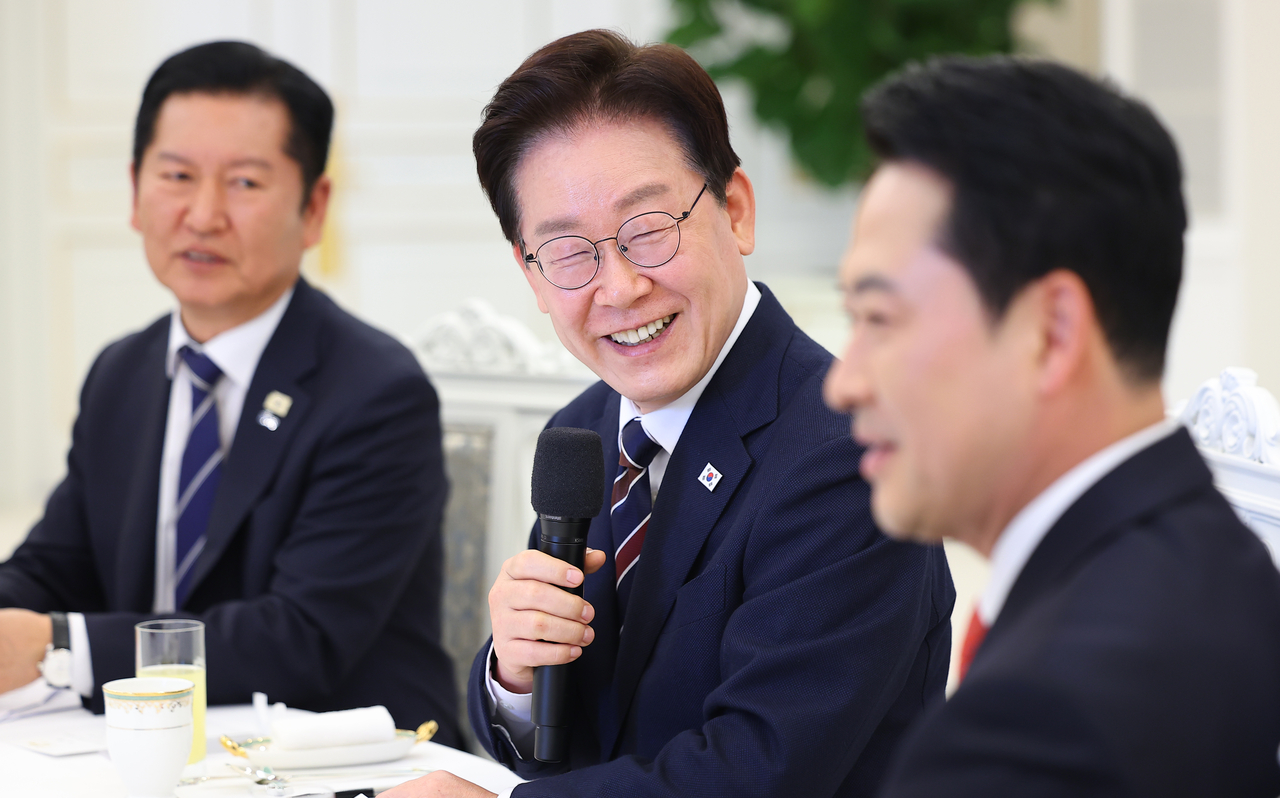
A luncheon last September among President Lee, Jung Chung-rae and Jang briefly suggested the possibility of cross-party cooperation, but the goodwill did not last. Jang subsequently ratcheted up his confrontational posture, seizing on issues including visits to former President Yoon Suk Yeol, the special prosecutor push and the constitutional reform debate.
In February, Jang declined an invitation to a presidential luncheon. At an April meeting, he directly challenged President Lee, demanding that Lee "first make a public declaration to the people that he will not seek a second consecutive or additional term before any discussion of constitutional reform" — a direct collision between the two leaders.
The PPP's own upcoming national convention is seen as a turning point for the party's future relationship with the government. The next leadership will in effect control candidate nominations for the 2028 general election. With calls for party renewal growing louder after the local election defeat, the party faces the challenge of holding together its hard-line conservative base while broadening its appeal to centrist voters.
Interpretations of the June 3 local election results diverge. The Democratic Party secured a majority of regional government head posts, expanding its hold on local power, but the PPP held on in Seoul and several other key areas — a result some read as confirmation that a desire to check the ruling party still exists among voters.
Experts analyzed the election as reflecting not simply a win or loss but the simultaneous pull of pro-government stability sentiment and a desire to check power. Given the complex political landscape now taking shape between the central and local governments, repeated cycles of cooperation and conflict appear likely going forward.
Yang Seung-ham, an emeritus professor at Yonsei University, said internal conflict is inevitable when power becomes overloaded, but warned that "the timing has come early — in the president's first year, not at the end of his term." He stressed that "it is important for the president to carry more gravitas and maintain neutrality." Yang added that the ruling party "could show signs of internal division at this national convention ahead of the general election," and urged the opposition to use the local elections as an opportunity to build a genuine check on power "rather than dogmatically focusing only on rallying its hard-line base."
mp1256@heraldcorp.com