Authorities blame speculative NDF trading for won's sharp slide; smoothing operations, national pension swaps to continue; banks flag CET1 erosion and rising loan delinquencies among small exporters
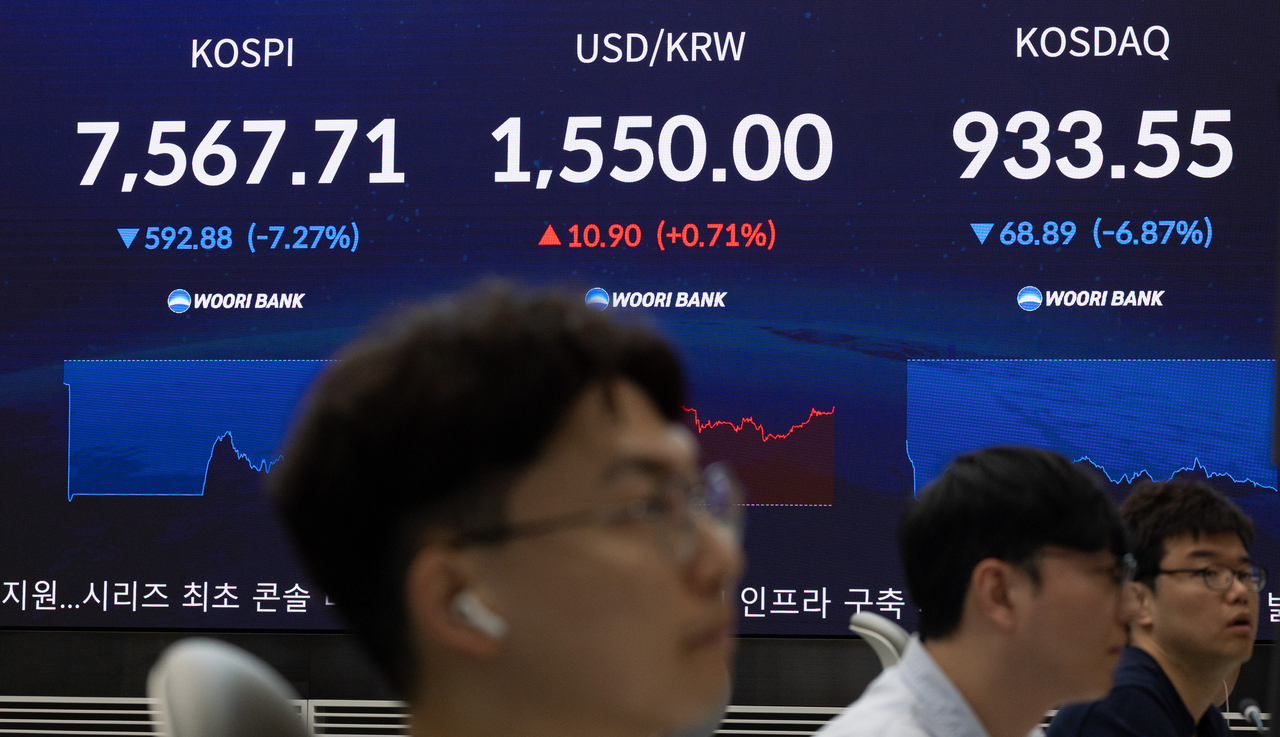
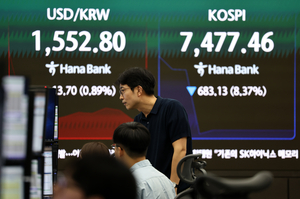
The won-dollar exchange rate has breached the psychologically critical 1,550-won threshold, sending a wave of anxiety through South Korea's financial sector. Large-scale equity sell-offs by foreign investors are deepening the won's weakness. With the Middle East conflict showing no sign of ending and expectations of further US interest rate hikes mounting, a growing number of analysts say the rate could climb all the way to 1,600 won.
The government has diagnosed the situation as an unprecedented high-exchange-rate shock not seen since the 2008 global financial crisis, attributing part of the surge to speculative trading that has amplified one-directional momentum, and has pledged to pursue market stabilization measures.
The won opened Monday's Seoul foreign exchange session at 1,555.2 won per dollar — the highest level in 17 years and three months — as authorities trained their sights on speculative currency trading.
Regulators have identified speculative foreign exchange transactions centered on the non-deliverable forward market as the primary driver of the won's recent sharp depreciation. In their view, exchange rate gains engineered in the NDF market have fed broader market expectations of further won weakness, eroding the currency's value. An NDF is a derivative instrument settled offshore on the difference between the contracted rate and the spot rate at maturity, without any actual exchange of currency. Because only a margin deposit is required, traders can take positions worth dozens of times the collateral — giving a relatively small amount of capital an outsized influence on the broader foreign exchange market.
At an emergency market review meeting chaired by Deputy Prime Minister and Minister of Finance and Economy Koo Yun-cheol on Sunday, participants agreed to develop measures to improve transparency in NDF trading and to bring NDF activity into the domestic foreign exchange market.
The authorities' push to extend domestic foreign exchange trading to 24 hours — part of a broader "won internationalization" drive — is also aimed at reducing the NDF market's influence by drawing opaque offshore transactions onshore to minimize speculative currency dealing. Whether round-the-clock market access would immediately stabilize the exchange rate remains uncertain, however, as thinner late-night trading volumes could amplify price volatility.
At the same time, authorities are expected to continue short-term measures to prevent excessive one-directional moves, including smoothing operations and national pension foreign exchange swaps. Smoothing operations involve the Bank of Korea selling dollars from its reserves and buying won, while the national pension swap arrangement allows the National Pension Service to source dollars directly from the central bank.
Because both measures draw on foreign exchange reserves to stabilize the rate, reserves could shrink further in the months ahead. According to the Bank of Korea, reserves fell $880 million from the previous month to $426.99 billion in May amid market stabilization efforts. Notably, even as overall reserves declined, cash-equivalent deposits rose $2.59 billion month-on-month — a move some observers interpreted as the authorities stockpiling additional ammunition for future market interventions.
Foreign exchange authorities reiterated their position Monday — as they had Sunday — through a joint statement issued under the names of Bank of Korea International Affairs Director Yoon Gyeong-su and Ministry of Finance and Economy International Finance Bureau Director Lee Hyeong-ryeol. The statement said they judged that "beyond supply-and-demand factors, some speculative foreign exchange transactions including NDF trading have amplified volatility."
They went on to warn that the authorities "will never tolerate excessive volatility and one-directional moves beyond what fundamentals justify, and will respond forcefully." The won-dollar rate trimmed some of its gains immediately after the verbal intervention but continued to hover in the 1,540-won range.
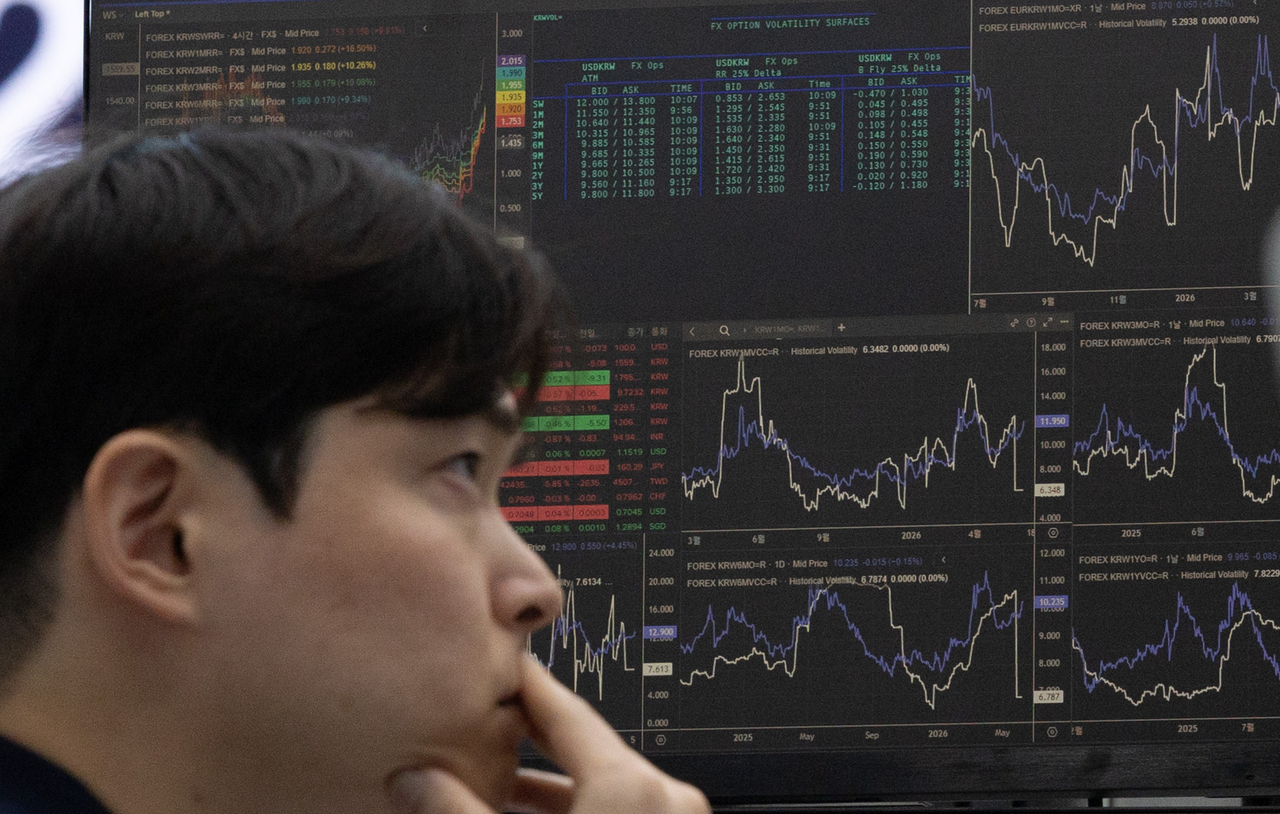
Major financial holding companies and banks are closely monitoring the impact on capital adequacy and liquidity as exchange rate pressure intensifies. Their most immediate challenge is defending capital soundness ratios: a weaker won inflates the won-denominated value of foreign currency assets, swelling risk-weighted assets and pushing capital ratios lower.
As a rule of thumb, every 10-won rise in the won-dollar rate shaves roughly 0.02 percentage points off a bank's common equity tier 1 ratio. Given that the rate has climbed nearly 70 won over the past month, CET1 ratios are estimated to have fallen by around 0.14 percentage points.
A rising exchange rate also tightens foreign currency liquidity, increasing banks' funding costs and weighing on their liquidity coverage ratio calculations.
By far the financial sector's biggest concern is the spillover into the real economy. Small and medium-sized export and import companies with limited capacity to hedge currency risk are seen as most vulnerable to a rapid deterioration in loan quality. Rising delinquency rates would inevitably translate into higher non-performing loans and heavier provisioning burdens for banks.
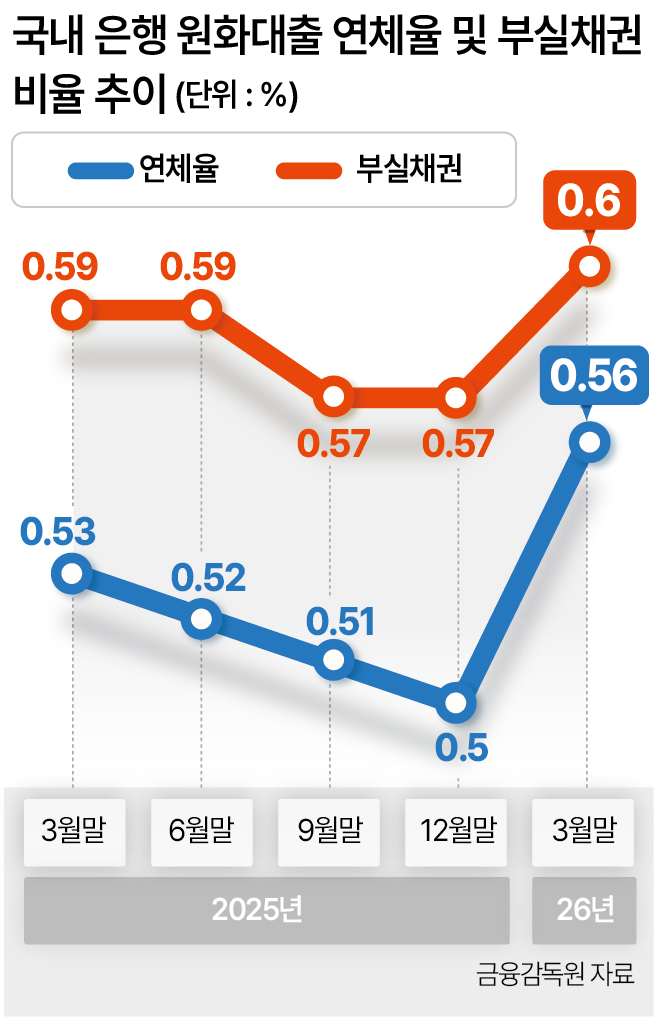
Loan quality has already deteriorated sharply after a prolonged economic slowdown. According to the Financial Supervisory Service, the non-performing loan ratio at domestic banks stood at 0.6 percent as of end-March — the first time it had entered that range since March 2021 — after bad-loan balances grew by more than 1 trillion won (approximately $648 million) in three months. The delinquency rate also hit 0.56 percent in the same period, the highest for that month since 2016 (0.63 percent).
"What matters far more than whether the rate crosses a particular level is how much damage it does to the real economy," a commercial bank official said. "If the impact spreads to the real economy or delinquency rates among small and medium-sized enterprises start rising, the effect on banks will be very significant."
Banks are scrutinizing their soundness indicators and focusing closely on how the rising exchange rate is affecting the real economy. They are particularly working to identify export and import companies in sectors most exposed to currency swings and analyzing the risk implications for individual borrowers.
Foreign currency positions are being managed with an emphasis on hedging. Banks say their internal guidelines on buy and sell positions limit their exposure to exchange-rate losses even amid a sharp won depreciation. "What worries us is not so much the level of the exchange rate as the speed at which it is rising," another commercial bank official said.
Adding to the concern, some banks have begun moving to raise lending rates, a development likely to deepen fears of a real-economy slowdown.
KB Kookmin Bank on Monday cut the preferential rate on its variable-rate non-face-to-face mortgage product by 0.20 percentage points, effectively raising the rate charged to customers. The ceiling rate on its "KB Star Apartment Mortgage Loan II" product was adjusted from 4.92 percent to 5.12 percent per annum. NH NongHyup Bank had already raised rates on its five-year fixed and six-month variable mortgage products by 0.2 percentage points effective June 1.
The moves are widely read as an effort to keep loan growth at manageable levels. With the Bank of Korea signaling a benchmark interest rate hike, upward pressure on market rates broadly is expected to persist, and borrowers' interest burdens look set to grow for now.
Experts agreed that the recent sharp rise in the exchange rate reflects a confluence of geopolitical risk in the Middle East and fears of further US monetary policy tightening. Iran's retaliatory missile strike over the weekend, they said, is stoking international oil prices and import costs, feeding US inflation and adding to pressure for higher US interest rates.
Structural domestic factors are also pushing the exchange rate higher. Analysts warned that if the US AI bubble bursts and the semiconductor cycle turns down, the South Korean economy could deteriorate sharply.
"Upward pressure is persisting and the rate could reach 1,600 won," said Kim Jeong-sik, an emeritus professor of economics at Yonsei University. "Domestic factors are substantial, US interest rates are rising, and oil prices could remain elevated for an extended period."
Ahn Dong-hyun, a professor of economics at Seoul National University, warned that if the Middle East situation does not calm down this week, the 1,550-won level is likely to be breached. Park Tae-hyeong, head of the TCE Signature Center private banking branch at Woori Bank, said volatility will inevitably remain elevated through mid-June.
A concern experts share across the board is the authorities' capacity to defend the won. With foreign exchange reserves threatening to fall below the $400 billion mark, critics say the government lacks the firepower to intervene effectively in the market.
"Normally, authorities can hold the line by intervening through reserves, but they cannot let reserves fall below $400 billion, which leaves very little room to act," Professor Kim said. "There is a risk that speculative forces, sensing the lack of ammunition, will move in."
With traditional policy tools such as interest rate hikes and fiscal spending cuts also off the table given fears of a domestic demand slump, some analysts say the only remaining option is to hope for the conclusion of a Korea-US currency swap agreement.
The won-dollar rate opened Monday's weekly session at 1,555.2 won — up 16.1 won from the previous session — marking its highest level since the global financial crisis.
ehkim@heraldcorp.com
kimstar@heraldcorp.com
hyuk@heraldcorp.com
won@heraldcorp.com