Workers advised to avoid non-essential trips to DRC and other high-risk areas; remote work and paid leave recommended to prevent workplace spread
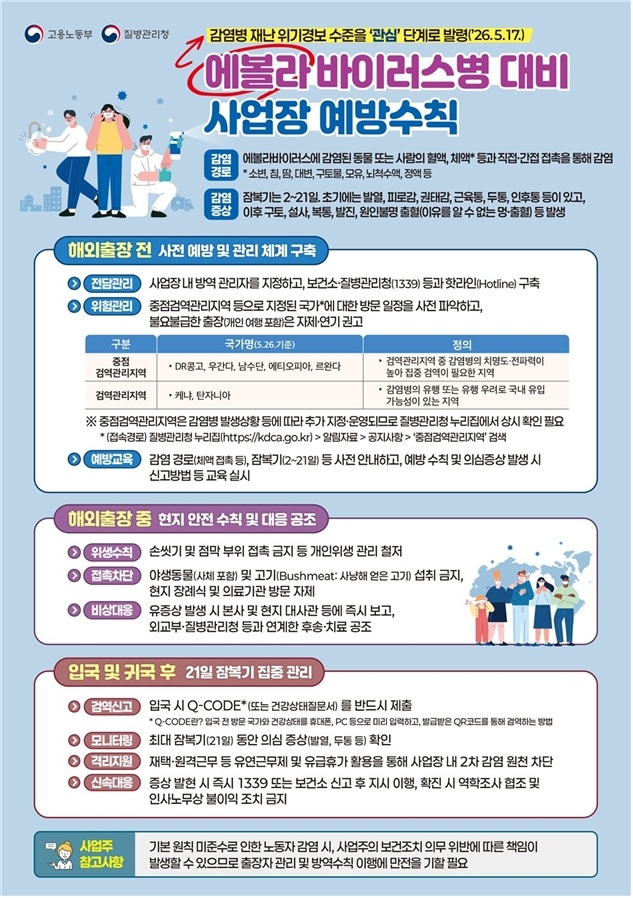
South Korea's Ministry of Employment and Labor has drawn up workplace prevention guidelines for Ebola virus disease and will distribute them to businesses nationwide, as the virus continues to spread in parts of Africa. The move aims to strengthen worker health protections and infection-response systems, particularly at companies whose employees travel abroad frequently.
The ministry said Monday it had developed the "Workplace Prevention Guidelines for Ebola Virus Disease" in consultation with the Korea Disease Control and Prevention Agency. The guidelines were prompted by discussions at a KDCA-led overseas infectious disease assessment meeting held May 28. They focus on clarifying employers' legal obligations to take health measures for workers traveling abroad and on establishing coordination channels with relevant authorities in the event of an outbreak.
Under the guidelines, employers must designate an infection-control officer before any overseas business trip and set up emergency contact lines with the KDCA (1339) and local public health centers. Employers are also advised to avoid or postpone non-essential travel to high-priority quarantine management zones, including the Democratic Republic of the Congo.
During overseas stays, workers must strictly follow personal hygiene practices such as handwashing and avoid contact with wild animals or carcasses. If symptoms such as fever appear while abroad, workers must immediately notify their head office and the nearest South Korean embassy, then coordinate with relevant authorities to arrange evacuation and treatment.
After returning to South Korea, workers face intensive monitoring for 21 days — the maximum incubation period for the virus. Travelers must declare their overseas itinerary upon entry and monitor themselves for symptoms including fever. Employers are urged to make full use of flexible work arrangements, such as remote work or paid leave, during this period to prevent secondary infections in the workplace.
The ministry also specified in the guidelines that employers who neglect their legal duty to take preventive health measures could be held liable if an infection occurs as a result.
Ryu Hyeon-cheol, head of the ministry's Occupational Safety and Health Bureau and a specialist in occupational and environmental medicine, said Ebola's high fatality rate and strong transmissibility made thorough advance preparation by workplaces essential. "The health of workers on overseas assignments is directly tied to a company's competitiveness," he said. "Please rigorously follow every step of the process — from pre-departure training to 21 days of monitoring after returning home."
fact0514@heraldcorp.com