Supply chain crisis response, tangible results for citizens and businesses
From crisis management to policy design — finding solutions on the ground
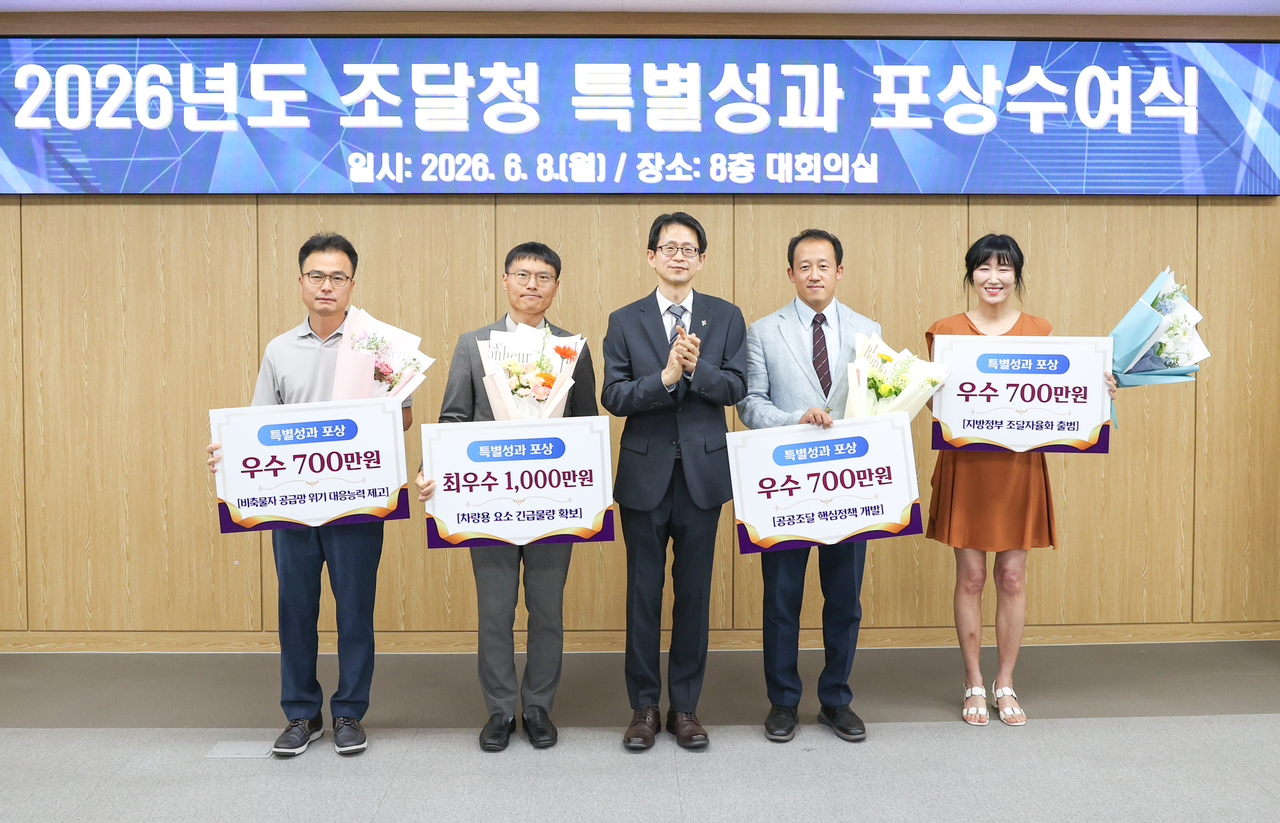
The Public Procurement Service recognized staff members whose work on supply chain crises delivered tangible results for citizens and businesses.
The agency on Monday presented special performance bonuses totaling 31 million won (about $20,100) to four employees who tackled pressing challenges in public procurement and contributed to the national economy and business activity.
The top prize of 10 million won went to Deputy Director Shin Bong-gi, who traveled to Vietnam and negotiated directly with local manufacturers to secure an emergency supply of automotive-grade urea. Three employees received the excellence award of 7 million won each: Deputy Director Kim Gwang-hwan, who helped ease corporate supply pressures by timely stockpiling and releasing raw materials such as aluminum and automotive urea affected by the war in the Middle East; Section Chief Kim Sung-hwan, who led the development of core procurement policies aligned with national policy priorities; and Senior Deputy Director Jeong Hwa-yeon, who helped lay the groundwork for greater procurement autonomy for local governments.
Shin secured a stable supply line by going directly to Vietnamese manufacturers at a time when countries around the world were competing fiercely to obtain urea.
After war broke out in the Middle East — a key alternative source of automotive urea to China — Japan, Australia and other countries rushed to compete for Vietnamese urea supplies. Shin traveled to Vietnam in person and negotiated unit prices and shipping terms with three local manufacturers, securing more than two months' worth of supply despite the intense competition and moving the shipment schedule up by a month, significantly stabilizing the urea solution market.
Kim Gwang-hwan moved quickly after the outbreak of the Middle East war to conclude supply contracts for key raw materials including aluminum, expanding stockpiles and releasing them to small and medium-sized enterprises at the right time, serving as a lifeline for manufacturing operations. He concluded supply contracts early for heavily import-dependent materials such as aluminum, rapidly building up reserves. He also maintained regular communication with urea solution producers to monitor inventory levels and production difficulties, facilitated transactions between companies with surplus stock and those facing shortages, and released stockpiled materials to smaller firms in a timely manner to help them produce and sell urea solution without disruption.
Kim Sung-hwan led the development of key policies that went beyond the existing procurement framework to strengthen the self-sufficiency of companies outside the greater Seoul area and position the government as a catalyst for the early AI market, supporting the country's growth strategy. He redesigned the basic structure of support programs to directly benefit companies in regions facing population decline and outside the metropolitan area, carefully crafting measures to expand their access to the procurement market, provide preferential evaluation treatment, and open domestic and overseas sales channels. He also developed a plan to promote the AI industry through government priority purchasing of AI products and services, helping strengthen the foundation for nurturing future strategic industries.
Jeong Hwa-yeon visited procurement sites across the country and persistently engaged local governments and procurement companies to lay the groundwork for local government procurement autonomy, a long-standing challenge. Over three months, she traveled nationwide to gather input from more than 400 procurement companies and over 200 demand agencies, carefully documenting field-level needs and concerns. Drawing on that work, she built the institutional foundation for local governments to choose procurement methods suited to their regional circumstances and needs.
Public Procurement Service Commissioner Baek Seung-bo said public procurement is "field administration that requires accurately reading the situation on the ground and continuously correcting unreasonable systems, procedures and practices." He added that the agency would "continue to fairly evaluate and generously reward employees who go the extra mile to find solutions under difficult conditions, fostering an active and creative work environment."
kwonhl@heraldcorp.com