Forum on US-China summit and Korean Peninsula peace strategy
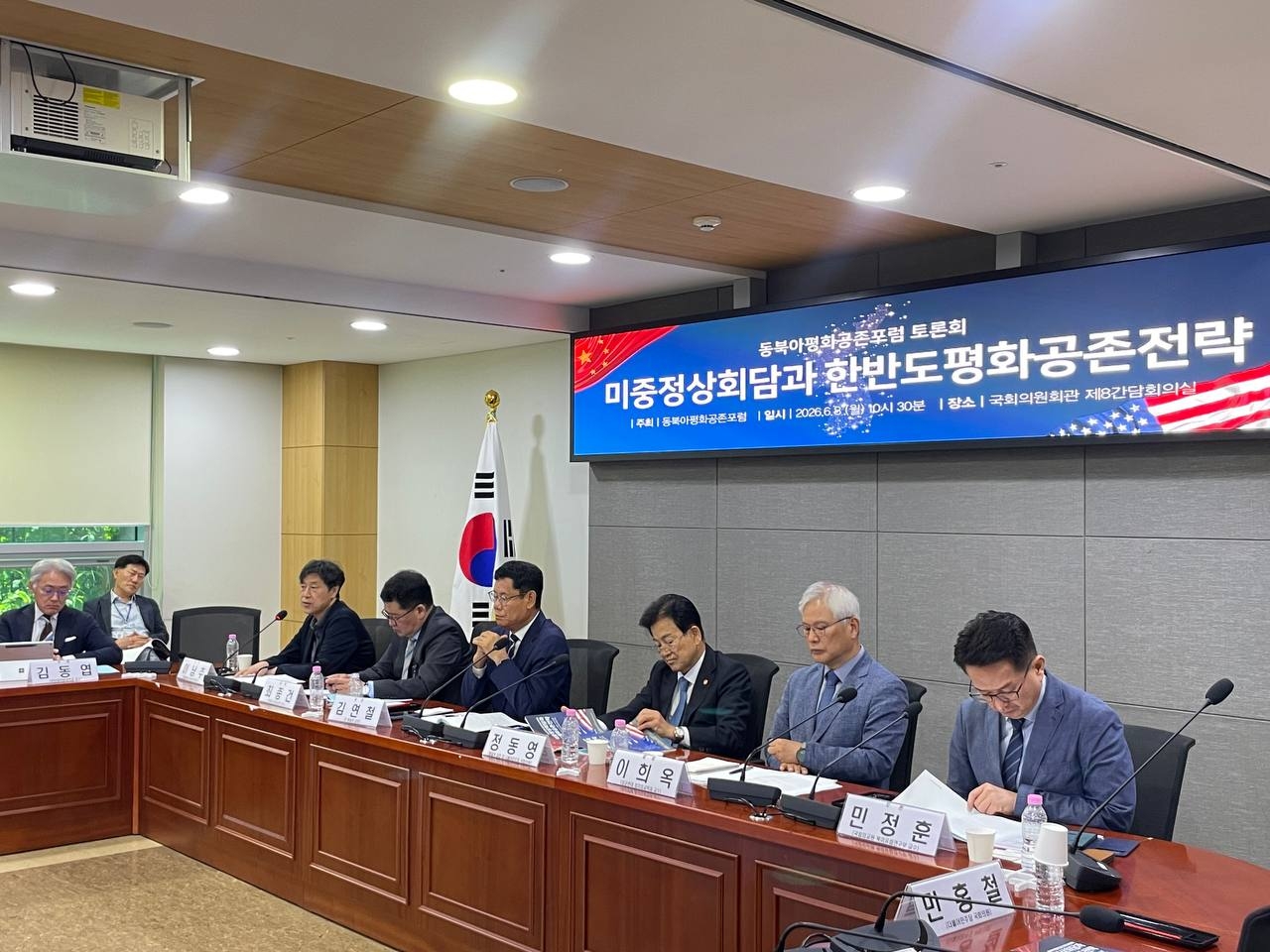
The Northeast Asia Peace Coexistence Forum, a National Assembly research group led by Democratic Party of Korea lawmaker Jeong Dong-young, who also serves as unification minister, held a forum Monday at the National Assembly Members' Office Building on the theme of "The US-China Summit and a Korean Peninsula Peace Coexistence Strategy."
Participants included Jeong, in his capacity as both unification minister and forum chair, and fellow Democratic Party lawmaker Lee Jeong-heon, a member of the National Assembly's Science, Technology, Information, Broadcasting and Communications Committee.
The forum was convened to assess last month's US-China summit and the subsequent China-Russia summit, analyze their implications for peace and coexistence on the Korean Peninsula, and explore strategic options for the Lee Jae Myung government's Korean Peninsula policy.
In his opening remarks, Jeong said Xi Jinping's reference to the "Thucydides Trap" reflected the intensity of strategic competition between the United States and China. "Because the Korean Peninsula sits at the center of that US-China rivalry, we must watch it closely, hold firm to our own principles, and navigate the obstacles pragmatically," he said.
He added that a thorough analysis was needed of what Xi's visit to North Korea on Monday would produce for Korean Peninsula peace and coexistence.
Lee Hee-ok, a professor of political science and diplomacy at Sungkyunkwan University who delivered the keynote, said the US-China summit showed that "the default settings of the bilateral relationship are shifting — not because of China's success, but because of America's failure." He warned that developments following the summit could contribute to stability on the peninsula if they built momentum for Korean Peninsula peace, but that "if the Korean Peninsula issue is treated as a dependent variable of US-China relations, there is a risk of Korea being sidelined." He also said South Korea should anticipate a prolonged lull in inter-Korean relations, accept that gap as a reality, and use it as a period of preparation.
Choi Jong-gun, a professor of political science and diplomacy at Yonsei University who co-presented, said the Beijing talks "did not stabilize US-China relations — they began managing the instability." While the Korean Peninsula could be among the issues subject to that management, he cautioned, South Korea would not automatically be among those doing the managing. "If we have no strategy of our own, the Korean Peninsula will simply become one item on the G2's agenda again," he said.
Lee Nam-joo, a professor of Chinese studies at Sungkonghoe University, said the United States and China are currently focused on managing their bilateral relationship through small deals rather than a grand bargain, and that relative stability in Northeast Asia could follow from a more stable US-China relationship. On North Korea's posture of treating inter-Korean ties as a relationship between two hostile states, he said South Korea could work to shift that adversarial dynamic toward a managed or cooperative one, and use the two-state framework to its advantage in developing inter-Korean relations.
Min Jeong-hun, a professor at the Korea National Diplomatic Academy's North America and Europe Studies Division, forecast that US-China relations would broadly hold their current course under a framework of "competitive coexistence," with both sides focused on managing economic and trade ties. He said the summit had raised international expectations for China to play a more active role on major global issues, including the war involving Iran and the Korean Peninsula question. He recommended that the South Korean government establish a clear strategic position between Washington and Beijing grounded in "national-interest-centered pragmatic diplomacy," and work to encourage China to engage more actively on the North Korea issue on the basis of a proposed four-way negotiation framework involving South Korea, North Korea, the United States and China.
Kim Dong-yeop, a professor at the University of North Korean Studies, said stability in US-China relations does not automatically translate into peace on the Korean Peninsula, noting that great-power stability can operate by keeping regional problems "at a manageable level." South Korea's strategic autonomy had become all the more important as a result, he said.
bigroot@heraldcorp.com