![The SpaceX logo. [Reuters]](https://wimg.heraldcorp.com/news/cms/2026/06/09/news-p.v1.20260609.afef0abc9d7b4c8b9aa1eeaa75939db2_P1.jpg)
SpaceX's upcoming initial public offering is drawing attention to the possibility of a capital shift away from US technology stocks. Analysts warn that if unlisted AI companies such as OpenAI and Anthropic begin trading directly on public markets, the flow of money that has poured into semiconductor stocks as a proxy bet on AI growth could change course. In South Korea's market, where large-cap semiconductor names like Samsung Electronics and SK Hynix have attracted outsized concentration, observers say intraday volatility in related ETFs and individual share prices could intensify.
Industry analysts on Tuesday flagged SpaceX's Nasdaq debut, set for Friday, as a potential trigger for capital rotation within US technology stocks. The listing is seen as more than just one space company entering the market — it is also stoking expectations that major unlisted AI firms, including OpenAI and Anthropic, could follow with their own listings. As AI companies that investors could not previously buy on public exchanges begin emerging as listing candidates one by one, analysts say money flowing into related semiconductor stocks could be redirected.
OpenAI and Anthropic have until now helped lift the share prices of related stocks. Because both remain private and unavailable to ordinary investors on public exchanges, those investors have instead bought shares in companies that make the chips these AI firms use or that sit within their supply chains — effectively betting on AI growth through the semiconductor sector. But if OpenAI and Anthropic list directly, that dynamic could shift. With AI company shares available to buy outright, the rationale for investing through semiconductor proxies weakens.
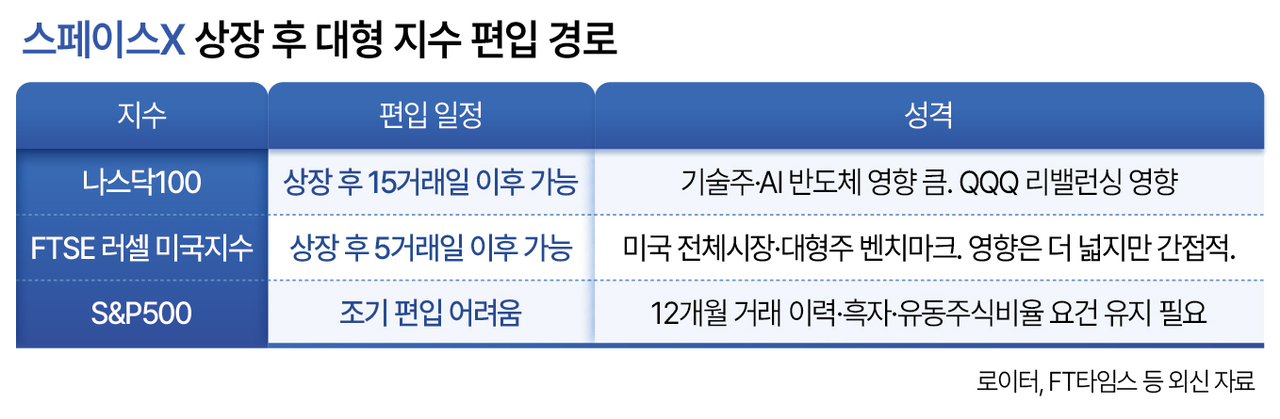
Index inclusion schedules could amplify capital rotation within US technology stocks. The Nasdaq 100 has relaxed its rules to allow large IPOs to join the index as soon as 15 trading days after listing. The FTSE Russell US indexes have introduced a similar regime, permitting qualifying large IPOs to be added just five trading days after their debut. If SpaceX gains early entry into major indexes, ETFs tracking those indexes will need to buy SpaceX shares while trimming existing holdings. That rebalancing is more likely to play out through the Nasdaq 100 and FTSE Russell US indexes than through the S&P 500.
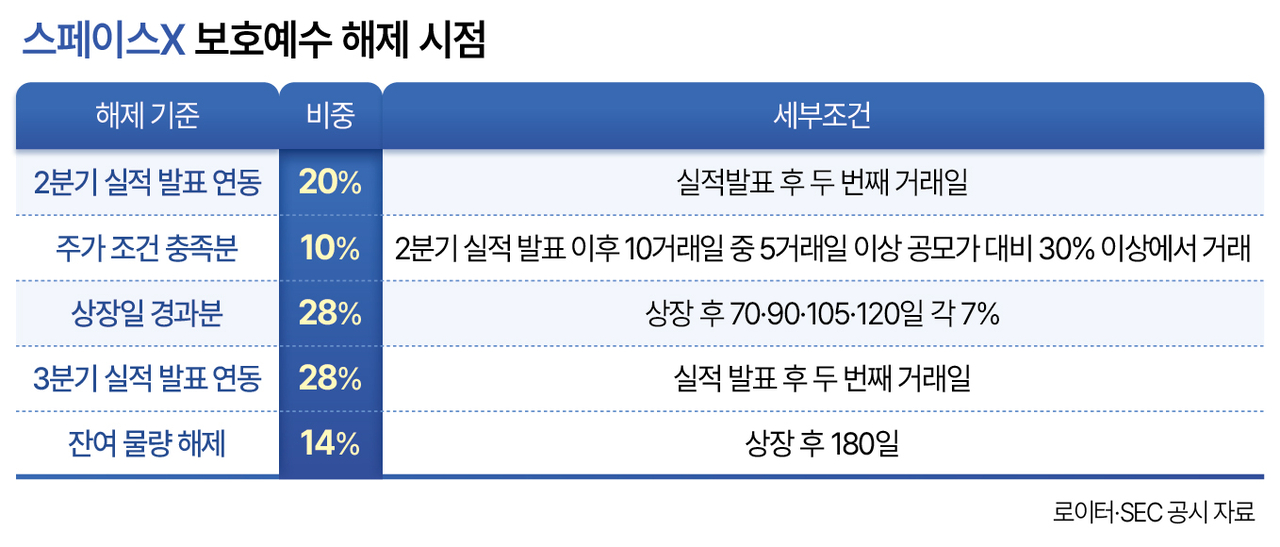
SpaceX's low initial float could amplify the index-inclusion effect further. Only about 4 percent of total shares are expected to reach the market immediately after listing. If early index inclusion materializes, ETFs will need to absorb a large volume of shares against a thin supply, which could drive sharp price swings. Once lock-up periods expire and more shares become freely tradable, the added supply could weigh on the share price.
In South Korea's market, the movements of Samsung Electronics and SK Hynix warrant close attention. Large-cap semiconductor stocks, including both companies, played a significant role in pushing Kospi toward the 9,000 threshold in recent sessions. AI semiconductor ETFs holding Samsung Electronics and SK Hynix — along with single-stock leveraged and inverse ETFs — have also been listed in succession. If US AI semiconductor stocks come under pressure, South Korean investors could trade related ETFs more reactively, and that activity could in turn amplify price swings in Samsung Electronics and SK Hynix.
Some market participants in South Korea view the SpaceX listing as a short-term alert factor on top of existing market leaders. Lee Sang-jun, a researcher at NH Investment, said in a recent weekly outlook that "with SpaceX's Nasdaq listing scheduled for Friday, concerns about capital outflows from existing leading stocks could emerge from a supply-demand perspective."
Within Kospi, analysts also flag the heavy concentration in semiconductor and AI value-chain stocks as a potential driver of near-term volatility. Lee Gyeong-min, a researcher at Daeshin Securities, said that "ahead of the SpaceX listing on Friday, global liquidity will inevitably concentrate in the United States, and on Thursday the simultaneous expiration of futures and options could also expand the influence of derivatives on supply and demand." He added that "in a situation where an unusual degree of concentration has persisted, AI value-chain stocks that have led Kospi's level-up — including semiconductors, IT hardware and home appliances — could sit at the center of heightened volatility."
However, it is difficult to read the SpaceX listing as a direct shock to Samsung Electronics and SK Hynix. Although SpaceX's IPO demand has reportedly reached around $150 billion — roughly twice the offering size — that capital does not flow directly out of South Korean semiconductor stocks. Given the market capitalization of Samsung Electronics and SK Hynix and the scale of global semiconductor investment, the SpaceX listing alone is unlikely to determine the trajectory of either stock. Instead, analysts expect it to act as an external variable that could amplify intraday volatility within the AI and semiconductor-heavy market environment.
kacew@heraldcorp.com