US CPI beat, AI funding fears weigh on sentiment
Forward PBR nears long-term average at 1.05x
Analysts eye 5,300 as key support level
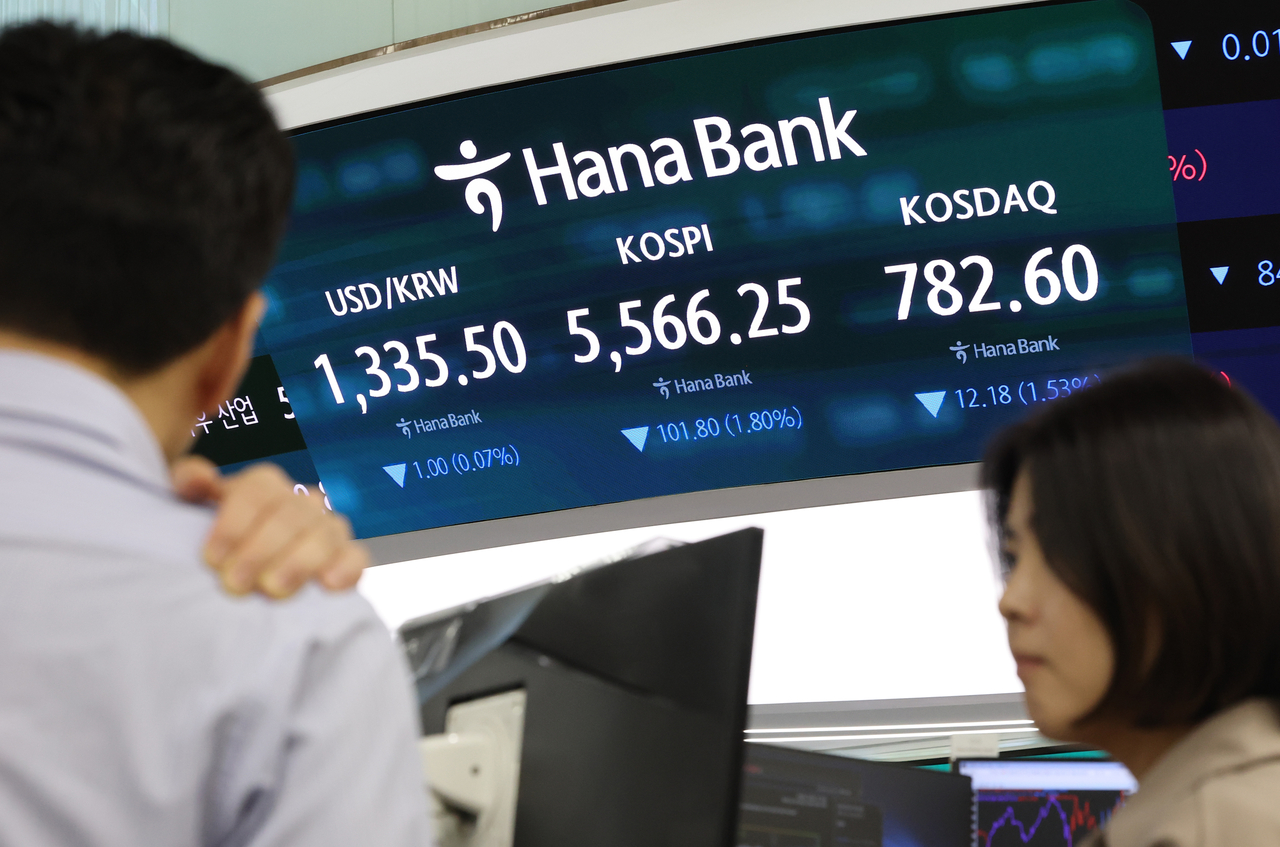
A chill from the US technology sector sent the Kospi tumbling more than 3% at Monday's open, pushing the benchmark below the 5,500 mark for the first time in roughly six months. Samsung Electronics and SK hynix also opened at their lowest levels since April, freezing investor sentiment across semiconductor stocks. Buying by institutions and foreign investors trimmed early losses, but renewed concerns over AI overinvestment and funding pressures kept the domestic market under significant strain.
As of 10 a.m. Monday, the Kospi was trading at 5,569.79, down 1.73 percent, or 98.26 points, from the previous session, according to Korea Exchange. The opening print of 5,488.41 was the lowest since Feb. 13.
At the same time, Samsung Electronics was trading at 212,500 won ($158), down 1.39 percent from its previous close, while SK hynix was down 4.25 percent at 1.218 million won.
The opening prices for both Samsung Electronics and SK hynix were the lowest in roughly six months — since April 14 and April 23, respectively. The two stocks were pushed down as much as 4 percent and 5 percent in early trade, amplifying downward pressure on the broader market. Samsung Electronics opened at 207,000 won, off 3.94 percent, and SK hynix at 1.212 million won, off 4.72 percent, before both pared losses during the session.
Retail selling led the early decline. Individual investors, who had driven the domestic market's rally since the start of the year, were net sellers on Monday. As of 10 a.m., retail investors had net sold approximately 400 billion won worth of Kospi shares. The pattern of bargain-hunting that had persisted even after the Kospi broke below 7,000 earlier this month appeared to have faded.
Foreign investors, who had been slight net buyers in early trade, also turned to net selling of about 5 billion won. They had snapped an eight-session net-selling streak — the longest in more than two years, surpassing the seven-session run from Sept. 3 to Sept. 11, 2024 — by turning net buyers on Friday. But they resumed selling after just one session, and no clear directional signal, such as a trillion-won-scale net buying surge, has emerged. Institutions were the sole buyers, continuing to accumulate shares worth roughly 300 billion won.
Monday's sharp drop extended a global semiconductor selloff that began last week. The Kospi fell 14.5 percent from Oct. 12 through Friday, with Samsung Electronics and SK hynix declining 17.7 percent and 24.3 percent, respectively, over the same period. Thursday's 7.57 percent plunge in the Kospi, followed by further weakness in US semiconductor stocks, has limited the technical rebound buying that would normally follow such a steep decline.
Han Ji-young, a researcher at Kiwoom Securities, attributed the weak open to the US September consumer price index coming in above consensus and a simultaneous sharp drop in US AI infrastructure stocks exposed to profitability concerns. "After seven consecutive sessions of sharp declines, some technical buying has come in to trim losses," Han said. "There is a possibility of a rebound as the market digests TSMC's earnings results, due to be released later in the session."
Some analysts said the Kospi could find support around the 5,300 level amid the continued selloff. The index's 12-month forward price-to-book ratio has fallen to 1.05 times, approaching its long-term average of 0.99 times since 2010, while the projected return on equity for 2026 stands at 28 percent — well above the historical average of 8 percent. Analysts said that if corporate earnings power holds, the current level could represent a medium- to long-term buying opportunity.
Kim Du-eon, a researcher at Hana Securities, said the Kospi's 12-month forward PBR was nearing its long-term average, with the index level corresponding to a PBR of 1.0 times based on projected net assets at around 5,150 points. "If earnings forecasts and net asset values hold, the valuation compression from the recent price decline could serve as a medium-term investment case," Kim said. He added, however, that 5,300 points remains a support-level projection, and investors should watch whether foreign spot buying continues and whether margin-related selling pressure eases.

kacew@heraldcorp.com