A patient walks into the hospital on their own two feet in the morning — and comes home cold by the afternoon. For the family, it makes no sense.
So they begin a fight that seems nearly impossible to win. They cash out savings accounts and sell their homes to fund one question: why did this happen? But proving a medical institution's liability is extraordinarily difficult for patients and their families. The reason is a fundamental asymmetry of information.
In South Korea, medical disputes are handled primarily through two channels: mediation and arbitration via the Korea Medical Dispute Mediation and Arbitration Agency, which receives an annual average of roughly 2,100 cases, and civil litigation, which accounts for an annual average of roughly 1,000 cases, according to research from the Korea Insurance Research Institute. Each year, more than 3,000 medical disputes play out like a battle between David and Goliath.
The Herald Business, in partnership with law firm O'Kims, analyzes medical dispute rulings to explore how David can beat Goliath — and how patients and their families can survive the Medical Survival Game. The series runs twice a month, on alternating Tuesdays. [Editor's note]
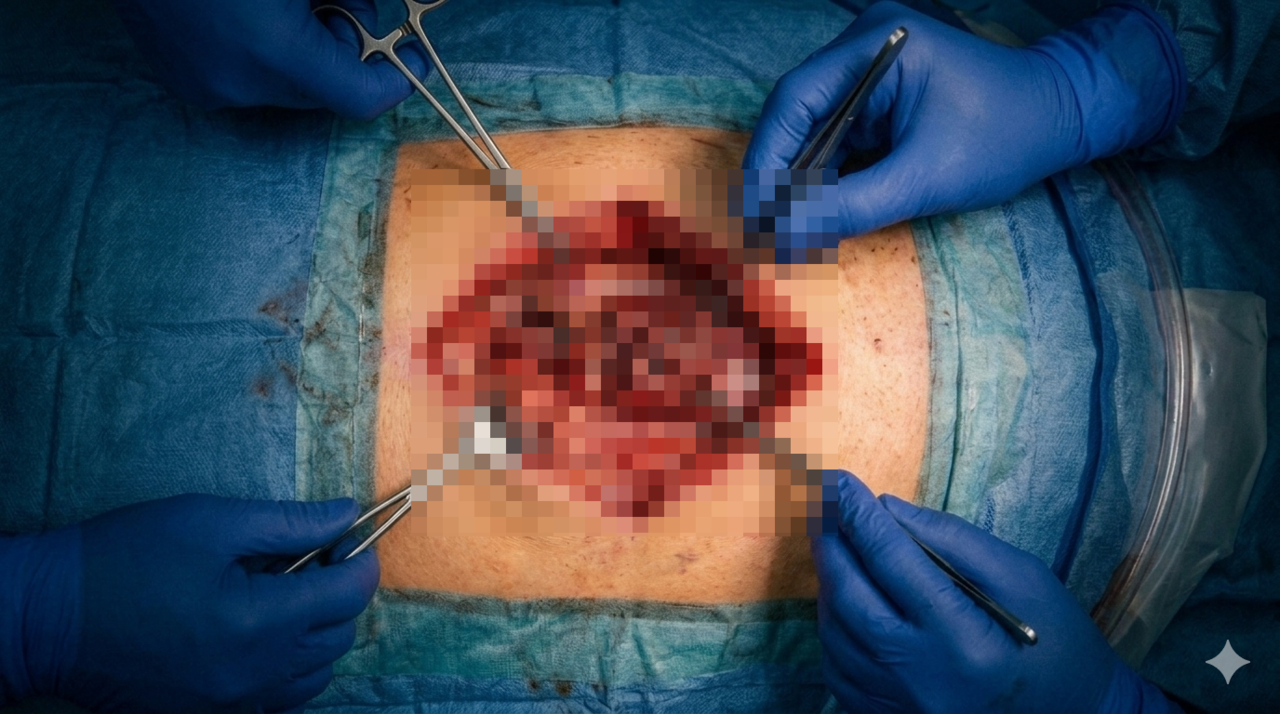
The outcome of a mediastinal tumor removal surgery was devastating. An operation meant to eliminate pain instead caused nerve damage — leaving the patient to live with chronic pain for the rest of his life.
The ordeal began in September 2014. A patient identified as A had been moving between hospital emergency rooms with pain in his left chest, and was eventually admitted to Chonnam National University Hospital after the pain kept recurring. With painkillers and other treatments failing to bring relief, the hospital performed a tumor removal surgery on Sept. 18 of that year.
What followed was the real problem. The pain did not stop after the surgery. A was transferred to another hospital but continued to report chest pain at outpatient visits to Chonnam National University Hospital. His attending physician, identified as B, attributed the pain to a common complication following open-chest surgery.
The pain persisted through the end of 2014, and A underwent coordinated treatment involving a pain clinic, dermatology and orthopedics for pain management until he was discharged on Jan. 1 of the following year.
Rather than subsiding, the pain spread — and A developed hyperhidrosis on the right side of his body. He was repeatedly hospitalized and discharged. During this period, he experienced pain radiating from the pit of his stomach to his left back, an absence of sweating on the left side of his face and upper body, and abnormally excessive sweating on the opposite side.
In September 2015, Asan Medical Center diagnosed A with suspected complex regional pain syndrome type 1. The condition is a rare chronic pain disorder in which the nervous system malfunctions after trauma or surgery — the wound heals, but severe pain persists.
A must now live with pain rated at around 4 on the visual analog scale, as well as pain from neuropathy of the left intercostal nerve, for the rest of his life.
The visual analog scale is a tool doctors use to quantify a patient's pain from 0 (no pain) to 10 (the worst imaginable pain). A score of 4 represents moderate pain — the kind that is distracting during daily activities and feels like a throbbing ache, comparable to a mild toothache, menstrual cramps or a persistent headache.
Neuropathy of the left intercostal nerve means that the nerve running between the left ribs was damaged during surgery and is now misfiring, causing ongoing pain.
Patient claims surgeons severed a nerve that should have been spared
Accepting a lifetime of pain is hard enough. It becomes even harder when the suffering feels like the direct result of a medical team's mistake.
A filed a damages claim of approximately 300 million won ($194,000) against Chonnam National University Hospital, alleging that surgeons had damaged a sympathetic nerve that should not have been cut.
He argued that the hospital had given no explanation about the risk of sympathetic nerve damage before the surgery, that it had simply dismissed the new pain and abnormal sweating that appeared after the operation as routine aftereffects, and that it had failed to make adequate efforts to identify the underlying cause.
In essence, A challenged the hospital on two grounds: a failure to exercise due care during the surgery, and a failure to fulfill its duty to inform the patient.
Court rejects all of patient's claims — what the ruling said
The court ruled against A on every count. The 12th Civil Division of the Seoul Western District Court, presided over by Judge Lee Won-shin, rejected all three of A's claims: negligence in performing the surgery, delayed diagnosis and treatment of complex regional pain syndrome, and failure to fulfill the duty of informed consent.
On the first claim, the court found that A's final diagnosis was a hemangioma and that the tumor removal surgery had been appropriate.
The court acknowledged that "there is room to suspect that A's abnormal sweating was caused by severance of the sympathetic nerve," given that aftereffects of such severance include abnormal sweating and ptosis of the eyelid. However, it held that "abnormal sweating alone is not sufficient to conclude that the sympathetic nerve was severed."
The court added that "the tumor was located close to the sympathetic ganglion, creating a situation in which the sympathetic nerve could be inadvertently severed during the procedure," and that "even if attending physician B damaged the sympathetic nerve while removing the tumor, it is difficult to conclude that this constitutes medical negligence."
The court reached the same conclusion on the claim of delayed diagnosis and treatment of complex regional pain syndrome. While timely pain management after the onset of the condition is important, the court noted that the surgical incision site itself is an area where the pain nervous system sustains significant damage and stimulation — making severe post-operative pain a normal finding.
The court also took into account that Chonnam National University Hospital had installed a patient-controlled analgesia device in the operating room, administered a combination of narcotic analgesics and anti-inflammatory painkillers after surgery, and arranged for readmission and coordinated specialist treatment. It found the hospital's response to have been appropriate.
The court also declined to find a violation of the duty of informed consent. It ruled that the hospital had explained the potential complications, aftereffects and risk of nerve damage that could arise during surgery, and that because it could not be established that A's sympathetic nerve had been severed — or that his pain was necessarily caused by sympathetic nerve damage — no duty to provide such specific disclosure had existed.
Jo Jin-seok: 'Ruling consistent with precedent — supporting evidence is key'
![Attorney Jo Jin-seok of law firm O'Kims [O'Kims]](https://wimg.heraldcorp.com/news/cms/2026/06/09/news-p.v1.20260609.0fb1c3bfbe3b43f4ae04cd3452bab8b2_P1.jpg)
Jo Jin-seok, an attorney at law firm O'Kims, said the ruling was consistent with the established judicial approach of distinguishing between outcomes caused by medical negligence and those that are unavoidable complications. He said the court's finding that sympathetic nerve damage could occur unexpectedly, given the tumor's location and characteristics, reflects the general stance seen in existing precedent.
Jo said additional factors in the court's reasoning included the fact that the cause of complex regional pain syndrome has not been clearly established at the current level of medical knowledge, and that the condition can develop independently of any medical negligence.
He identified the keys to litigation in similar cases as demonstrating, through medical review, whether the sympathetic nerve could have been preserved, and proving the risk of sympathetic nerve damage and its potential aftereffects before surgery. The evidence supporting a claim, he said, is what matters most.
He also predicted that the ruling could serve as a significant reference precedent in similar medical dispute cases.
"Given the tumor's location, size and anatomical relationship to surrounding structures, it is necessary to conduct a medical review of whether the sympathetic nerve could have been preserved," Jo said. "Through that process, it must be demonstrated — through specific arguments and evidence — that the nerve damage was not an unavoidable outcome but the result of a preventable error."
On the failure to inform, he added: "It must be thoroughly demonstrated whether the patient received a specific explanation before surgery about the risk of sympathetic nerve damage and the potential aftereffects, including abnormal sweating and persistent pain."
"This ruling strictly evaluated whether nerve damage that can inevitably occur during surgery should be distinguished from damage caused by negligence, and whether the medical team was at fault for delayed diagnosis and treatment of complex regional pain syndrome — a condition whose cause remains unclear," Jo said. "It will serve as a key reference precedent in similar medical disputes."
Meanwhile, A, who pursued the case with the help of a medical specialist attorney, is understood to have reached a damages settlement with Chonnam National University Hospital after the unfavorable ruling.
ko@heraldcorp.com