
![Employees work at the dealing room of Hana Bank's headquarters in Jung-gu, Seoul, on Wednesday. The Kospi opened down 197.16 points, or 2.43 percent, at 7,899.77 that day. [Yonhap]](https://wimg.heraldcorp.com/news/cms/2026/06/10/rcv.YNA.20260610.PYH2026061004000001300_P1.jpg)
On Tuesday, as the Kospi staged a sharp rebound of more than 8 percent after the previous session's steep selloff, South Korea's so-called "fear index" soared to an all-time high. The index climbed, yet the options market was pricing in a growing likelihood of large swings in either direction.
The KOSPI 200 Volatility Index, known as the VKOSPI, closed at 91.23 on Tuesday, up 19.04 percent from the previous session, according to Korea Exchange — a record not only since the index's official launch but also above the retroactively calculated peak of 89.30 reached during the 2008 global financial crisis on Oct. 29 of that year.
Commonly called the "fear index," the VKOSPI translates the market's expected price swings into a single number. It is calculated from KOSPI 200 options prices. Options are contracts giving holders the right to buy or sell an index at a predetermined price, and their value rises as the likelihood of large market moves increases. For investors, options function as a form of insurance against sharp share price swings, so their prices reflect market participants' expectations for future volatility. The VKOSPI converts that implied volatility into an index.
Comparing this year's trend with the United States and Japan highlights how acute South Korea's volatility stress has become. The US has the VIX, derived from S&P 500 options prices, while Japan has the Nikkei 225 VI, based on Nikkei 225 options. Each serves as the benchmark measure of expected future volatility for its respective market.
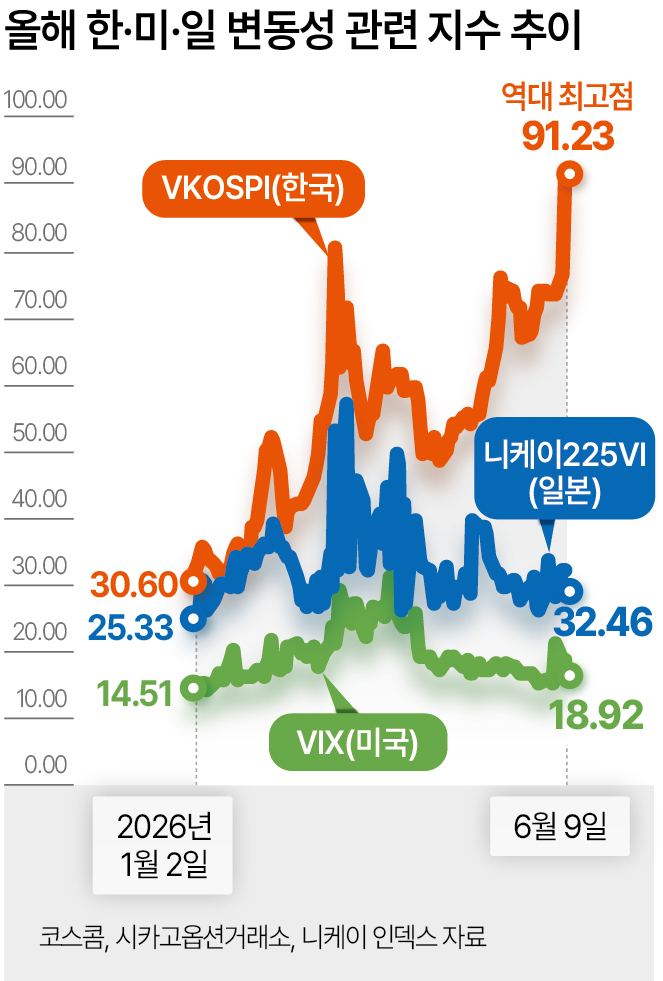
When Middle East war risk rattled markets last March, the US VIX and the Nikkei 225 VI topped out at 31.05 on March 27 and 57.00 on March 9, respectively. Both have since retreated to about 60.9 percent and 56.9 percent of those peaks — while the VKOSPI alone has gone on to set a new all-time high.
What makes this unusual is that, unlike its US and Japanese counterparts, South Korea's volatility index hit its record on a day the market rose. Since Korea Exchange officially launched the VKOSPI on April 13, 2009, peak readings for the US and Japanese volatility indexes have always come during sharp market selloffs. The US VIX topped out on March 16, 2020, when the full force of the COVID-19 pandemic hit equities. The Nikkei 225 VI peaked on Aug. 5, 2024, when the Nikkei 225 plunged 12.4 percent amid fears of yen carry-trade unwinding following the Bank of Japan's interest rate hike. Both indexes now stand at just 23 percent and 46 percent of those respective peaks.
The latest surge in the VKOSPI reflects a rise in two-way volatility — encompassing both sharp declines and sharp rallies — rather than simple fear of a downturn, unlike what drives the US and Japanese gauges. After the Kospi's steep drop the previous session, a rebound of more than 8 percent on Tuesday made it difficult to predict which way the market would move next. Analysts say the options market simultaneously absorbed demand from traders betting on further gains and hedging demand from those bracing for another sharp fall.
Industry observers describe the current environment — in which share prices and volatility are rising together — as unusual, while also viewing it as a transitional phase in the normalization of the volatility index.
Jeon Gyun, a researcher at Samsung Securities, said the record reading was "the result of heightened investor sensitivity to 'upside risk' driven by the geometrically rising Kospi." He added that "the US S&P 500, even as it set new all-time highs, saw the VIX remain stable relative to its historical peak." Jeon also noted that "there had been an abnormal period since 2010 in which the VKOSPI stayed below the US VIX despite South Korea being an emerging market," and that "the sharp rise above the VIX since the re-rating began in 2025 may be a transitional phase in the Kospi's level-up process and part of a normalization trend."
A volatility index surging on a day of rising share prices is not, however, a phenomenon unique to South Korea. Volatility indexes reflect expectations for the magnitude of future price swings rather than their direction, so a strong rebound after a sharp selloff can still push the index higher if market participants assign significant probability to both a further rally and another steep decline.
Some in the industry also point to structural features of South Korea's options market as a factor amplifying the VKOSPI's sensitivity. Jeon said the KOSPI 200 options market is dominated by foreign investors and lacks institutional investors capable of deploying sophisticated strategies such as options selling, and that "this structure makes options prices more sensitive during periods of sharp swings in either direction."
kacew@heraldcorp.com





