
Volatility gauge breaks 90 for the first time, surpassing levels seen during the global financial crisis, as wild swings in both directions rattle investor sentiment
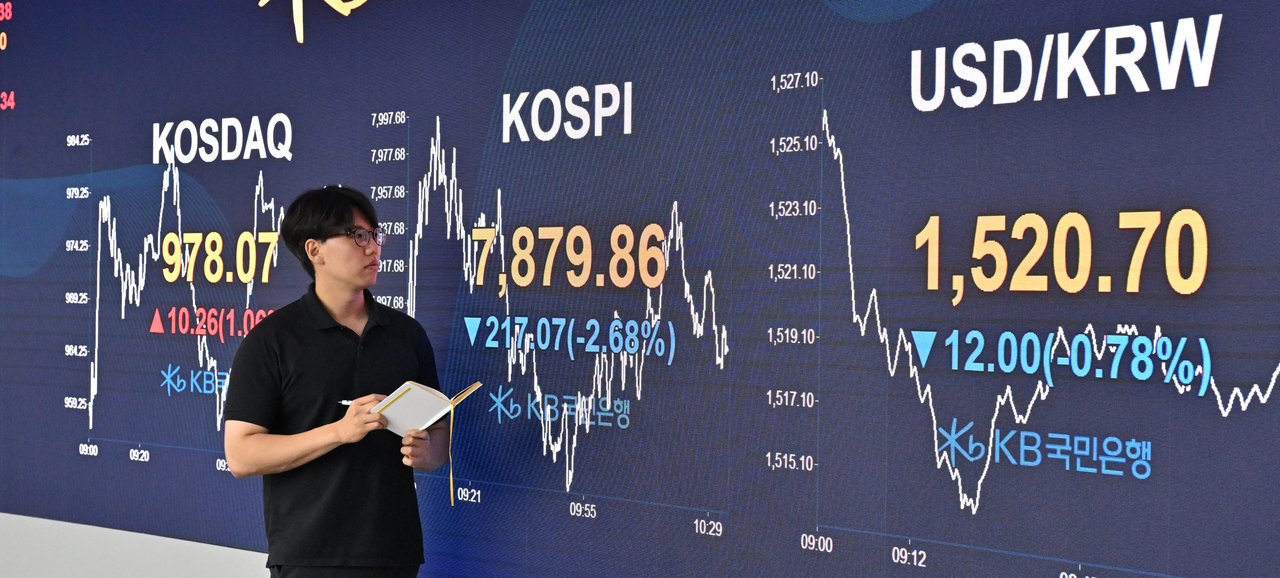
South Korea's so-called "fear index" soared to an all-time high as the Kospi swung between historic plunges and surges, stoking deep concern about market volatility.
The gauge typically rises during sharp selloffs — making its record-breaking climb on a day of steep gains all the more unusual. Analysts say the reading reflects not just the rally itself but lingering fear that another sharp drop could follow.
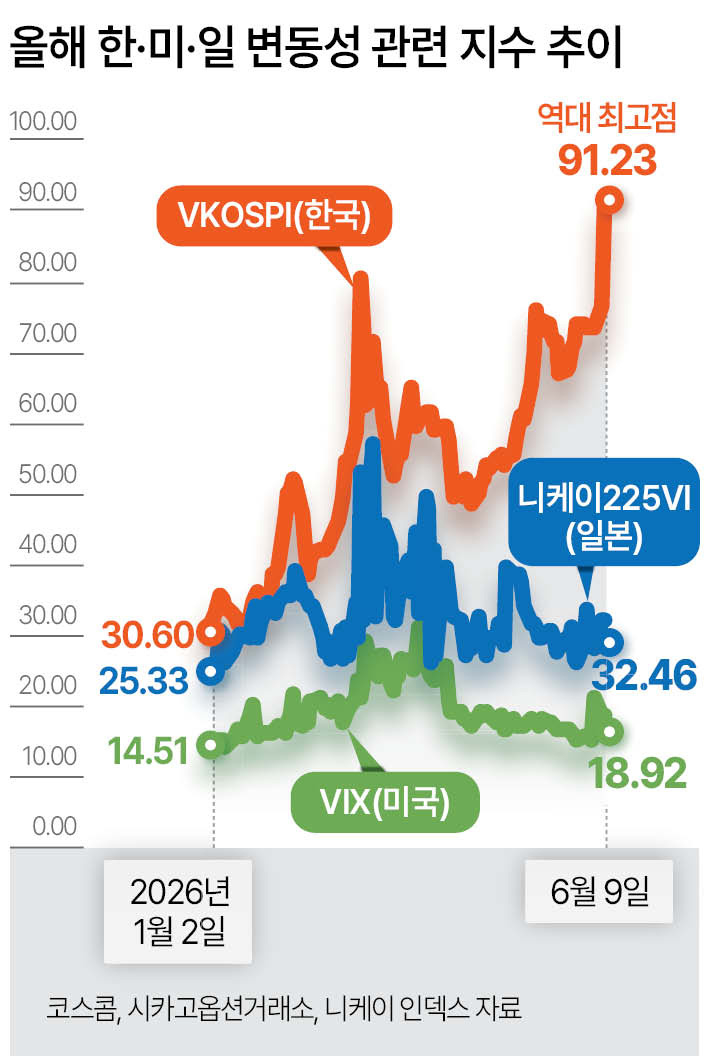
The divergence from overseas peers is striking. Volatility indexes in the United States and Japan have trended lower since spiking in March amid Middle East tensions, while South Korea's equivalent has continued to climb to record highs — underscoring just how extreme the swings in the domestic market have become by global standards.
The KOSPI 200 Volatility Index, known as the VKOSPI, closed Tuesday at 91.23, up 19.04 percent from the previous session, according to Korea Exchange. The VKOSPI measures the expected volatility of the KOSPI 200 over the next 30 days, derived from options prices. Korea Exchange began officially publishing the index on April 13, 2009. Tuesday marked the first time it had ever broken above 90, surpassing even the worst levels of the global financial crisis. The previous closing peak was 89.30, set on Oct. 29, 2008.
Widely known as the "fear index," the VKOSPI reflects how much the KOSPI 200 is expected to move over the coming month. It is calculated from KOSPI 200 options prices, which embed market participants' expectations for future price swings: the wider those expected swings, the higher the index climbs. The US equivalent is the VIX, derived from S&P 500 options, while Japan uses the Nikkei 225 VI, based on Nikkei 225 options.
Notably, the fear index hit its record on Tuesday — a day when the Kospi surged sharply. Industry analysts attribute this to two-way volatility: after a steep drop the day before, the index rebounded just as sharply, making the market's direction nearly impossible to predict. Demand from traders betting on further gains and hedging demand from those bracing for another plunge both fed into the VKOSPI's rise simultaneously.
The all-time highs for the US and Japanese volatility indexes, by contrast, were both set during market crashes. The VIX peaked on March 16, 2020, when the full force of the COVID-19 pandemic hit equity markets. The Nikkei 225 VI topped out on Aug. 5, 2024, when the Nikkei 225 plunged 12.4 percent on fears of yen carry-trade unwinding following the Bank of Japan's interest rate hike.
A comparison of this year's volatility index trends across South Korea, the US and Japan tells a similar story. When Middle East war risk rattled markets in March, the VIX and the Nikkei 225 VI hit their respective year-to-date highs of 31.05 on March 27 and 57.00 on March 9. Both have since retreated, falling to roughly 60.9 percent and 56.9 percent of those peaks, respectively.
The VKOSPI has followed a different path. It spiked in March, appeared to ease, then surged again — and has now risen to its highest level ever. The trajectory signals that the domestic market is facing far more severe volatility than its major global peers.
"The result is heightened investor sensitivity to 'upside risk,' driven by the Kospi's near-vertical ascent," said Jeon Gyun, a researcher at Samsung Securities. "Even as the S&P 500 set successive all-time highs, the VIX remained stable relative to its historical peaks."
He added that South Korea had experienced an unusual period since 2010 in which the VKOSPI traded below the US VIX despite South Korea being an emerging market. "The sharp divergence above the VIX since the re-rating began in 2025 may represent a transitional phase in the Kospi's level-up process — and a normalization of sorts," he said.
Some in the industry also point to structural features of South Korea's options market as a factor amplifying the index's sensitivity. "The KOSPI 200 options market is heavily dominated by foreign investors, and institutional investors capable of deploying sophisticated strategies such as options selling are largely absent," Jeon said. "That structure makes options prices react more sharply during periods of extreme swings."
kacew@heraldcorp.com





