Updated 2026 hepatocellular carcinoma clinical guidelines announced
The National Cancer Center (NCC), led by President Yang Han-gwang, jointly announced the revised 2026 hepatocellular carcinoma (HCC) clinical guidelines with the Korean Liver Cancer Association at the international academic conference "The Liver Week 2026."
The revised guidelines incorporate the latest research findings accumulated since the 2022 edition and reflect domestic clinical realities. Covering the full spectrum of liver cancer care — from diagnosis to local treatment, radiation therapy and systemic treatment — the update is being recognized as establishing a new standard for liver cancer care in South Korea.
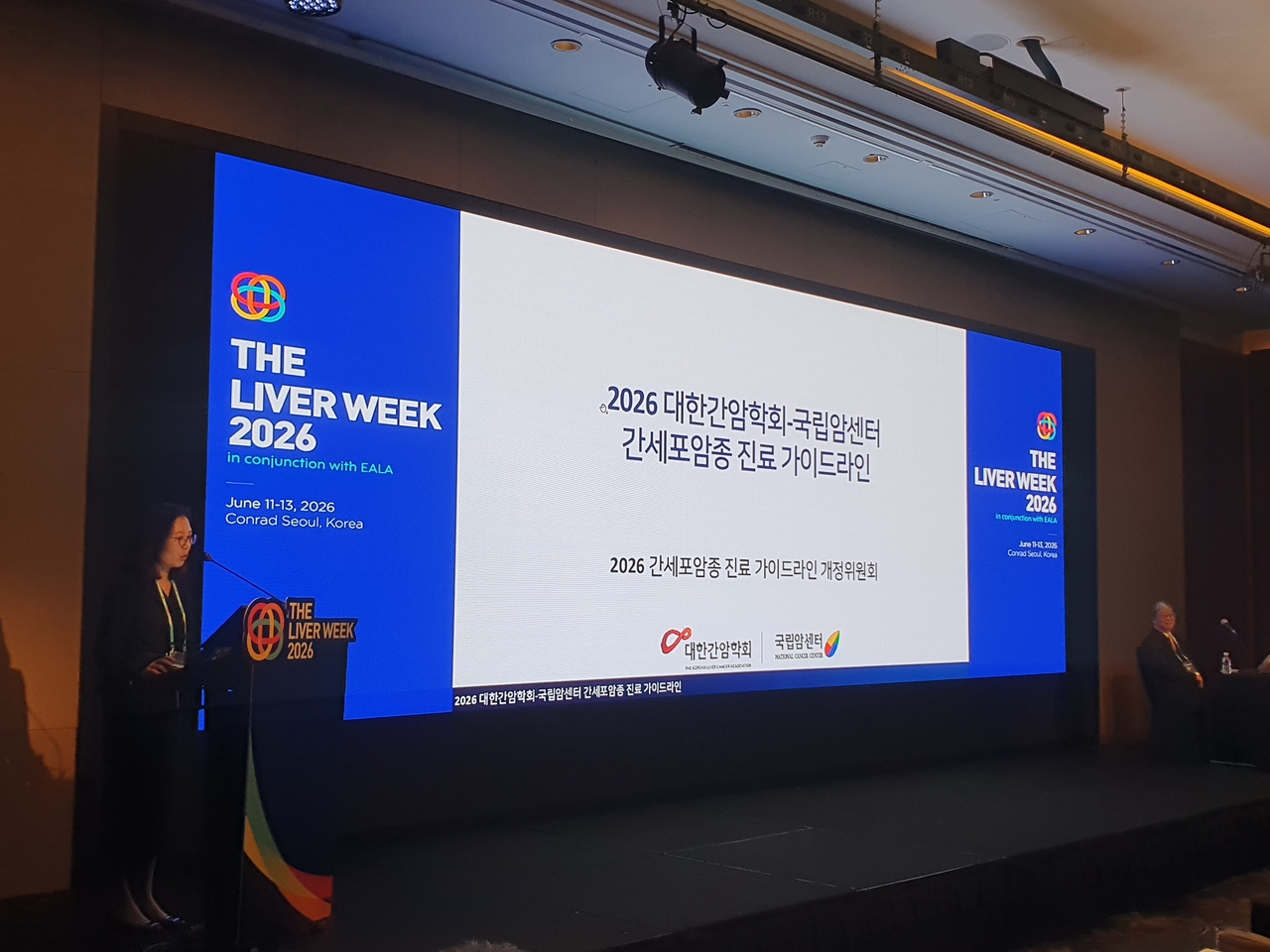
The most significant change in the revised guidelines is a comprehensive overhaul of systemic treatment strategies centered on immune checkpoint inhibitor-based combination therapies. The update recommends several immunotherapy combinations — atezolizumab-bevacizumab, durvalumab-tremelimumab and nivolumab-ipilimumab — as primary first-line treatments. These combinations had only been in the introductory stage when the 2022 guidelines were issued.
Particularly notable is that the guidelines, for the first time in South Korea, systematically address the question that has long posed the greatest challenge in clinical practice: which drugs to use after first-line immunotherapy fails. The revised guidelines provide clear direction for selecting targeted therapies such as lenvatinib or sorafenib, or alternative immunotherapy combinations, based on the patient's condition following first-line treatment failure. The approach is expected to strengthen personalized care significantly.
The guidelines also move beyond the conventional treatment strategy centered on transarterial chemoembolization (TACE), refining the criteria for alternative treatments based on patient condition. Transarterial radioembolization (TARE) is recommended as a possible alternative to TACE for certain patient groups. For patients with a single tumor 8 centimeters or smaller, the guidelines newly introduce radiation segmentectomy — a TARE technique that delivers high-dose radiation confined to the liver segment containing the tumor, achieving local treatment effects while minimizing damage to healthy liver tissue.
For small liver cancers of 3 centimeters or smaller where surgical resection is difficult, the guidelines recommend stereotactic body radiation therapy (SBRT) or proton therapy as options alongside conventional radiofrequency ablation. These are expected to offer safe and effective treatment alternatives for elderly patients, those with reduced liver function, or patients whose tumor location makes surgery or radiofrequency ablation impractical.
The revised guidelines also address patients with TACE-refractory disease — cases where cancer repeatedly recurs and TACE is no longer effective. The update explicitly calls for a prompt switch to systemic therapy before the patient's liver function deteriorates further, aiming to improve treatment outcomes and long-term survival rates.
In addition, the recommended rating for minimally invasive hepatectomy using laparoscopic or robotic techniques has been raised for liver cancers in relatively accessible locations, such as the left lateral or anteroinferior segments. This reflects clinical evidence showing that minimally invasive approaches achieve equivalent oncological outcomes to open surgery while offering faster recovery.
The 2026 revised guidelines introduce systematic literature review and meta-analysis for the first time. Multidisciplinary specialists from internal medicine, surgery, radiology and radiation oncology identified the key clinical questions most prone to disagreement in practice, then scientifically validated data from numerous domestic and international studies to raise the reliability and evidence level of the recommendations.
"Because treatment options for liver cancer vary greatly depending on each patient's liver function, tumor stage and location, a multidisciplinary approach in which specialists from multiple departments work in close coordination is essential," NCC President Yang said. "These guidelines are expected to serve as a Korea-specific standard treatment protocol that can be applied immediately in clinical settings, contributing to the standardization and quality improvement of care. They are also meaningful in that they offer alternatives for elderly patients with limited treatment options and those for whom previous treatments have failed."
Kim Bo-hyun, a professor at the NCC's Hepato-Biliary-Pancreatic Cancer Center, served as vice chair of the revision committee, while Professor Cho Yu-ri served as general secretary. NCC Proton Therapy Center professor Kim Tae-hyun and radiology professor Lee In-jun also participated as committee members. The full guidelines are available on the Korean Liver Cancer Association's website, and an English-language version is scheduled for publication in Clinical and Molecular Hepatology and the Journal of Liver Cancer.
kty@heraldcorp.com