50 construction site deaths recorded in first half of this year
"The recent accident at the Seosomun overpass was a tragic disaster that occurred during the demolition of a structure. We will work closely with the Ministry of Land, Infrastructure and Transport to put institutional safety measures for the demolition of aging infrastructure in place as quickly as possible."
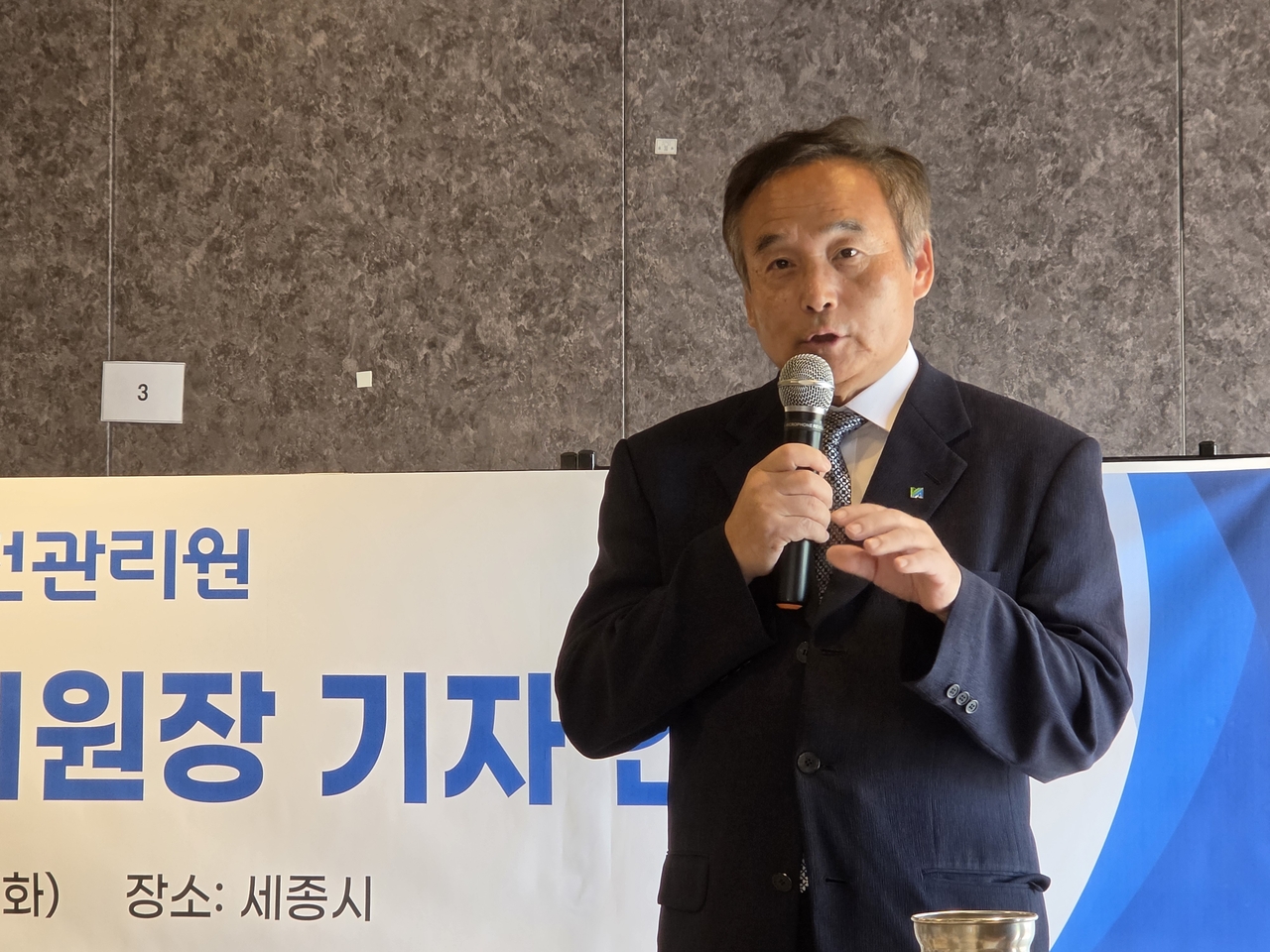
Park Chang-geun, head of the Korea Infrastructure Safety Corporation, made the remarks at a press briefing near the Sejong Government Complex on Tuesday, saying "safety cannot be overemphasized."
Park said 50 workers had died at construction sites through Monday, down from 99 in the first half of last year. "I believe this reflects the considerable attention the government has paid to safety," he said.
He added that the agency plans to strengthen safety management at small-scale sites, where a disproportionate share of fatal accidents occur. "Toward the end of last year and the beginning of this year, the president directed at Cabinet meetings that safety management at small construction sites be reinforced," Park said. "Forty percent of all accidents happen at small sites with construction costs of 5 billion won ($3.26 million) or less. In civil engineering alone, about 90 percent of the 150,000 to 160,000 active sites fall into that category. This year we plan to select about 15,000 of them and conduct safety-diagnosis patrol consultations through year-end."
He said experts from the corporation visit sites to identify hazards and recommend improvements, and that when problems go unaddressed, the agency notifies the relevant local government and project owner. Those efforts have contributed to a significant reduction in fatal accidents at small sites, he said.
On the growing threat to public safety from sinkholes, Park said it was an area of particular focus. He said the agency had formed a task force to conduct detailed analyses of about 20 major sinkhole incidents that have occurred recently. "When I reviewed the educational materials for underground safety assessments, I found they were outdated and disconnected from real-world conditions, so I ordered a complete overhaul," he said. "We plan to ensure that engineers who prepare underground safety assessment reports receive training that reflects actual site conditions, so they can properly understand what is happening and incorporate that into their designs."
Park also said that properly setting construction costs was essential to reducing accidents. "I studied civil engineering myself, and my juniors work in the field," he said. "One of the problems we need to solve is making sure construction costs are set at the right level." Pointing to the limitations of the current performance-based cost system, he noted that 15 sinkholes had appeared along the Busan Sasang-Hadan line. "Even there, construction costs came to only 80 percent of the estimated price," he said. "We cannot have a culture where a site manager is considered capable simply for finishing a job under budget. Labor costs, material costs and safety management costs must be fully reflected so that sites can operate properly." Adequate safety management budgets would allow sites to maintain proper safety equipment and provide sufficient safety training, he said.
Park said the agency also plans to make full use of AI technology to maximize the efficiency of safety inspections. "Conducting on-site inspections of dams, bridges and similar structures is extremely dangerous," he said. "By using AI — for example, equipping drones with AI technology to carry out inspections — we will be able to cover twice as many sites in the same amount of time. We will work toward building an integrated platform to make that possible."
smh@heraldcorp.com