Inaugural 'Korea Rising' session draws big pharma, investors; Boehringer Ingelheim says it has closed 6 deals from Korean assets; capital constraints and M&A activity flagged as key challenges
"I've never been to Korea personally, but our portfolio has not missed a single innovative technology from the country. We already know very well that first-in-class drugs exist in Korea."
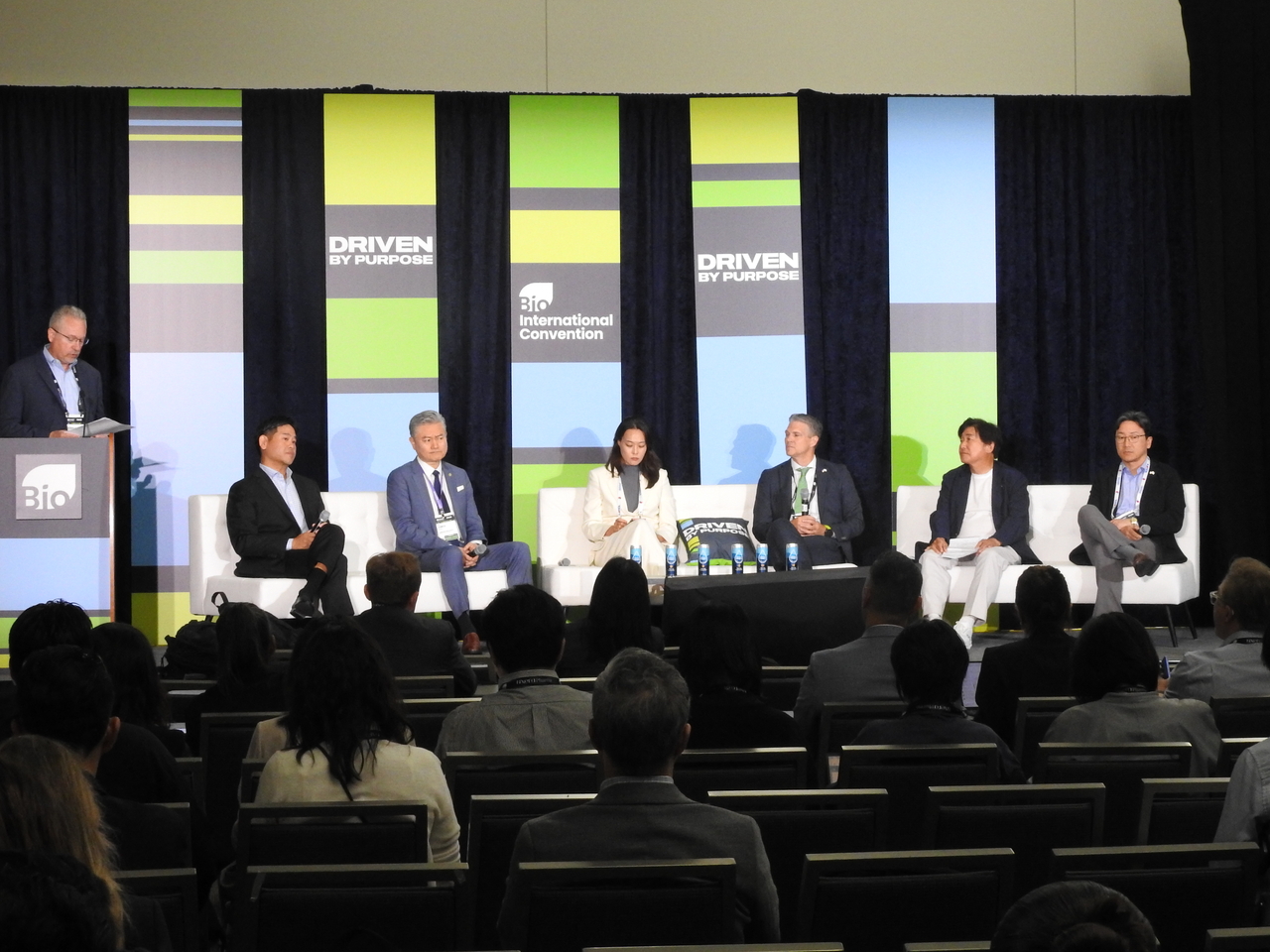
Those words set the tone at the inaugural "Korea Rising: Don't Miss Asia's Next Innovation Hub" session, held Tuesday on the sidelines of the 2026 BIO International Convention in San Diego. Co-hosted by BioCentury and the Biotechnology Innovation Organization, the session brought together executives from global pharmaceutical companies, investment firms and leading Korean biotech companies to assess South Korea's rising profile as Asia's new center of biopharmaceutical innovation.
The remarks that drew the most attention came from Scott Marshall, head of business development at Boehringer Ingelheim. Marshall said the German drugmaker had recognized Korea's strong innovative capabilities for a decade and had since closed six deals sourced from Korean biotech assets, four of which were licensing agreements.
"At first I thought it was a coincidence, but as the deals accumulated, I became convinced of Korea's unique capabilities," he said. "We now have local BD staff permanently based in Korea reviewing all therapeutic areas, and we believe we can find first-in-class molecules there."
The session also examined South Korea's standing in quantitative terms. Hwang Ju-ri, head of international affairs at the Korea Biotechnology Industry Organization, said a McKinsey report from the first quarter of this year ranked South Korea third globally in biotech pipeline size, behind only the United States and China, and first in the world on a per-capita basis.
Hwang said the fact that global pharmaceutical companies had begun deploying dedicated BD teams in Korea over the past two to three years was itself proof of the country's growing stature. She noted, however, that while the government has established a national growth fund worth $1.56 billion, the total capital available remains insufficient to fully support more than 3,000 domestic pipeline programs.
On the manufacturing side, speed was highlighted as a key competitive advantage. James Choi, a senior vice president for sales support at Samsung Biologics, said the company had built production facilities 40 percent faster than the industry average, drawing on advanced infrastructure, an efficient construction environment and strong government support. He said Samsung Biologics can complete the process from ground-breaking to GMP-certified operation within 24 months. Choi also said the acquisition of a factory in Rockville, Maryland, completed in April, had established a dual global supply network, and shared plans to set up an open-innovation laboratory with Eli Lilly at the Songdo Bio Campus to nurture up to 30 biotech startups.
Panelists also shared lessons from real-world licensing deals. Lee Sang-hoon, chief executive of ABL Bio, cited the company's major deal with GSK, saying ABL Bio had received an upfront payment of $75 million and an additional $16 million milestone for technology using IGF-1R as a blood-brain barrier shuttle in a bispecific antibody targeting alpha-synuclein. "Ultimately, what seals a deal in the global market is presenting precise proof-of-concept data for BBB penetration," he said. Lee added that Korean biotech must move toward generating royalty income, and that ABL Bio is pursuing a strategy of establishing a US subsidiary to attract local capital and advance clinical trials as a way to overcome capital constraints.
The need for traditional pharmaceutical companies to reinvent themselves also came up. Lee Jae-jun, chief executive of Ildong Pharmaceutical, said Korea's domestic market, funding base and talent pool are inherently limited compared with countries such as China. "Ultimately, shifting to an export-driven structure and embracing open innovation are the only survival strategies," he said. "Korean companies need to be flexible, nimble and agile." Ildong Pharmaceutical is currently running a GLP-1 program roadmap targeting a 2031 launch.
Panelists agreed that diversifying capital inflows and activating the mergers and acquisitions market are urgent priorities for the sustained growth of Korea's biotech ecosystem. Kook Chan-woo, chief investment officer at KB Investment, said Korean biotech companies demonstrate world-class early-stage scientific capabilities but are often structured around a single entity with no exit strategy beyond an initial public offering. He advised companies to secure structural flexibility — including setting up local entities — to effectively attract US capital. Hwang echoed the point, saying M&A activity between domestic pharmaceutical companies and biotech firms needs to accelerate, and that the time has come for rigorous sorting of promising assets from the vast pipeline.
silverpaper@heraldcorp.com