Minimum Wage Commission opens first wage-level talks at 9th plenary session; labor cites 670,000-won gap with living costs, employers warn of business closures
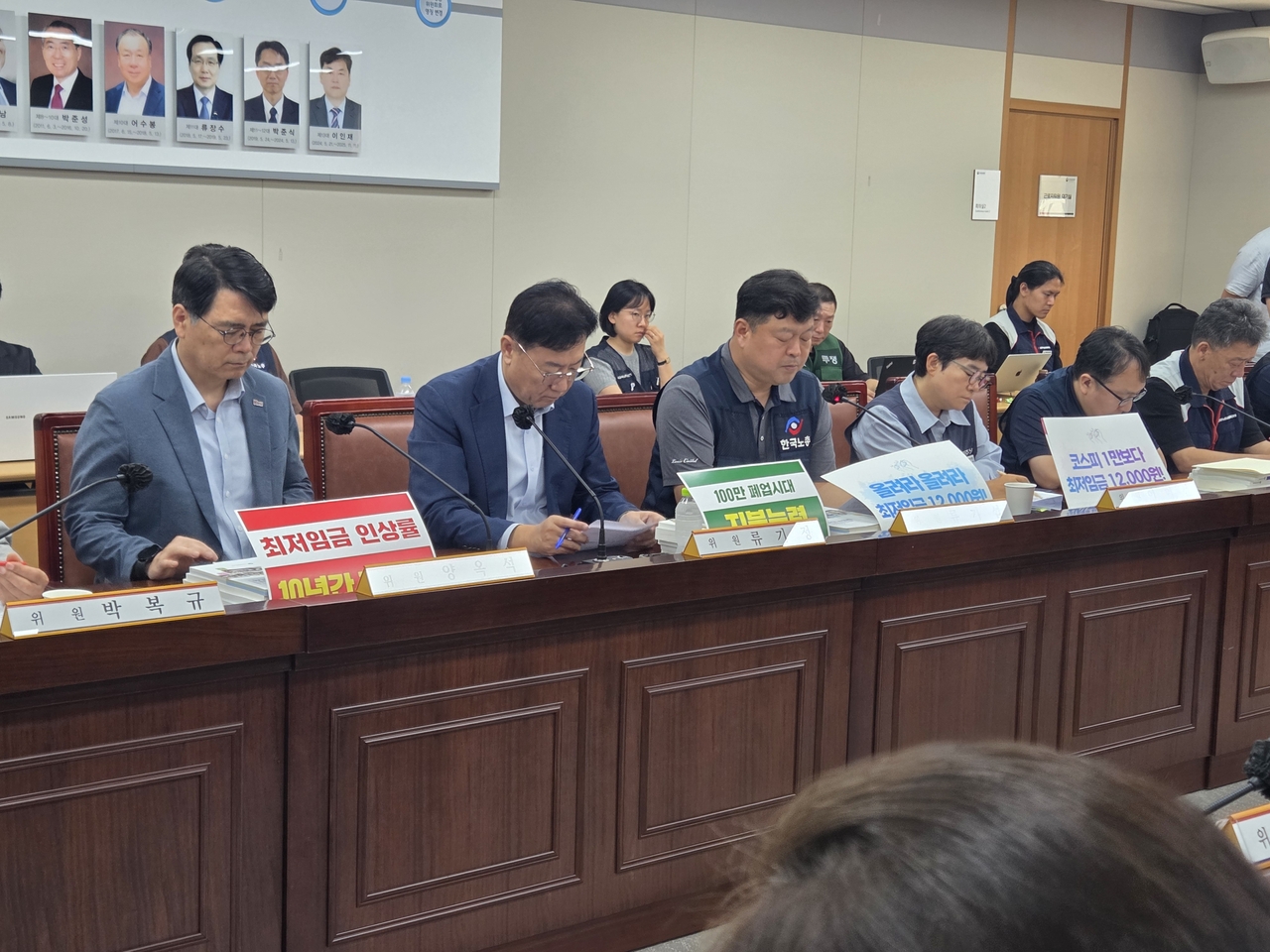
Negotiations over next year's minimum wage have begun in earnest, with labor and management staking out sharply opposing positions.
Labor representatives called for a raise to 12,000 won ($8) per hour, describing it as "the bare minimum for survival," while employers reaffirmed their push for a freeze, citing the limits of what small businesses and self-employed workers can afford to pay.
The Minimum Wage Commission held its 9th plenary session Thursday at the Government Sejong Complex, continuing deliberations on the minimum wage to take effect in 2027. At the previous 8th session, labor submitted an initial demand of 12,000 won per hour — a 16.3 percent increase over this year's rate — while the employer side proposed keeping the wage at the current 10,320 won. The gap between the two sides stands at 1,680 won.
Federation of Korean Trade Unions Secretary-General Ryu Ki-seop criticized the employers' freeze proposal, calling it "a stance that ignores the lives of minimum-wage workers" and saying it reflected an effective two-decade pattern of freezes and cuts repeated since 2007.
Ryu said the actual monthly living cost for a single, unmarried worker this year stands at around 2.82 million won, while the monthly equivalent of the minimum wage is no more than about 2.15 million won — a gap of roughly 670,000 won. "The minimum wage system exists to ensure the livelihood of low-wage workers," he said, urging a meaningful increase that could serve as a catalyst for restoring people's livelihoods.
Korean Confederation of Trade Unions Vice Chairperson Lee Mi-seon made an emotional appeal for a raise, her voice breaking as she spoke. "The 12,000-won minimum wage that labor is calling for is not money for luxuries or savings — it is the cost of survival for a minimally dignified human life," she said. "A minimum wage increase is the starting point for workers and the self-employed to thrive together."
Employer representatives, meanwhile, stressed the need for a freeze, citing a worsening business environment.
Korea Employers Federation Executive Vice President Ryu Ki-jung cited a financial stability report released Wednesday by the Bank of Korea, saying 56.8 percent of small and medium-sized enterprises in 2025 could not cover even their interest costs with operating profit. He added that outstanding loans to the self-employed reached a record 1,095.5 trillion won at the end of the first quarter of this year.
"If the burden of a high minimum wage grows further, small businesses and the self-employed will inevitably be pushed into a crisis they can no longer survive," Ryu said. "Forcing additional burdens on business owners who cannot afford to pay is no different from telling them to shut down."
Yang Ok-seok, head of the human resources policy division at the Korea Federation of SMEs, also urged a freeze, saying "if businesses close, there will be no jobs and no minimum wage." Yang cited a federation survey of 994 small businesses and self-employed operators, noting that 77.6 percent of respondents said the current minimum wage level was a burden on their operations, and 62.6 percent said next year's rate should be frozen or reduced.
Seong Jae-min, vice president of the Korea Labor Institute and a public-interest commissioner on the panel, said Thursday's session "should serve as a starting point for closely examining each side's reasoning based on the legal criteria for setting the minimum wage, and for narrowing the gap." He expressed hope that the meeting would bring the commission "one step closer to a rational conclusion that society can accept."
The statutory deadline for completing minimum wage deliberations is Monday — 90 days after the Ministry of Employment and Labor minister formally requested the review. In practice, however, talks have often stretched into July past the deadline. Observers also note that next year's minimum wage is unlikely to be decided by labor-management consensus, as was the case this year. Since the minimum wage system was introduced, labor and management have reached a consensual agreement on the rate only eight times.
fact0514@heraldcorp.com