Overseas housing excluded from domestic property count
First-time domestic buyers may qualify for single-household exemption
Rental income from overseas property must be reported under global income tax
US capital gains tax paid can be credited against Korean liability
Time the sale of your US home to minimize local income
Penalty of up to 10% of sale price for failing to file overseas real estate disposal report
![What happens to your tax status — and how are you taxed — when you sell a home abroad and buy one in Korea? A tax expert walks through the key checkpoints for families planning to settle in Korea. [Image generated with ChatGPT]](https://wimg.heraldcorp.com/news/cms/2026/06/25/news-p.v1.20260625.8c737bd25acc400a88adee179fab3e41_P1.png)

"After retirement, I want to wrap up my life in the United States and settle back in Korea ..."
Choi Woori, 57, spent a total of 30 years in the United States — from his student days after high school through his entire working career. He retired from his American job earlier this year and returned to Korea with his wife and his son, who had enrolled at a Korean university, intending to put down roots in his hometown.
The area Choi had in mind was near his parents' home in Yeongdeungpo-gu, Seoul. Around that time, he began drawing up plans to purchase a home with a market price of around 1.5 billion won ($975,000) and a government-assessed value of around 1 billion won. With Korean housing prices continuing to rise, he felt he could not rely on jeonse indefinitely.
One concern, however, gave him pause. He still owned a home in the United States that he had not yet sold. He worried that buying a new property in Korea while holding the American one might expose him to the heavy tax surcharge applied to multi-home owners. At the same time, he was reluctant to sell the US property outright — it generated about $10,000 (approximately 15 million won) in annual rental income, a welcome supplement to his retirement budget.
Ultimately, Choi sought advice from tax consultancy Hoehyeon-dong eTax to work through the tax implications of acquiring, holding and eventually disposing of a domestic property while still owning a home in the United States.
Q: I already own a home in the US. Will buying a new home in Korea trigger the heavy acquisition tax surcharge for multi-home owners?
A: No. There is no need to worry.
Under Korean tax law, the multi-home surcharge applies only to housing, association membership rights, pre-sale rights and officetels that a single household <style ref="s1">owns domestically</style> as of the acquisition date. In other words, <style ref="s2">the overseas property Choi holds in the United States is not counted when calculating the number of homes owned in Korea.</style>
Choi would therefore be recognized as a single-household, single-home owner under Korean standards and would need to file and pay only the standard acquisition tax rate of 3.3 percent (including the local education tax of 0.3 percent). On a home purchased for 1.5 billion won, the total acquisition tax would come to 49.5 million won.
Q: So overseas housing is excluded from the property count. Does that mean I can also receive the single-homeowner exemption for the annual holding taxes — property tax and the comprehensive real estate tax?
A: Yes, that is correct.
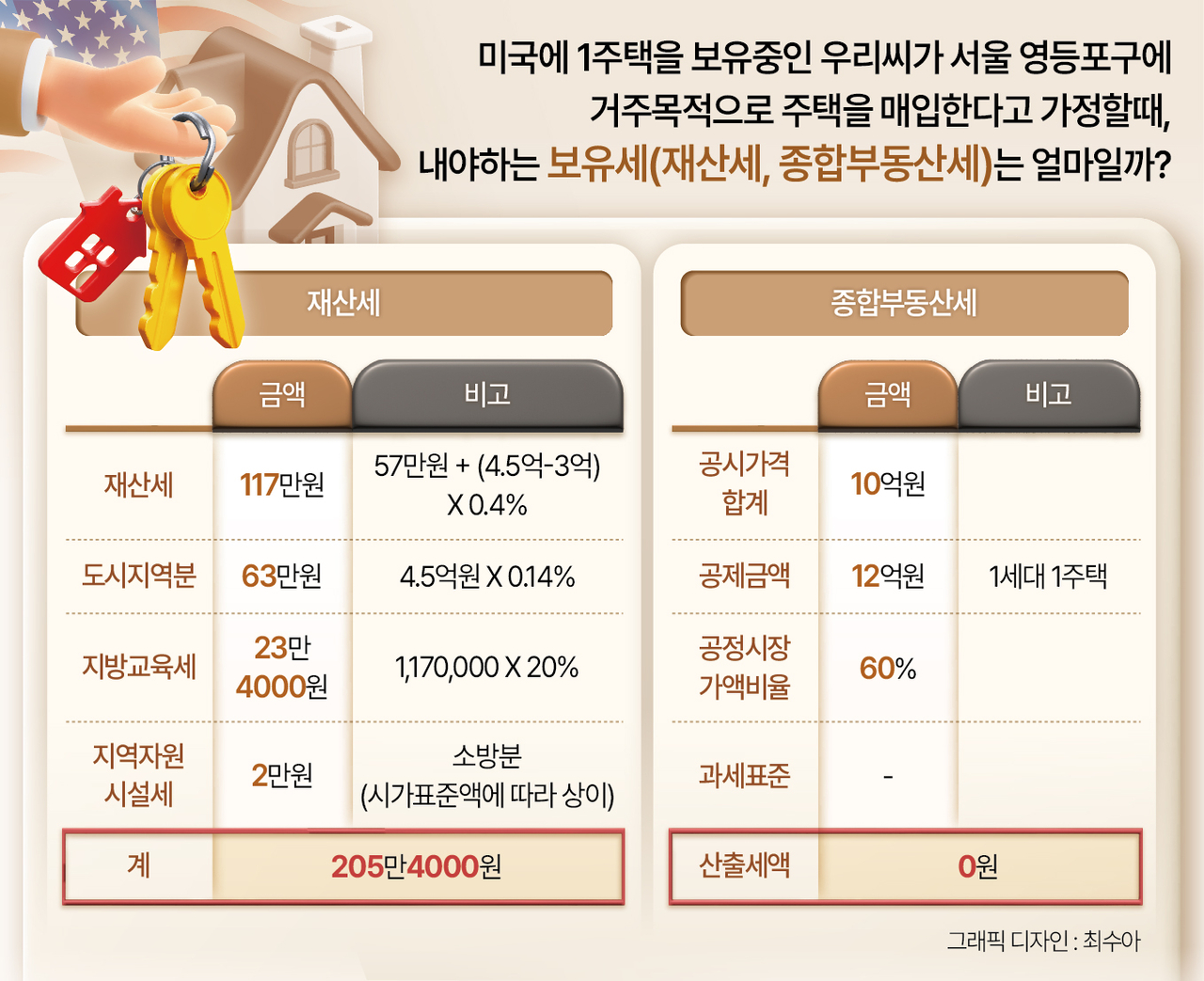
When paying property tax and the comprehensive real estate holding tax on the Yeongdeungpo-gu apartment he plans to purchase, Choi's US property will again not be counted. He would therefore qualify as a single-household, single-home owner under tax law, entitling him to substantial benefits — a fair market value ratio of 45 percent and a deduction of 1.2 billion won.
Property tax, levied in two equal installments each July and September, would come to approximately 2,054,000 won based on a government-assessed value of 1 billion won. The comprehensive real estate holding tax, meanwhile, would be zero. Under the single-household, single-home exemption, deductions apply up to 1.2 billion won, and since the assessed value of the property falls below that threshold, no liability arises.
Q: I plan to rent out the US home and use the income for retirement. Do I need to report that overseas rental income separately in Korea?
A: Yes. As a Korean resident, you have a filing obligation.
Rental income generated from an overseas property must be reported under the global income tax return by the end of May of the year following the year in which the income was earned. If annual rental income is $10,000 — approximately 15 million won at an assumed exchange rate of 1,500 won to the dollar — the separate taxation rule for residential rental income (applicable when rental income does not exceed 20 million won) would apply, and the tax would be calculated as follows.
Starting from gross income of 15 million won, subtracting necessary expenses (50 percent of revenue, or 7.5 million won) and the basic deduction (2 million won) leaves a taxable base of 5.5 million won. Applying the separate taxation rate of 14 percent yields an estimated global income tax liability of 770,000 won.
In addition, by the end of June of the year following the year in which the rental income was earned, an <style ref="s3">overseas real estate acquisition, holding, investment management (rental) and disposal report</style> must be submitted to the relevant tax office.
Q: I have no firm plans yet, but I intend to sell the US home eventually. If I pay capital gains tax to the US authorities, do I have to pay again to Korea's National Tax Service?
A: Yes. You must separately file and pay <style ref="s4">capital gains tax</style> with the domestic tax office as well.
If Choi had a Korean address or resided in Korea for at least 183 days a year over five years before transferring the US property, a capital gains tax obligation on overseas assets would arise. Notably, unlike domestic housing, overseas property is not eligible for the single-household, single-home capital gains tax exemption — that exemption applies only when transferring a property located within Korea.
There is, however, a mechanism to prevent double taxation. If Choi first pays real estate capital gains tax in the United States under US tax law, the amount paid can be credited against his Korean capital gains tax liability as a foreign tax credit. Under US law, homeowners who meet the primary residence requirement may exclude up to $500,000 in gains for married couples, and the capital gains tax rate for properties held more than one year is up to 20 percent.
It is also worth noting that while overseas property is not subject to the multi-home surcharge on disposal, it is equally ineligible for the long-term holding special deduction available for domestic properties. After selling the property, an <style ref="s5">overseas real estate disposal report</style> must be submitted to the relevant tax office by the end of June of the following year — separately from the capital gains tax filing — to avoid penalties. Failure to submit can result in a fine of up to 10 percent of the disposal price, capped at 100 million won.
Q: It sounds like I need to carefully weigh the tax burden on both sides. Are there any tax-saving tips for timing the sale of the US home?
A: The key is choosing the right time to sell. When disposing of a US property, the capital gain is combined with other ordinary income earned in the same year under US tax law — wages, business income, other investment income and the like — which can push the taxpayer into a higher bracket. The most effective way to reduce the local tax burden is to sell in a year when other US-source income is absent or at its lowest.
Q: If I live in the Yeongdeungpo apartment for more than 10 years before selling, how much capital gains tax would I owe? Let's assume the home appreciates and sells for 2 billion won.
A: Even if Choi goes ahead with the Yeongdeungpo apartment purchase as planned, he would hold only one domestic property, so the capital gains tax benefits available to a single-household, single-home owner would apply in full.
When transferring a domestic property, overseas housing is again excluded from the property count, meaning Choi would qualify for the single-household, single-home capital gains tax exemption — gains up to 1.2 billion won are tax-free, with only the portion above that threshold subject to tax. Assuming he buys at 1.5 billion won, holds and occupies the property for 10 years, and then sells for 2 billion won, the estimated capital gains tax would be approximately 3.77 million won.
The detailed calculation runs as follows. Taking the sale price of 2 billion won and the acquisition cost of 1.5 billion won, and subtracting other necessary expenses such as acquisition tax (49.5 million won), the total capital gain comes to 450.5 million won.
For a single-household, single-home owner like Choi, only the portion of the gain attributable to the value above 1.2 billion won is taxable on a high-value home. The taxable gain is calculated as the total gain multiplied by (sale price minus 1.2 billion won) divided by the sale price, which yields 180.2 million won. After applying the long-term holding special deduction of 80 percent (144.16 million won), the net capital income figure is 36.04 million won. Subtracting the basic capital gains deduction of 2.5 million won leaves a taxable base of 33.54 million won. Applying the 15 percent tax rate (with a progressive deduction of 1.26 million won) produces a capital gains tax of 3.771 million won and a local income tax of 377,100 won.
Q: I plan to sell in about 10 years. Can I still count on receiving the maximum long-term holding special deduction of 80 percent as the law stands today?
A: The National Assembly is currently deliberating amendments to the relevant tax laws, so it is important to monitor how the situation develops.
Nothing has been finalized yet, but if the proposed amendments pass, even single-home owners could face a tax burden that differs by hundreds of millions of won, drawing considerable attention from property owners.
Under the current rules, the longer a homeowner holds and occupies a property, the greater the deduction — up to a maximum of 80 percent — substantially reducing the effective tax burden. The proposed amendments under review, however, would significantly curtail or abolish this long-term holding special deduction, potentially dismantling the fundamental structure under which longer ownership translates to lower taxes. The legislation is still in progress, with committee review and other parliamentary steps remaining, so it is essential to recheck the law in force at the actual time of sale.

won@heraldcorp.com