Slumping construction demand cuts sales and worsens finances; industry needs more than 5 trillion won in environmental investment by 2035 but lacks the funds
![KGM C&E's Donghae factory, the largest single cement manufacturing facility in South Korea. [Korea Cement Association]](https://wimg.heraldcorp.com/news/cms/2026/06/26/news-p.v1.20260626.54e1de34b06244efa8240ec454ffa04f_P1.jpg)
The cement industry's goal of achieving carbon neutrality is growing more distant.
A sharp drop in domestic cement sales driven by the construction slump is expected to further erode the industry's capacity for facility investment this year, following a similar squeeze last year. Cement production is a major source of carbon dioxide emissions, as the process involves heating limestone (CaCO₃) to manufacture clinker.
That makes it essential to install carbon capture, utilization and storage (CCUS) systems as well as selective catalytic reduction (SCR) equipment — needed to cut nitrogen oxide (NOx) emissions from fossil fuel use — both of which require enormous capital outlays.
The most pressing need is investment aligned with the national greenhouse gas reduction target (NDC) for 2035. Core technologies required for emissions cuts are considered close to commercial readiness. But the industry says it has no clear way to raise the more than 5 trillion won ($3.24 billion) in facility investment needed by 2035.
Financial difficulties have mounted for years as cement sales have fallen. Shipments last year dropped 16.5 percent from the prior year to 36.5 million tons, and the industry expects an even steeper decline this year.
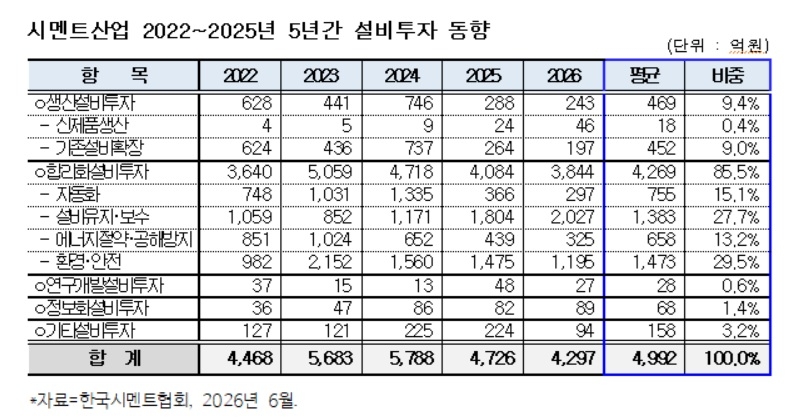
The picture emerges from a report released Friday by the Korea Cement Association detailing 2025 facility investment results and plans for 2026. The planned investment for this year stands at 429.7 billion won — down 10 percent from 472.6 billion won last year and 13.9 percent below the five-year average of 499.2 billion won. After peaking at 578.8 billion won in 2024, annual facility investment has fallen steadily, to 472.6 billion won in 2025 and a projected 429.7 billion won in 2026.
The industry says it cannot close the funding gap on its own and is calling on the government for attention and support.
"Logistics costs rose sharply after the introduction of the safe freight rate system for cargo truckers, and production costs surged due to soaring oil prices triggered by the war in the Middle East — all of which rapidly worsened our profit structure," a Korea Cement Association official said. "The gap between the investment funds needed and what we can actually raise is expected to widen further."
freiheit@heraldcorp.com