Better choices for a better future [Earth, What's Up? — Pick]
In the rush of daily life, fighting climate change can feel abstract. Faced with a relentless stream of grim headlines and a reality that seems impossible to change, it is easy to think: what difference can I make?
But small, environment-conscious efforts — even the tiniest acts — can accumulate into meaningful change. No grand gestures are required. What matters is understanding the reality we face and finding what we can do.
What is the state of our planet right now? And what better choices can we make? Here is the honest story of Earth that you need to know.
![Crowds fill a street in Seoul. [Getty Images Bank]](https://wimg.heraldcorp.com/news/cms/2026/06/27/news-p.v1.20260627.cb3ca6183b364421b4e6f26620511ffc_P1.jpg)
A promise was just a promise
About a decade ago, on Dec. 12, 2015, leaders from 194 countries came together and made a pledge.
Nations that had long clashed over competing interests set aside their differences that day in pursuit of a single goal.
It was a promise made not for any one country's benefit, but to secure the survival and future of all people on Earth. That promise was the Paris Agreement.
The Paris Agreement was more than a simple environmental protection treaty. It was the first universal consensus to recognize the climate crisis as a shared survival challenge for all of humanity. Though a global crisis demanding collective action had arrived, it carried the meaning of a declaration of hope — that humanity, working together, could meet it.
![A wildfire. [Getty Images Bank]](https://wimg.heraldcorp.com/news/cms/2026/06/27/news-p.v1.20260627.bb1836b718004f498b124dbbd160fa5d_P1.jpg)
The reality bears this out. Warming oceans do not respect borders, and heat waves strike regardless of nationality or ethnicity. Beneath the flow of weather, no human-drawn boundary holds any power.
The weight of the "1.5 degrees" threshold the Paris Agreement established was considerable — because it was never just a scientific number.
It was humanity's last line of defense: drawn so that some nameless creature would not perish in a heat wave, so that no family would be torn apart by an unexpected storm, so that no one would lose their home to rising seas.
Yet less than a decade after the Paris Agreement, Earth's annual average temperature crossed 1.5 degrees Celsius above pre-industrial levels. That alone does not mean the agreement has failed. But the embers of hope have clearly grown dim.
![Citizens gather in front of the Eiffel Tower in Paris, France, holding parasols amid a heat wave on June 10 (local time). [EPA]](https://wimg.heraldcorp.com/news/cms/2026/06/27/news-p.v1.20250813.56c5a058c3584c45a1f6d3159e244743_P1.jpg)
World's climate pledge unravels, accelerating the human crisis
The World Meteorological Organization said Earth's average temperature in 2024 was 1.55 degrees Celsius above the 1850–1900 pre-industrial average. The EU's climate monitoring agency Copernicus also identified 2024 as the hottest year on record, reporting that temperatures had risen about 1.6 degrees above pre-industrial levels.
Last year, 2025, came in at 1.47 degrees above pre-industrial levels. The three-year average from 2023 to 2025 also exceeded 1.5 degrees. This year shows no sign of relief, with extreme heat waves striking regions around the world since spring.
That said, the Paris Agreement's official target has not formally collapsed. The 1.5-degree goal refers to warming that persists over a long period — more than a decade. In other words, a single year exceeding 1.5 degrees does not mean the long-term target has scientifically failed.
![People sunbathe near the Canal Saint-Martin in Paris, France, on June 20. [AFP]](https://wimg.heraldcorp.com/news/cms/2026/06/27/news-p.v1.20260623.bcdc5ed2fe6648b6a621667dd6e258fe_P1.png)
Still, the odds of holding the 1.5-degree line are narrowing. It may be too early to call it failure, but the probability is high. What matters most is that the international community's commitment to upholding the Paris Agreement appears to be moving backward, not forward.
The most glaring weak point is the United States. As befits the world's largest economy, the US has historically been the single largest emitter of greenhouse gases. According to Carbon Brief, cumulative US carbon dioxide emissions since 1840 total 542 billion tons — the highest in the world, far exceeding China's 336 billion tons.
Yet in 2020, Donald Trump's first administration formally withdrew from the Paris Agreement less than five years after it took effect — the result of a prominent climate change denier rising to lead the world's largest economy. The Joe Biden administration rejoined in 2021, but Trump, upon returning to the presidency, initiated withdrawal again.
![US President Donald Trump answers reporters' questions during a meeting with NATO Secretary General Mark Rutte at the White House on June 24 (local time). [UPI]](https://wimg.heraldcorp.com/news/cms/2026/06/27/news-p.v1.20260625.da0de79df9514b7cb8024bd3c0c56c57_P1.jpg)
The US withdrawal exposed one of the Paris Agreement's fundamental weaknesses: as a non-binding, voluntary framework, a change of heart by even one country can undermine the entire accord. When that country is a major power, there is no mechanism to hold it accountable.
This was a problem flagged repeatedly even as the Paris Agreement was being negotiated. Where its predecessor, the Kyoto Protocol, was designed primarily around binding reduction obligations for developed nations, the Paris Agreement was conceived as a shared responsibility for all countries.
Under the agreement, each country was to submit a nationally determined contribution, or NDC, every five years, with each successive submission setting a higher target. The idea was that mutual monitoring would generate the political momentum to act. But the power of that monitoring mechanism has varied enormously from country to country.
The Paris Agreement also rested on the premise that countries with higher cumulative emissions bear greater responsibility. In practice, developed nations pledged at the UN Climate Change Conference, COP29, in 2024 to scale up climate finance for developing countries to $300 billion a year by 2035. But the US withdrawal has cast doubt on the reliability of those financial commitments.
As noted, the Paris Agreement relies on mutual trust and political pressure rather than penalties. When the country bearing the greatest responsibility steps away, other nations inevitably find justification to delay raising their own targets. Domestically, voices asking "why should we bother if the US won't?" gain traction.
A decade has passed since the international community forged its landmark global pledge in 2015. The first benchmark — limiting warming to 1.5 degrees — is now close to failure. Deep cracks have also appeared in the commitment itself, raising questions about whether the international cooperation framework can hold together effectively.
![Students on their way to school. [Getty Images Bank]](https://wimg.heraldcorp.com/news/cms/2026/06/27/news-p.v1.20260627.683c6df073744d4a975640701c2c52c1_P1.jpg)
Ten years after Paris, climate change is outpacing expectations
The deeper problem is that over the past decade, as the international community maintained its framework of cooperation, climate change has been producing victims faster than anyone anticipated.
The WMO said the 11 years from 2015 to 2025 were the hottest 11 years ever recorded. The very decade in which the Paris promise was made turned out to be the hottest decade humanity has ever experienced.
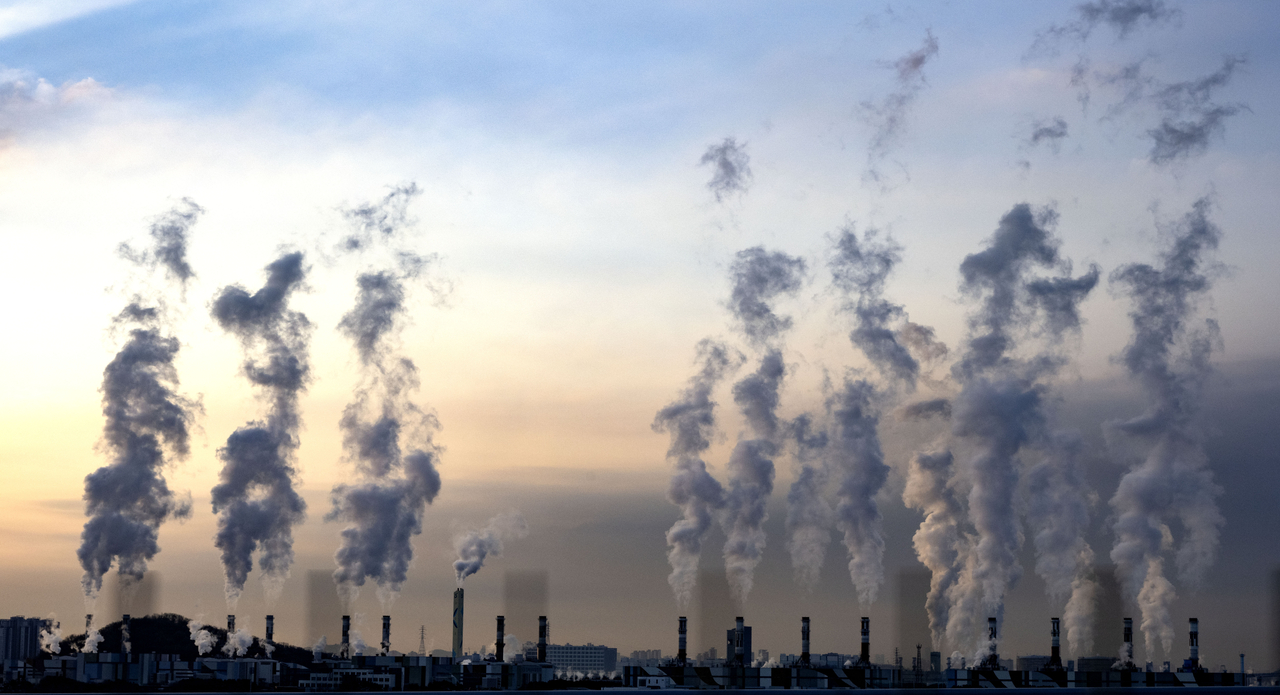
The cause is clear. Greenhouse gases continue to pour into the atmosphere and accumulate. According to the WMO's 2025 greenhouse gas report, the global average atmospheric CO₂ concentration in 2024 hit a record high of 423.9 parts per million. The increase from 2023 to 2024 was the largest ever recorded since modern measurements began.
![A power plant. [Getty Images Bank]](https://wimg.heraldcorp.com/news/cms/2026/06/27/news-p.v1.20260627.a1eb64eed42c49e6807de5627a485bf9_P1.jpg)
Fossil fuel emissions — the primary driver — are not declining either. According to the Global Carbon Budget 2025 report by the Global Carbon Project, global fossil fuel CO₂ emissions are projected to reach 38.1 billion tons in 2025, up 1.1 percent from the previous year. Even the core cause of climate change shows no sign of peaking.
The outlook for 2026–2030 is starker still. There is a 91 percent probability that at least one of the next five years will exceed 1.5 degrees. The probability that the five-year average for 2026–2030 will exceed 1.5 degrees stands at 75 percent. The chance that at least one year in that period will set a new heat record surpassing 2024 is 86 percent — suggesting this is no temporary blip above the threshold.
The heat is not the only concern. The oceans, which absorb most of Earth's excess heat and serve as a buffer against climate change, are in an even more alarming state. The WMO said the oceans have absorbed the equivalent of roughly 18 times humanity's total annual energy consumption in heat every year over the past two decades.
![A coastline blanketed in plastic waste. [Greenpeace]](https://wimg.heraldcorp.com/news/cms/2026/06/27/news-p.v1.20260627.6bccb41c78a24baca894be48052910b6_P1.jpg)
As the oceans absorb more heat, marine ecosystems collapse, extreme weather events such as typhoons and heavy rainfall grow more frequent, and sea-level rise accelerates.
The human toll is already substantial. The 2025 Lancet Countdown report found that failure to curb the warming effects of climate change has driven a 23 percent increase in heat-related mortality since the 1990s, with an annual average of 546,000 people now dying from extreme heat. Deaths and injuries from climate-driven wildfires, droughts and floods are even harder to tally.
The Intergovernmental Panel on Climate Change has already assessed that between 3.3 billion and 3.6 billion people live in environments highly vulnerable to climate change — meaning nearly half the world's population faces risks from heat waves, drought, flooding, food insecurity, water scarcity and the spread of infectious disease.
![Land cracked by drought. [Getty Images Bank]](https://wimg.heraldcorp.com/news/cms/2026/06/27/news-p.v1.20260627.897030e2d9994e07a3299e234aa01202_P1.jpg)
No time for despair — developed nations hold the key variable
Even so, the current situation cannot be allowed to end in despair. Staring down the reality of the climate crisis must not become an excuse to abandon whatever possibilities remain.
It is clear that damage has already begun. But that also means there is still a great deal of future harm that can be prevented.
Just because the 1.5-degree target is slipping does not mean that 1.6 degrees, 1.7 degrees and 2 degrees of warming all lead to the same future. Every tenth of a degree avoided means fewer people exposed to heat waves, fewer regions suffering water shortages, and dramatically fewer ecosystems lost and lives cut short.
There are also genuine reasons for cautious optimism. The UN Environment Programme, in its Emissions Gap Report released last year, projected that if countries maintain their current national climate policies, warming by 2100 would reach 2.8 degrees.
If all submitted NDCs were fully implemented, that figure would fall to between 2.3 and 2.5 degrees. Given that the warming trajectory projected at the time of the Paris Agreement pointed to more than 3 degrees of warming by 2100, that represents meaningful progress.
![People cool off in the Trocadéro fountains near the Eiffel Tower in Paris, France, on June 22. [Reuters]](https://wimg.heraldcorp.com/news/cms/2026/06/27/news-p.v1.20260627.afb48ee073ed43b782841e9ea5c9ffa4_P1.jpg)
There are also signs of hope in the shift away from fossil fuels. The International Energy Agency projects global energy investment will reach $3.3 trillion in 2025. Of that, roughly $2.2 trillion is expected to flow into clean energy — renewable energy, nuclear power, electricity grids and efficiency improvements — about double the $1.1 trillion directed toward fossil fuels. Capital, too, is moving in a greener direction.
The pace of renewable energy expansion is also far faster than it was a decade ago. The IEA projects that global renewable energy generating capacity will grow by about 4,600 gigawatts between 2025 and 2030 — twice the increase recorded between 2019 and 2024. The industry-led shift toward cleaner energy, including the expansion of electric vehicles, continues to gain momentum.
![A mobile phone thermometer displays the temperature of a building support structure near the Garonne River in Toulouse, France, on June 22. [AFP]](https://wimg.heraldcorp.com/news/cms/2026/06/27/news-p.v1.20260627.805b1b6991944e66b7c5e20cc3e7dfab_P1.jpg)
Yet these numbers are evidence of possibility, not victory — and they are not enough. UNEP estimates that even if all NDCs were fully implemented, global emissions in 2035 would be only about 15 percent below 2019 levels. But to stay on track for the more realistic target of limiting warming to 2 degrees, a roughly 35 percent reduction is needed.
In short, the current pace falls short. As the effects of climate change intensify, calls are growing for a stronger response. In particular, there are persistent demands that developed nations — which hold the keys to climate action — set more ambitious carbon reduction targets and back them with concrete policy.
In a statement released in December 2025 to mark the 10th anniversary of the Paris Agreement, Greenpeace said the accord "set the world on a new course and played a pivotal role in accelerating the clean energy transition and reducing global greenhouse gas emissions," while warning that the world "remains dangerously off track from the 1.5-degree goal and faster action is needed to cut fossil fuel emissions."
Did you enjoy this article?
The "Earth, What's Up?" newsletter is now available, packed with the latest climate and environment news.
It will include stories that didn't make it into the articles, along with a range of lifestyle tips you won't want to miss.
↓↓To subscribe, copy and paste the link below into your address bar↓↓
https://speakingearth.stibee.com/

woo@heraldcorp.com