Agreement reached Friday, two days after union secured strike rights on Wednesday
Demolition set to begin in September 2027
Reconstruction of Ulsan factory to proceed in earnest
Deal includes priority placement at EV factory and right of return after reconstruction
Compensation for 40-month shutdown and production transfers left for future talks
Internal union backlash grows over deal seen as 'a step back from Kia'
![An overview of Hyundai Motor's Ulsan factory complex. [Provided by Hyundai Motor]](https://wimg.heraldcorp.com/news/cms/2026/06/29/news-p.v1.20260625.5ad94c071c13463e9dc3d5dc12cf2b7d_P1.jpg)
Hyundai Motor and its union have agreed to reconstruct the site currently occupied by Ulsan Plant 1 and Line 42. Demolition of the existing facilities is set to begin in September 2027, and workers assigned to those lines will receive priority transfer rights as well as the right to return once reconstruction is complete. Several key issues — including compensation during the shutdown, production realignment and which vehicle models will be assigned to the rebuilt plant — have been deferred to future talks, leaving internal union dissent as a potential complicating factor.
Industry sources said Monday that Hyundai Motor and its union held the fifth and sixth sessions of their Employment Stability Committee on June 24 and June 25 respectively, then reached a final agreement on the reconstruction of the Ulsan Plant 1 and Line 42 site on June 26. Under the deal, Hyundai Motor plans to begin demolition in September 2027 as part of its shift to a future vehicle production system and efforts to strengthen the competitiveness of its domestic factories.
The reconstruction of Plant 1 and Line 42 had already been agreed upon in broad terms through a 2022 special agreement on future domestic factory investment and a 2025 special accord on labor-management co-development. The Employment Stability Committee sessions focused on the specifics of workforce management ahead of demolition — including transfer arrangements, priority placement at the EV factory and the right to return after reconstruction.
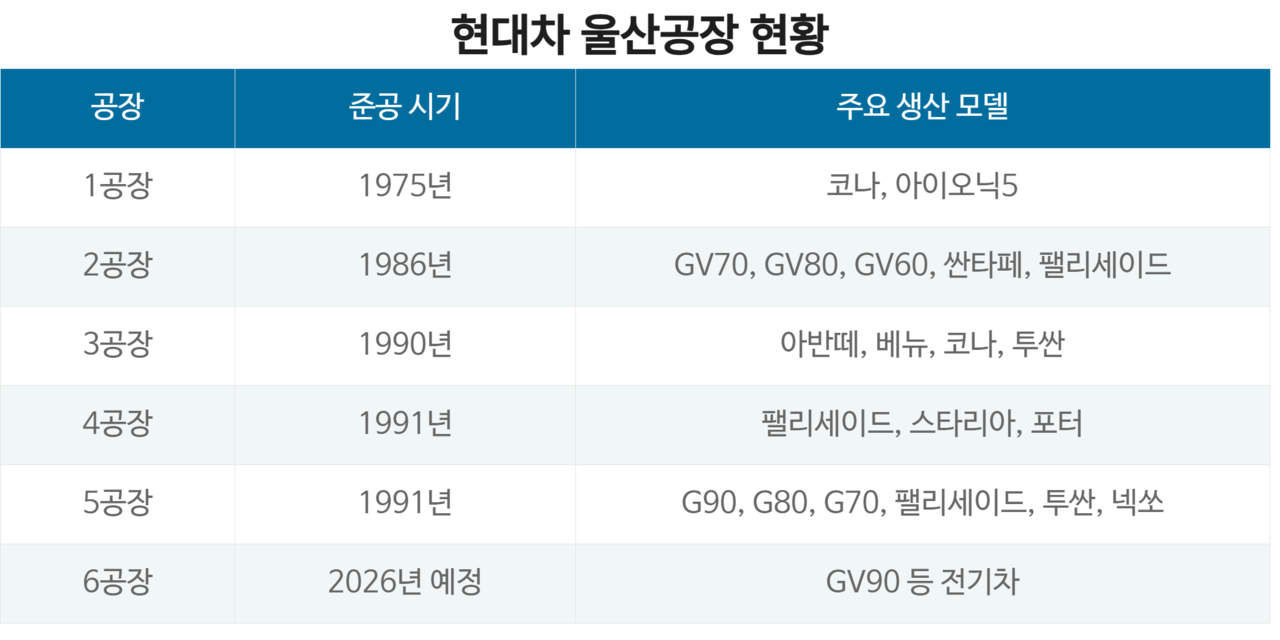
The discontinuation dates for models currently produced at Plant 1 and Line 42 — including the Ioniq 5, Kona EV and Porter — will be determined in connection with the 2027 business planning cycle and decided in consultation with the union.
Detailed schedules for each phase of the reconstruction — covering the specific site layout, demolition, factory construction, model assignments, equipment installation and test runs — will be explained to the union and carried out in accordance with collective bargaining procedures. Division-level details related to the reconstruction will be negotiated separately between labor and management at each of the Plant 1 and Line 42 units.
Job security measures were also included in the agreement. Hyundai Motor will grant technical workers at Plant 1 and Line 42 priority consideration in three rounds of regular transfers. Workers born in 1966, 1967 and 1968 — those approaching mandatory retirement — will receive the highest-priority transfer opportunities.
The possibility of placement at the EV factory was also left open. Depending on operating conditions at the EV plant, workers from Plant 1 and Line 42 who wish to transfer there will be given priority consideration.
The Ulsan EV factory is the first fully new domestic passenger vehicle plant Hyundai Motor has built in South Korea since the Asan factory opened in 1996 — a gap of about 29 years. Completed late last year, the plant is scheduled to begin full-scale operation in September and is designated as a key electrification hub, tasked with producing the Genesis flagship electric SUV GV90.
In addition, certain eligibility criteria — including a minimum two-year tenure in a current department, restrictions on core technical roles and age limits for the EV factory — will be temporarily waived for transfers specifically related to the reconstruction.
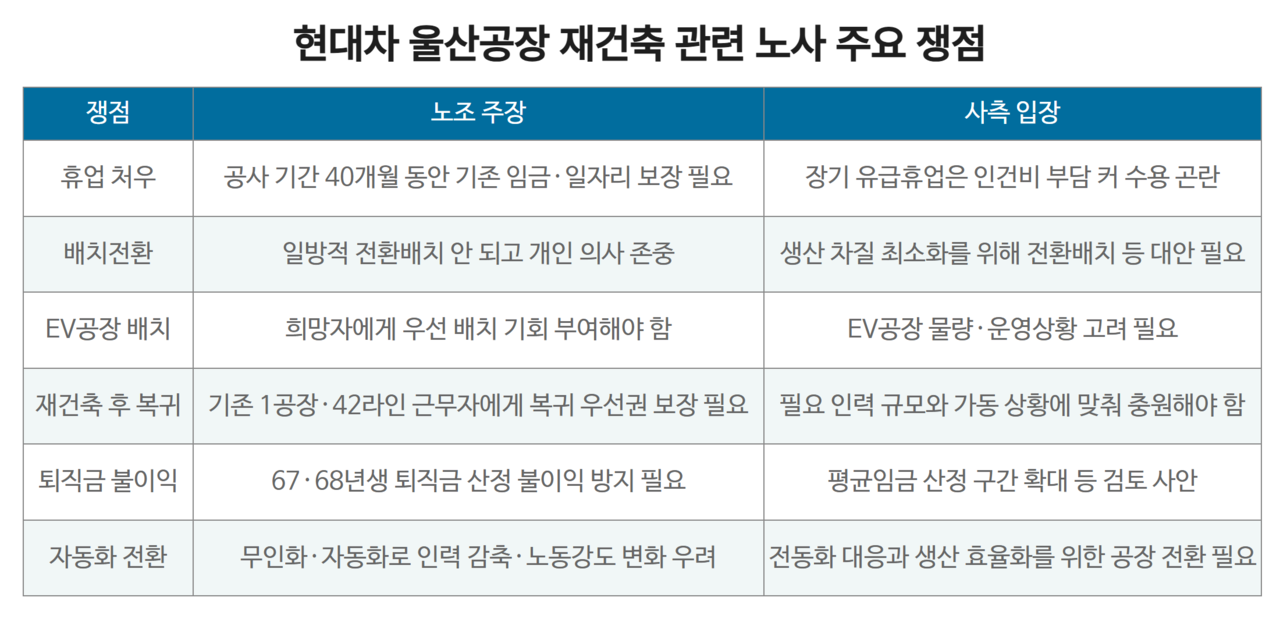
Provisions for returning to the rebuilt factory were also established. In line with the operational plan for the reconstructed plant, technical and general workers currently assigned to Plant 1 and Line 42 who wish to return will be given priority. If the number of workers eligible to return when the rebuilt factory begins operation falls short of what is needed, the shortfall will be filled through regular transfers and new hires.
Several core issues, however, remain unresolved. The most contentious is how to manage the workforce during the roughly 40-month reconstruction period — about three years and four months. Once demolition begins, production on the affected lines will inevitably slow or stop. The union's position is that members' existing jobs and wages must be maintained throughout, and it is calling for a guarantee of extended paid leave and restrictions on unilateral transfers.
Management, by contrast, argues that guaranteeing paid leave for the entire reconstruction period would simultaneously drive up labor costs and disrupt production. It wants to minimize the shutdown period and find workforce solutions through transfers and production adjustments at other plants.
The two sides agreed to defer the shutdown question to future discussions, taking into account production volume changes, the demolition timeline and precedents from the discontinuation of engine and transmission factories. The reallocation of seat production volumes and vehicle transfers linked to the broader domestic factory realignment will also be finalized through the Employment Stability Committee.
![A layout map of Hyundai Motor's Ulsan factory complex, which comprises Plants 1 through 5, an engine and transmission factory, and an export dock, among other facilities. [Captured from Hyundai Motor website]](https://wimg.heraldcorp.com/news/cms/2026/06/29/news-p.v1.20260403.a2cd4dcb03e040bc949213b464589dd3_P1.png)
Within the union, the agreement has drawn criticism. Some members argue that the leadership rushed to conclude the reconstruction deal without consulting the rank and file at a critical moment ahead of a general strike. Critics contend that the union executive moved too quickly after the June 24 strike vote and that the agreement lacks clear provisions on key matters such as shutdown compensation, production volumes and workforce planning. Particular objections have been raised over the absence of specifics — including the length of the shutdown period, departmental staffing levels, new hiring plans and model assignments — compared with the deal Kia struck for its new purpose-built vehicle factory.
There are also concerns that the agreement does not spell out how the rebuilt factory will be operated. Because the reconstruction is premised on multi-model flexible production and expanded automation, some within the union worry it could eventually lead to workforce reductions, forced transfers or changes in work intensity.
Calls for a membership-wide vote have also emerged. Some shop-floor groups argue that because the Plant 1 and Line 42 reconstruction directly affects the employment, work locations and production allocations of the workers concerned, their views should be sought separately. The union leadership, for its part, is expected to emphasize that the agreement secured job protection measures — including transfer priority and the right to return after reconstruction.
The timing of the agreement has also drawn attention: it came immediately after the union secured the legal right to strike. The union voted to authorize a strike on June 24, with 92.03 percent of those who cast ballots — and 86.65 percent of all eligible members — voting in favor. The National Labor Relations Commission then issued a mediation suspension ruling on June 25, giving the union the legal right to strike.
![The Ioniq 5 production line at Hyundai Motor's Ulsan factory. [Provided by Hyundai Motor]](https://wimg.heraldcorp.com/news/cms/2026/06/29/news-p.v1.20260527.4b02c322b71341549f64e78d963831ad_P1.jpg)
The union plans to hold a launch ceremony for its strike action committee on Monday to discuss the format, schedule and intensity of any future industrial action. Key sticking points in the wage negotiations include a base pay increase of 149,600 won ($97), a 30 percent performance bonus, an 800 percent increase in regular bonuses, an extension of the mandatory retirement age and an expansion of new hiring.
Industry observers believe the internal backlash over the reconstruction agreement could also affect the trajectory of the wage talks. The union now faces the dual challenge of continuing wage negotiations with management while managing the controversy over the reconstruction deal internally. With the union needing to decide on the level of strike action following its authorization vote, internal cohesion is seen as another key variable.
"The Kia PBV new factory deal guaranteed up to two years of paid leave, but the Hyundai Motor reconstruction agreement has regressed to the level of the engine and transmission factory discontinuation cases," a union official said. "Since this Plant 1 and Porter factory reconstruction will set the standard for future Ulsan factory rebuilds, getting the first step wrong means the same problems will inevitably repeat." The official added: "If the principle of paid leave is undermined, not only the collective agreement but also members' livelihoods and job security could be shaken."
At the fourth session of the Employment Stability Committee on June 18, Hyundai Motor and the union held intense discussions over the transfer of North American export production to the United States and the Ulsan factory reconstruction.
kwater@heraldcorp.com