Interview with Han Se-eok, director of Dong-A University's AI Government Research Institute
Analyzed 32 types of unfairness using AI; developed a fairness-augmentation solution
"The neutrality of fair AI comes from 'procedural neutrality'"
"Whether AI fairness succeeds depends on building an implementation framework"
Unfairness is one of the defining issues of our time. Young people speak of a "tilted playing field" in employment, housing and labor. Democratic legitimacy has been shaken by mismanaged elections. The wage gap between large corporations and small and medium-sized enterprises refuses to close. A survey by the Anti-Corruption and Civil Rights Commission found that more than half of South Koreans believe their society is unfair.
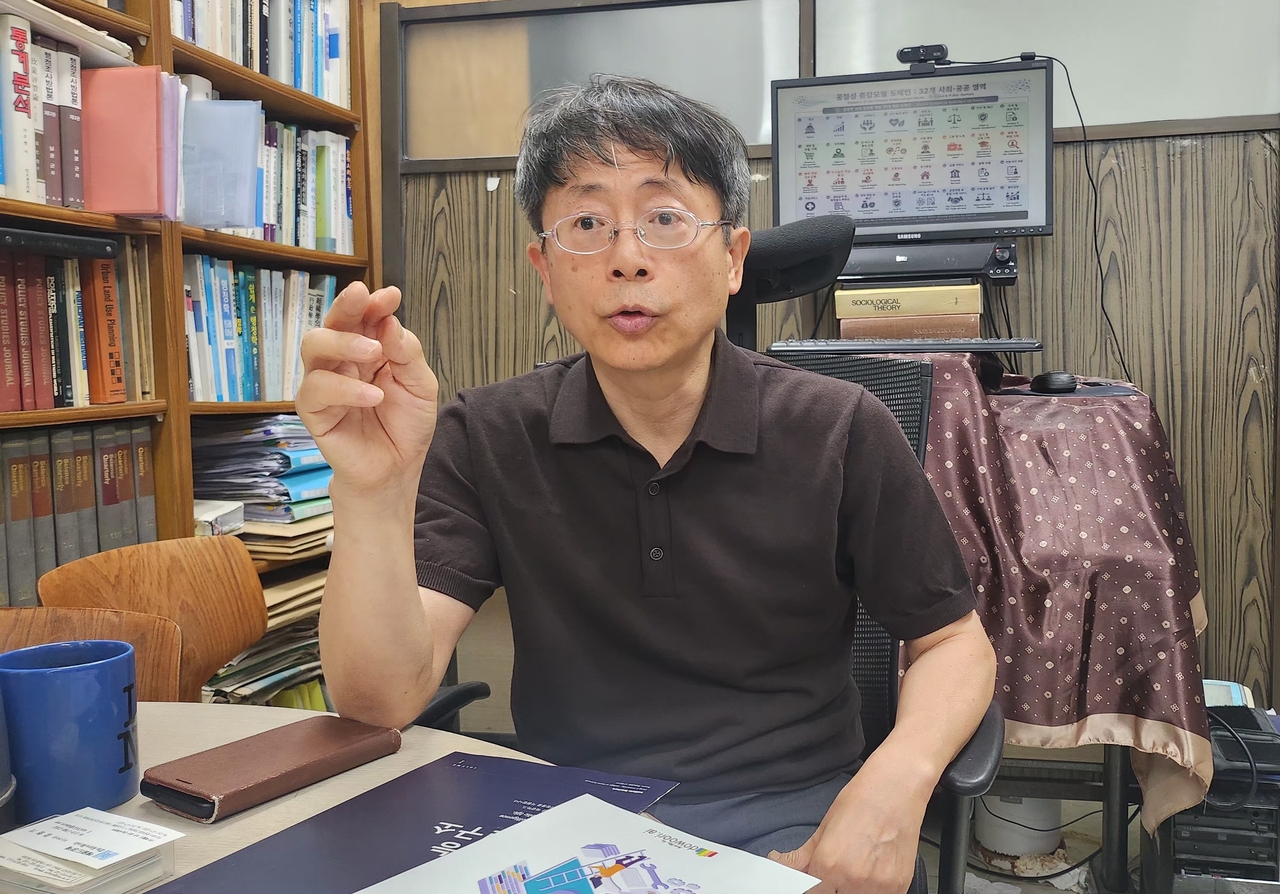
Can AI solve any of this? The Herald Business sat down with Han Se-eok, a professor at Dong-A University and director of its AI Government Research Institute, at the university's Bumin Campus in Seo-gu, Busan, on Wednesday. A former Samsung Electronics employee who has spent 30 years researching e-government, Han has developed what he calls a "fairness-augmentation solution" — a four-stage AI model covering detection, diagnosis, meta-evaluation and recommendation — to analyze structural unfairness across 32 areas of society. "AI cannot adjudicate fairness," he said. "But it can use data to expose unfair structures."
'Social legitimacy' — not elites or any particular government — as the standard for AI fairness
Han said mathematical indicators alone are not enough when it comes to setting the criteria by which AI judges fairness — a question he acknowledged is deeply sensitive.
"The fairness standard in this model is socially constructed fairness — derived by comprehensively learning from laws and court precedents, international norms, social science theory, civic perceptions and policy goals," he said. "It is not set arbitrarily by any particular group, whether elites or a government. It reflects constitutional values, legal coherence and social acceptability all at once."
Asked whether AI can guarantee neutrality in political and judicial domains — where value judgments inevitably intrude, as in debates over impeachment and insurrection — Han was unequivocal: there is no such thing as a perfectly neutral AI. Depending on what data is fed into it, the same event could be characterized by AI as either a "legitimate exercise of authority" or "damage to democracy."
"What matters is not what conclusion AI reaches, but whether the data and criteria used in the analysis can be made public," Han said. "Four safeguards are needed: data transparency, explainability, independent external verification and the right to challenge findings." He added that the neutrality of fair AI "comes not from neutrality of conclusions, but from procedural neutrality."
On the ballot shortage that emerged during the June 3 local elections, Han suggested AI could play the role of an early-warning system — detecting signals such as a risk of ballot shortfalls, sudden spikes in wait times at specific polling stations, or surges in complaints before they escalate. He drew a line, however, at using AI to determine whether an election was fraudulent, saying that remains the domain of courts, the National Assembly and audit bodies.
"AI must not conclude that 'this election was rigged,'" he said. "It should be a system that warns of danger before an incident, not one that apologizes after."
AI confirms youth deprivation in asset accumulation, real estate, employment and education
The sense of injustice felt by younger generations also came up. Han said AI cannot judge the rights and wrongs of intergenerational conflict, but it can measure the degree of imbalance in opportunities and resources. "We can derive an intergenerational fairness risk index by assigning weights to assets, housing, employment, education and political participation," he said. "What the data shows is that young people today are experiencing high levels of deprivation in asset accumulation, real estate, employment and education."
Han also identified structural patterns in finance, welfare and labor. In finance, the problem is what he called an "asset-based opportunity gap" — those who already hold assets benefit from the compounding effect of rising markets, while those who do not are left bearing high prices and borrowing risk. In welfare, the issue is a "need-benefit mismatch," where those who need help most are the least able to access the system. South Korea's Gini coefficient worsened in 2024 compared with the previous year, and the relative poverty rate stood at 15.3 percent. In labor, lifetime earnings are determined less by individual effort than by which company or type of employment a person belongs to. Wages at small and medium-sized enterprises stand at just 53.1 percent of those at large corporations.
"Finance, welfare and labor do not operate in isolation," Han said. "Differences in labor income accumulate into asset gaps, and those asset gaps reproduce themselves as differences in educational, housing, financial and employment opportunities. Exposing the entrenchment of this chain of inequality is what AI can do."
Youth exodus, restructuring — the Busan-Ulsan-South Gyeongnam region as the ideal testing ground for fairness AI
Han sees the Busan-Ulsan-South Gyeongnam region as the ideal testing ground for fairness AI. The area is experiencing a simultaneous convergence of youth exodus, manufacturing restructuring, aging and inner-city decline — making it, he said, the most suitable place to apply fairness AI in practice. He plans to expand its application in sequence, starting with social welfare, then licensing and permits, youth policy, public hiring and fiscal allocation.
"The core of AI government should be fairness, not efficiency," he said. "Faster approvals mean nothing if favoritism persists, and automated welfare breeds distrust if discrimination remains." His goal, he said, is not merely an "intelligent government" but a "fair government."
When critics noted that detection findings are useless if they do not lead to actual policy reform, Han agreed. "That is precisely the governance problem," he said. He argued that the solution requires a fairness governance framework running from detection and diagnosis through meta-evaluation, recommendation, implementation, audit and re-evaluation — backed by the enactment of a tentatively named Basic Act on AI Fairness, the introduction of citizen panels and the establishment of an independent external verification committee.
"AI is not a technology that automatically delivers fairness," Han said. "It must become a public decision-making infrastructure that supports society in improving fairness on its own terms." Whether AI fairness succeeds, he said, depends "not on the accuracy of the model, but on how well we build the implementation framework that turns its findings into institutional reform."
kaf2002@heraldcorp.com