Korea Forest Service chief vows to complete 'K-forest policy' spanning desertification, REDD+ and supply chain security
As climate change rapidly reshapes environmental ecosystems worldwide, UN-led efforts and those of individual nations to address the crisis have grown markedly.
South Korea's Korea Forest Service has expanded its role well beyond wildfire control, drawing international attention in areas such as desertification prevention and REDD+ climate policy. The agency's overseas development assistance projects in forestry and its work on carbon credit acquisition — particularly with ASEAN and Latin American countries — have produced results worth noting.
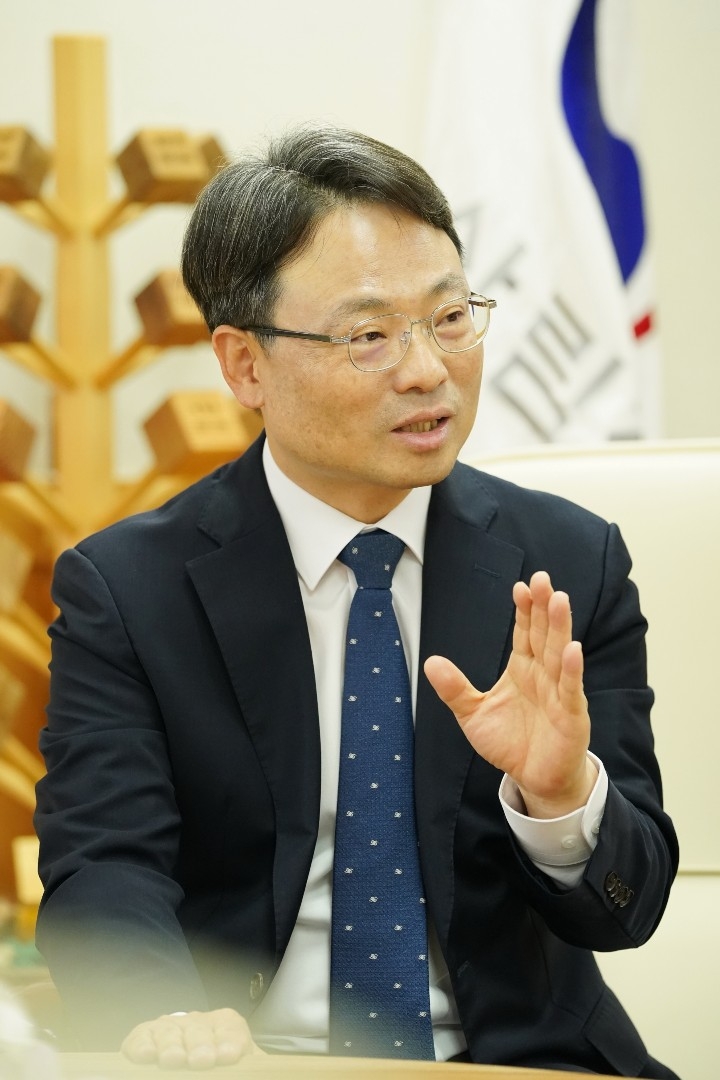
The Korea Herald sat down with Korea Forest Service Commissioner Park Eun-sik to examine the outcomes of overseas forestry cooperation amid rapidly shifting climate conditions and to explore the agency's policy direction and priorities in the global forestry market.
Q: The Korea Forest Service has been stepping up international cooperation activities to mark World Day to Combat Desertification and Drought. What were the key achievements in the first half of 2026, and what activities are planned going forward?
A: The Korea Forest Service marked World Forest Day on March 21 and World Day to Combat Desertification and Drought on June 17 with commemorative events aimed at building international consensus on forest policy.
On World Forest Day, under the theme "Forests and the Economy," the agency shared the value and role of forests with ambassadors and diplomatic officials from 13 countries at the DMZ forest. For the desertification and drought awareness day, it ran tailored public outreach campaigns by generation to help citizens better understand the increasingly serious global problems of desertification and land degradation.
State visits by the leaders of Indonesia and France in April provided opportunities to strengthen cooperation in forestry, including wildfire management. The agency concluded a wildfire cooperation memorandum of understanding with Indonesia and a forest cooperation agreement, and signed a wildfire cooperation letter of intent with France — covering areas directly tied to the safety and livelihoods of citizens in both countries. It also identified practical cooperation models, including implementation of a program to train wildfire experts from 15 Asian countries under the Asian Forest Cooperation Organization.
In August, the agency plans to use the 17th Conference of the Parties to the UN Convention to Combat Desertification, to be held in Mongolia, to promote the 20th anniversary of the Korea-Mongolia Green Belt initiative and showcase desertification restoration achievements, enhancing the country's international standing. It will also publicize South Korea's contributions to land degradation neutrality, dryland greening and sand and dust storms, and operate a pavilion marking the 15th anniversary of the Changwon Initiative to promote land degradation neutrality and dryland greening.
The agency will also expand strategic forest cooperation in digital forest management using forest satellites and forest disaster response, timed to summit meetings with Mongolia in July and Central Asian nations in September.
Q: With South Korea's 2035 nationally determined contribution finalized last November, the importance of the Korea Forest Service's Reducing Emissions from Deforestation and Forest Degradation (REDD+) projects in developing countries has come into focus. What is REDD+, why does the agency consider it important, and what is the current status?
A: REDD+ refers to activities that reduce carbon emissions by curbing deforestation and forest degradation in developing countries while strengthening sustainable forest management and conservation. The finalization of the 2035 NDC last November has given fresh momentum to the Korea Forest Service's REDD+ work.
The agency is advancing REDD+ projects and building implementation frameworks in four countries, including Laos and Honduras, which already have emissions reduction experience. Through the Forest Carbon Partnership Facility, a results-based payment REDD+ project is under way across six northern provinces, targeting a total reduction of 5.04 million tons of CO2 equivalent between 2019 and 2024.
In Honduras, a national-level project is pursuing a reduction of 11.7 million tons of CO2 equivalent along with internationally transferred mitigation outcomes. In Vietnam, the Forest Carbon Partnership Facility is running a results-based payment REDD+ project across six provinces in the north-central region, targeting a reduction of 16.21 million tons of CO2 equivalent for the 2018–2019 period.
Q: Amid global instability — including the Middle East war — what are the key achievements and future plans in forestry trade, including management of imported timber supply chains and exports of forest products?
A: The Korea Forest Service is working to stabilize the timber supply chain in response to risks posed by the Middle East conflict, selecting and operating lead operators to secure supply chains for economically strategic items. The goal is to safeguard national security and the stability of the domestic economy by maintaining a smooth supply of key materials — including wood pellets, particleboard, pulp wood chips, medium-density fiberboard, plywood and cork.
The agency is also building a timber management system that meets international standards by eliminating illegal logging and promoting legal timber trade in response to shifting global trade conditions. The process runs from importers submitting required documents at the time of import declaration, to document inspection by the National Institute of Forest Science, to import requirement verification by the Korea Customs Service, and finally to customs clearance using the Korea Customs Service clearance system and the Korea Forest Service forest products trade system. The agency is also diversifying the timber supply chain through country- and market-specific free trade agreement management in response to the Middle East conflict.
As of last May, South Korea had 23 FTAs in force with 60 countries and had signed or concluded agreements with 10 more, while negotiations with nine others — including Mongolia, Thailand, Serbia, Bangladesh, Pakistan, India, ASEAN member states, Singapore and China — are ongoing. Export performance for forest products in the same period showed strong results in promising categories such as wooden cases, fiberboard and shiitake mushrooms, laying a foundation for K-forest products to expand into overseas markets.
In line with the government's policy to promote K-food globally, the Korea Forest Service plans to strengthen tailored support for expanding K-forest product exports — nurturing core export organizations such as integrated export bodies and export councils, providing customized package project support for exporting companies, and expanding export-specialized facilities. To counter concerns about export slowdowns caused by rising oil prices stemming from the Middle East conflict, the agency is working to minimize the burden on businesses through raw material purchase financing for exporters — 10.1 billion won ($6.54 million) at an interest rate of 2 to 3 percent — and export insurance support of 40 million won.
"We will go beyond building a successful K-wildfire management model to complete a K-forest policy that the world is watching — one that addresses desertification driven by climate change, REDD+ and other climate policy areas, and stabilizes supply chains for economically strategic forest sector items," Commissioner Park said.
kwonhl@heraldcorp.com