![A large banner welcoming semiconductor investment hangs outside the South Jeolla Province government building in Muan-gun on Tuesday, ahead of the midnight launch of the Jeonnam-Gwangju Special Integrated City — South Korea's first metropolitan administrative merger. [Yonhap]](https://wimg.heraldcorp.com/news/cms/2026/06/30/rcv.YNA.20260630.PYH2026063011510005400_P1.jpg)
Ready-mix concrete, cement and building materials first in line
Back-end equipment makers including Hanmi Semiconductor also set to benefit
Physical AI push raises hopes for robot and farm-machinery firms
As the government, Samsung Electronics and SK hynix commit to massive semiconductor investment in the southwestern Honam region, mid-sized and small manufacturers are watching closely for the ripple effects. Before equipment ever enters a chip factory, site preparation, structural framing, power and water infrastructure, and supplier complex construction must come first — and that early phase is already drawing optimism from ready-mix concrete, cement and building-materials companies.
According to industry sources on Tuesday, the government's "Three Mega-Projects for South Korea's Great Leap Forward," announced Monday, includes plans to build four semiconductor fabs in the southwestern region and develop a supplier and talent ecosystem at a cost of 800 trillion won ($519 billion). The Chungcheong region is set to receive 81 trillion won to establish a packaging hub, with support earmarked for new HBM fabs in Onyang and Cheonan and HBM packaging investment in Cheongju. A separate 20 trillion won in combined public-private funding is to be deployed by 2030 to build the foundation for manufacturing data, AI models and robot adoption as part of an AI transformation drive for the manufacturing sector.
Given the sheer scale of the investment, the potential beneficiaries are broad. Securities analysts and industry insiders expect materials, components and equipment companies to feel the benefits first once construction begins in earnest.
For the ready-mix concrete industry, which has been grappling with falling shipments amid a construction slump, the news is a welcome relief. An official at Eugene Group said by phone that the investment "appears likely to create new demand for the ready-mix concrete industry, which has been suffering from a sharp drop in shipments due to the severe construction slowdown," adding that Eugene, together with its affiliate Dongyang, operates plants in the Chungcheong and Honam regions, meaning "ready-mix concrete demand could rise sharply once site preparation and factory construction get under way in earnest."
Ready-mix concrete is a quintessentially regional material. Because it must be poured on-site within a set time after production, long-distance procurement is not practical. Once construction of the southwestern fabs picks up pace, the key question will be how many concrete plants, mixer trucks and aggregate yards can reliably supply the sites within range.
The cement industry is equally upbeat. An official at Sampyo Group said that "large-scale investment is naturally welcome for the industry when construction conditions are at their worst," adding that "the speed of breaking ground will be the key going forward now that the government and companies have announced their investment plans." While cement producers have nationwide production and distribution networks capable of meeting overall volume demand, actual site operations will require bulk cement trailer logistics, storage silos and aggregate supply to all come together.
Building-materials companies are also viewing the investment plans favorably. An official at KCC said that "if large-scale investment translates into actual construction, there is no reason for the building-materials industry to be unhappy," while cautioning that "it is still too early to forecast specific demand at the business-unit level based on this announcement alone — still, there is a sense of anticipation." KCC operates across construction materials, paints and silicone, giving it exposure not only to general construction activity but also to industrial facility investment.
The glass industry, too, is hopeful that domestic companies will have a role in building the fabs and supplier complexes. An official at KCC Glass said that "since these are projects ordered by the government and major domestic conglomerates, domestic glass makers are more likely to be considered over imported glass," and that "given the limited number of major domestic flat-glass producers, the realization of related investment could be a positive factor." Beyond the fabs themselves, construction of ancillary facilities — research buildings, office blocks, supplier factories and dormitories — would generate additional demand for glass, windows and interior and exterior finishing materials.
Among semiconductor process equipment makers, Hanmi Semiconductor is widely cited as a direct beneficiary. The government's announcement that it will develop the Chungcheong region into an HBM packaging hub has raised expectations that investment momentum will spread to the back-end equipment sector. Hanmi Semiconductor has long been regarded as a leading mid-sized equipment company poised to benefit from expanding AI semiconductor investment, on the strength of its TC bonders and advanced packaging equipment used in HBM production.
Physical AI and robotics form a separate beneficiary cluster. The government said it will push to spread AI robots tailored to factory floors alongside the broader manufacturing AI transformation drive. As manufacturing automation and robot pilot programs expand, mid-sized and small robot and farm-machinery companies stand to gain new business opportunities. Daedong and TYM, among others, have been broadening their scope into autonomous farming equipment, robots and agriculture data-based services, putting them in alignment with the government's physical AI policy.
Daedong has positioned the robotization of farm machinery and AI-based agricultural management services as its future business. The company is expanding into autonomous tractors, agricultural robots and precision farming solutions built on operational data accumulated in the field. TYM is also developing autonomous farm equipment and unmanned technology. Should the government's physical AI pilot programs extend into manufacturing, agriculture, logistics and safety, farm-machinery companies could move beyond simple finished-product sales to test data- and service-based business models.
Industry insiders say speed and execution will be critical for the investment's ripple effects to materialize. A mid-sized manufacturer official said that "semiconductor investment may look like big-business investment, but on the ground, materials, equipment, logistics, maintenance and automation companies all move together," adding that "concrete and building materials could see benefits first in the early construction phase, with the gains then broadening to process equipment, manufacturing automation and robotics companies."
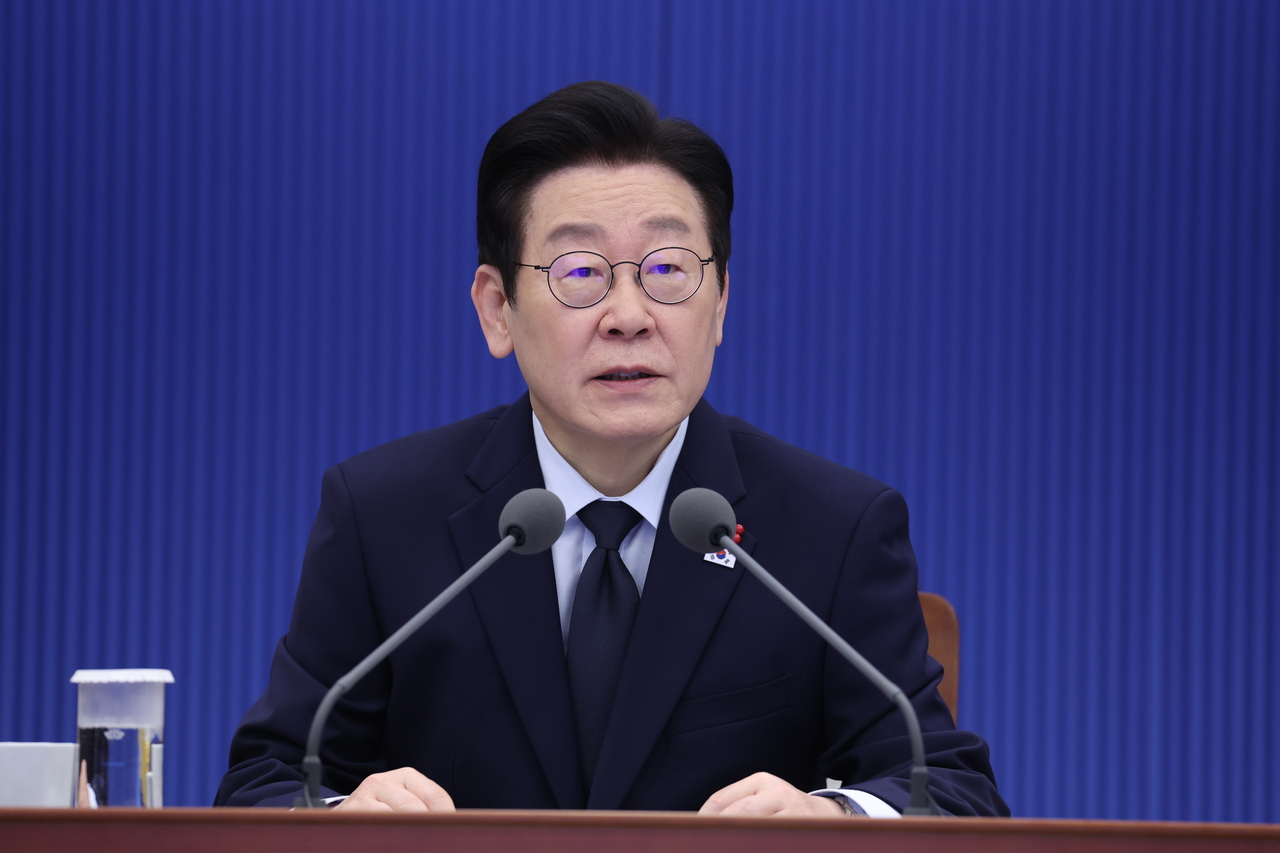
![President Lee Jae-myung speaks at a public briefing on the three mega-projects held at Cheong Wa Dae on Monday, urging that existing production hubs be completed quickly to meet "explosively growing semiconductor demand" and that "overwhelming supply capacity be secured in advance through large-scale new investment in the southwestern region." Pictured is the construction site of the Yongin Semiconductor Cluster general industrial complex in Yongin, Gyeonggi Province, also on Monday. [Yonhap]](https://wimg.heraldcorp.com/news/cms/2026/06/30/rcv.YNA.20260629.PYH2026062913610001300_P1.jpg)
hong@heraldcorp.com