Why a 140-member stablecoin consortium has emerged
Market shifts from individual issuers to global alliances
Competition moves toward securing payment networks and platforms
Korean firms act early amid domestic legislative vacuum
![[Screenshot from the Open Standards website]](https://wimg.heraldcorp.com/news/cms/2026/07/01/news-p.v1.20260701.9a620a4d3dc54b59b0988293f4d74775_P2.png)
A coalition of more than 140 global companies — including Visa and BlackRock — has entered the stablecoin market long dominated by Tether and Circle, launching a digital currency called OpenUSD and intensifying competition in the digital asset space. Particularly notable is the participation of major South Korean firms across different sectors, including Samsung Electronics, Shinhan Financial Group and Dunamu. The move is widely interpreted as a preemptive bid to secure global business opportunities amid concerns that the institutionalization of a won-denominated stablecoin may be delayed longer than expected.
The launch of OpenUSD has prompted market observers to predict that the stablecoin market's competitive landscape will shift from individual issuers to global corporate consortiums. Where the credibility of issuers and the size of their reserve assets once determined competitiveness — as was the case with Tether and Circle — analysts say the new battleground will be how many payment networks, platforms and financial institutions a single ecosystem can bring together.
Yoon Seung-sik, head of research at Tiger Research, identified network effects as the project's core competitive advantage. "Stablecoins are ultimately a form of currency, so companies that secure large-scale usage channels will inevitably have the upper hand," Yoon said. "The center of gravity is shifting from competition among issuers to competition over securing real-world use cases and payment networks." PayPal has issued its own stablecoin, PYUSD, but its market influence has remained limited.
The project is also expected to shake up the Tether-and-Circle duopoly. Shares of Circle Internet Group fell 17.55 percent to $62 in New York trading overnight, with markets interpreting the drop as a sign that the arrival of a compliance-oriented stablecoin poses a threat to Circle, which had long commanded a premium. "If global payment companies form a consortium to issue a stablecoin, it will eat into Tether and Circle's market share," one securities analyst said.
Still, the prevailing view in the market is that OpenUSD is less likely to immediately topple the Tether-Circle duopoly than to mark the beginning of a broader multipolar shift in the stablecoin space. "I don't think the market will solidify around just two stablecoins," Yoon said. "It is a natural progression for various stablecoins to emerge and build their own ecosystems, and this project is a prime example of that trend."
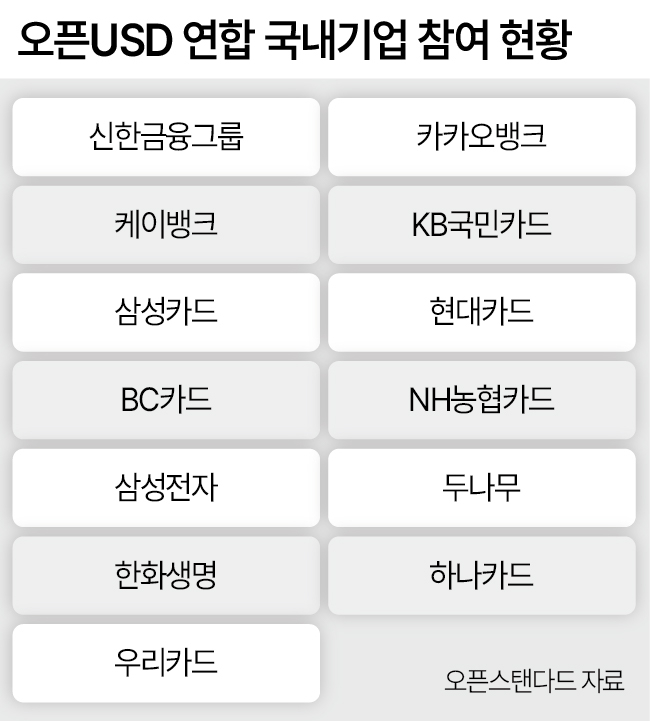
Behind the push by major South Korean players to look overseas lies uncertainty over domestic legislative delays. Calls for enacting a basic digital assets law have grown louder in political and industry circles since the local elections, but concerns remain that the actual passage of legislation and the subsequent rollout of business operations could take considerable time.
A growing sense of urgency has taken hold that growth strategies cannot be built on the domestic market alone. At a policy symposium held June 22 at Hashed Lounge in Gangnam, Seoul, analysts suggested that even after a basic digital assets law is enacted, full business licensing for operators could come as late as 2029 at the earliest.
At the event, participants noted that if the Financial Services Commission submits its draft bill to the National Assembly by the end of this year, it would still need to go through a consolidation and review process with previously introduced bills early next year. Factoring in subcommittee scheduling, the revision of subordinate regulations and grace periods, the bill's passage could slip to next year or later — pushing the full licensing process back by as much as three years.
"Because there is no domestic law in place, even institutional players have no idea what kind of business they can pursue in stablecoins or security token offerings," one industry expert said. "Aligning with the global direction is the only sensible choice from a risk management standpoint."
kyoung@heraldcorp.com
forest@heraldcorp.com