Ministry of Statistics data on June food consumer price index
Domestic and imported beef among meats rising above average
Kimbap, tteokbokki up around 4% as dining-out costs climb
Second-half price hikes continue: 'Felt impact even higher'
Food prices continue their steep climb. Staple ingredients such as rice and doenjang posted double-digit year-on-year increases in June, while popular street foods kimbap and tteokbokki also rose faster than the overall average.
The ongoing fallout from the Middle East war throughout the first half of the year, combined with climate-driven supply imbalances worldwide, has kept upward pressure on prices. With major food and restaurant companies preparing full-scale price hikes in the second half, consumers are expected to feel the pinch even more acutely.
According to item-by-item June statistics released Thursday by the Ministry of Statistics, the overall consumer price index for agricultural, livestock and fishery products rose 3.2 percent — matching the month's headline CPI average. But the gaps between individual items were stark.
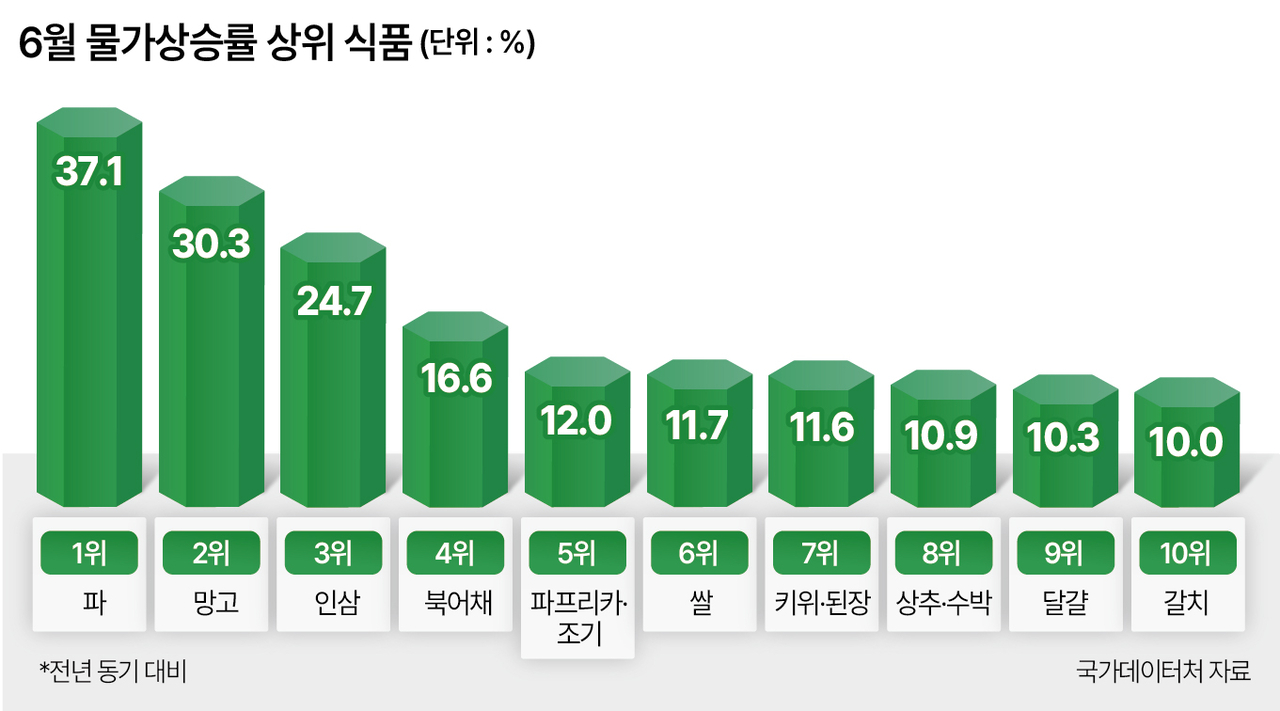
Green onions led all food items, surging 37.1 percent from a year earlier — more than 10 times the overall average. Mangoes ranked second with a 30.3 percent increase, driven by rising air-freight costs tied to the Middle East war. Ginseng (24.7 percent), dried pollack strips (16.6 percent), and paprika and yellow croaker (12.0 percent) followed.
Rice (11.7 percent), a Korean dietary staple, also ranked near the top. Prices have remained elevated since late last year following a government forecasting failure. According to the Korea Agro-Fisheries and Food Trade Corporation, the national average retail price of domestically grown rice (20 kilograms) stood at 60,800 won ($39) as of Thursday, up about 14.9 percent from 52,880 won a year earlier. Kiwi and doenjang each rose 11.6 percent, while lettuce and watermelon were up 10.9 percent.
Eggs (10.3 percent) also posted a sharp increase, still reeling from supply shortages caused by the highly pathogenic avian influenza outbreak last winter. The price of a 10-pack of large eggs surpassed 5,000 won for the first time since June statistics began being compiled, and by the end of the month had soared to around 5,300 won.
![A shopper examines eggs on display at a hypermarket in Seoul. [Yonhap]](https://wimg.heraldcorp.com/news/cms/2026/07/02/rcv.YNA.20260626.PYH2026062609950001300_P1.jpg)
Meat prices also weighed on household budgets. Domestic beef rose 7.5 percent, imported beef 6.8 percent and pork 4.5 percent. A drop in the number of cattle raised and slaughtered was cited as the main driver for domestic beef, while the exchange rate — now entrenched in the 1,500-won-per-dollar range as a "new normal" — pushed up imported beef costs. African swine fever outbreaks lifted pork prices. Chicken meat rose a relatively modest 2.3 percent, even as the price of fried chicken at restaurants climbed.
Seafood, heavily exposed to climate variability, told a similar story. Beyond yellow croaker, hairtail (10.0 percent), octopus (8.2 percent), mackerel (4.8 percent) and clams (4.6 percent) all exceeded the average. Processed fish products including dried pollack strips and salted fermented seafood (9.5 percent) were also elevated. The global food industry is watching the period from autumn through early winter closely. Scientists warn that warming Pacific Ocean temperatures could trigger the largest El Niño on record, a potential catalyst for broad price increases across both seafood and agricultural products.
Dining-out prices also rose well above the average. In June, galbitang (short-rib soup), kimbap, rice noodles and ready-to-eat foods recorded the steepest increase among restaurant menu categories at 4.2 percent. Hangover soup and tteokbokki (3.9 percent), jjamppong (3.7 percent), and bibimbap and naengmyeon (3.6 percent) followed, with increases concentrated in the everyday dishes most popular among ordinary consumers.
Prices are expected to climb even more steeply in the second half. Hotel buffets at the Grand Hyatt Seoul and Four Seasons, among others, raised their prices into the 200,000-won range starting Wednesday. Franchise chains such as Goobne Chicken opted for a "roundabout strategy," raising prices on side-menu items rather than main dishes. Convenience store soft-boiled and smoked eggs (two-packs) went up 100 won each, while baked eggs (three-packs) rose 200 won. In the broader food industry, Lotte Chilsung fired the opening shot on June 26 by raising factory-gate prices on 44 products — including Chilsung Cider — by an average of 5.3 percent.
Lee Hong-ju, a professor of consumer economics at Sookmyung Women's University, said the core problem is that prices are rising for essential items consumers buy frequently — eggs, doenjang and rice. "Because these are things people cannot easily cut back on, the price increases feel even sharper than the numbers suggest," she said. She added that food prices are unlikely to come back down "unless the government pushes hard," and that food inflation will likely remain elevated for now.
![The agricultural, livestock and fishery products section of a hypermarket in Seoul. [Yonhap]](https://wimg.heraldcorp.com/news/cms/2026/07/02/rcv.YNA.20260628.PYH2026062804630001300_P1.jpg)

"So that's why olive oil" — why Koreans may need it more [Food Obsession] Oils high in unsaturated fat are not automatically good for you. Unsaturated fats come in many forms, and the ratio of each type varies from oil to oil. The question is how much of what you are lacking is actually in the oil you choose.
soho0902@heraldcorp.com
siuu@heraldcorp.com