![[Generated with ChatGPT]](https://wimg.heraldcorp.com/news/cms/2026/07/02/news-p.v1.20260702.26117029d7534b719b7100c0d76cf065_P1.png)
Clad in black chef's coats and white aprons, they wield their knives with near-supernatural precision. Some sweat through survival cooking competitions, racing to plate a signature dish before rivals do. Others scramble to fulfill a guest's order in under 15 minutes, or go undercover at a local restaurant to prove their mettle. The rise of the "cheftainer" — part chef, part entertainer — has brought a surge of public attention to the world of gastronomy.
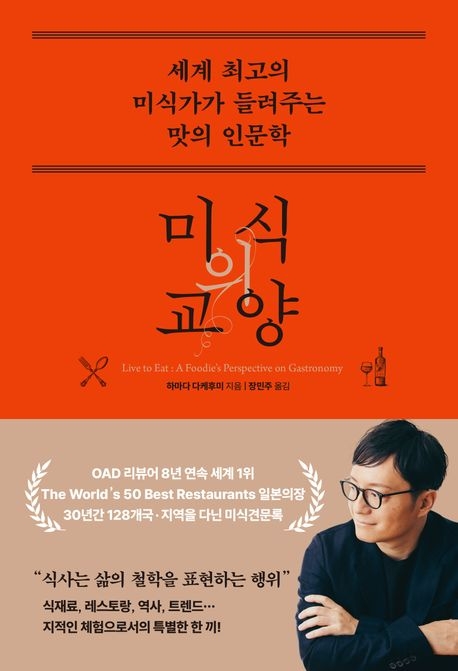
It is tempting to define gastronomy simply as food that tastes good, looks beautiful and costs a lot. But the reality is far more complex. The author of the newly published "Miksik-ui Gyoyang" (The Culture of Gastronomy) chairs the World's 50 Best Restaurants jury for Japan and has spent 30 years traveling to 128 countries in search of culinary knowledge. He argues that food is "an important window for understanding humanity and civilization," and that gastronomy, as its highest expression, resists any simple definition.
Rather than focusing on food alone, the author approaches gastronomy through the broader cultural ecosystem surrounding cuisine — what the West calls gastronomy, or in Japanese culinary discourse, "shokubunka." In this view, gastronomy extends well beyond mere deliciousness into the realm of cultural practice. The author contends that there is no objective standard for what "tastes good." Flavor, he argues, is shaped far more by subjective factors — personal preference, upbringing and food culture — than by any universal measure.
Preferences for saltiness, sourness, richness and texture can vary not only between individuals but between entire nations. In Italy, pasta is typically served with sauce absorbed into the noodles, while diners in South Korea, Japan and other Asian countries tend to prefer their pasta swimming in sauce. With no universal palate to appeal to, the author proposes a different benchmark for gastronomy: how rigorously a dish has been researched, and how fully it realizes the chef's vision. Dishes that meet these criteria, he argues, tend to satisfy a broad range of palates regardless.
The author also challenges common assumptions about food culture. Many assume that wealthier countries naturally have richer culinary traditions — but the evidence does not always bear this out. Germany ranks third in the world by per capita GDP, yet Bavaria, home to the high-income city of Munich, has remarkably few restaurants worth mentioning in the context of gastronomy, outside of the luxury resorts clustered in the Black Forest. Cambodia, by contrast, ranks around 140th in per capita GDP, yet the author found an abundance of high-quality restaurants when he toured the country.
The author also raises concerns about threats to sustainable gastronomy: growing polarization between restaurants, a climate crisis disrupting ingredient production, and a shortage of culinary talent driven by the low birth rate. He is particularly concerned about seafood, whose stocks have declined sharply due to global warming, pushing up prices and degrading flavor. "Japan's fish catch has been falling continuously since 1990, and globally, 30 percent of the total catch is discarded," he said. "If that could be put to use, it would generate enormous economic benefits for producers. In that process, the effort of chefs to transform these ingredients into something exceptional is indispensable."
"Miksik-ui Gyoyang" (The Culture of Gastronomy) / by Hamada Takefumi / translated by Jang Min-ju / The Quest
carrier@heraldcorp.com