Public sanitary pad dispensing service to begin July 6
Pilot program to run at public facilities across 12 regions nationwide
By Kim Do-yoon, The Herald Business
The government will provide free sanitary pads at select public facilities nationwide — including community centers, libraries and public health centers — regardless of age or income.
The initiative frames menstruation not as a personal financial burden but as a matter of everyday life and health rights, aiming to deliver an accessible, community-level public service available to anyone who needs it.
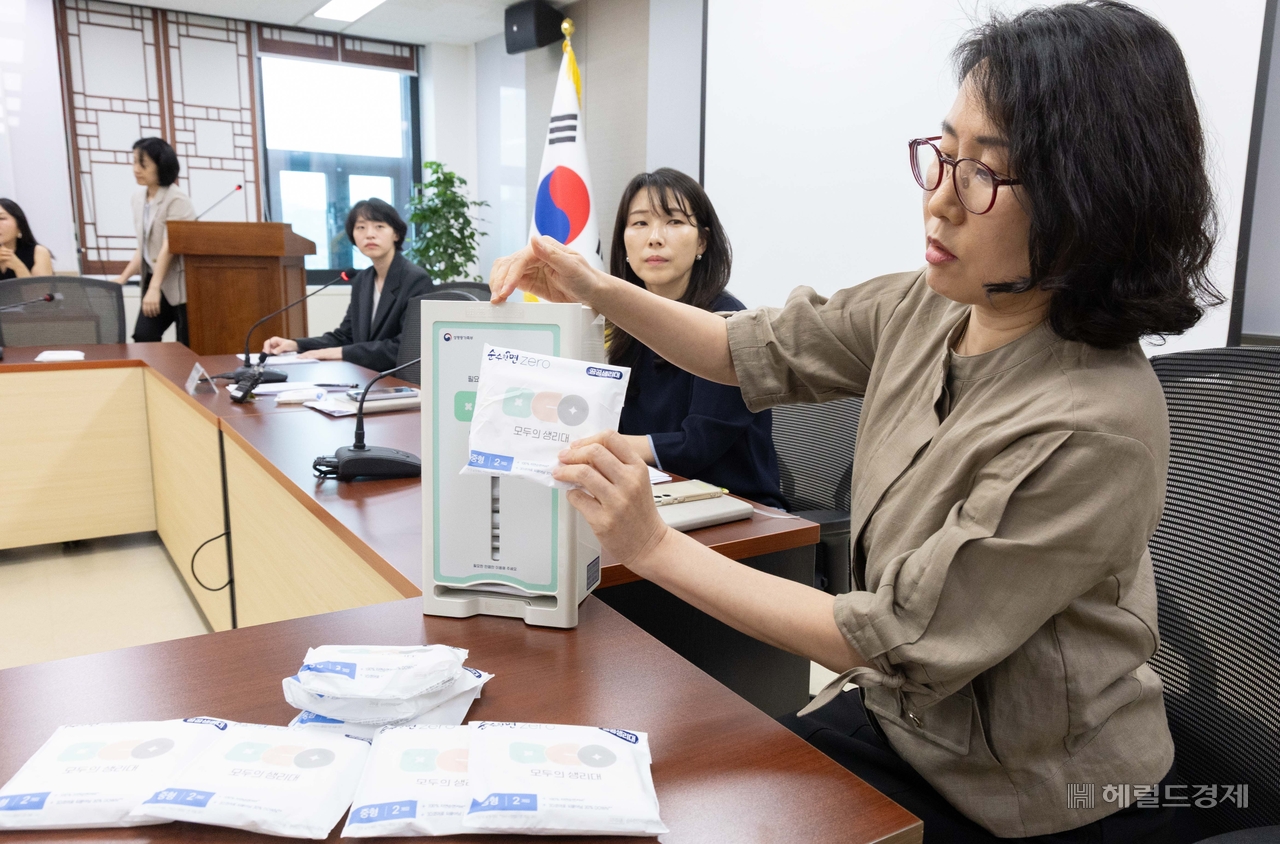
The Ministry of Gender Equality and Family demonstrated a manual sanitary pad dispenser at the Government Seoul Building in Jongno-gu, Seoul, on Thursday morning and announced that the public sanitary pad support service will launch July 6 at public facilities across 12 pilot regions nationwide.
The program will initially cover 12 of the country's 226 basic local government units. The pilot regions are Gwangjin-gu and Eunpyeong-gu in Seoul; Gwangmyeong and Suwon in Gyeonggi Province; Seocheon-gun in South Chungcheong Province; Jung-gu in Daejeon; Jeongeup in North Jeolla Province; Mokpo in South Jeolla Province; Buk-gu in Gwangju; Gumi in North Gyeongsang Province; Geochang-gun in South Gyeongsang Province; and Jeju.
The pilot will roll out sequentially, starting with Eunpyeong-gu in Seoul on July 6. The ministry plans to expand installation within the same week to Gwangjin-gu, Gwangmyeong, Jeongeup and Mokpo.
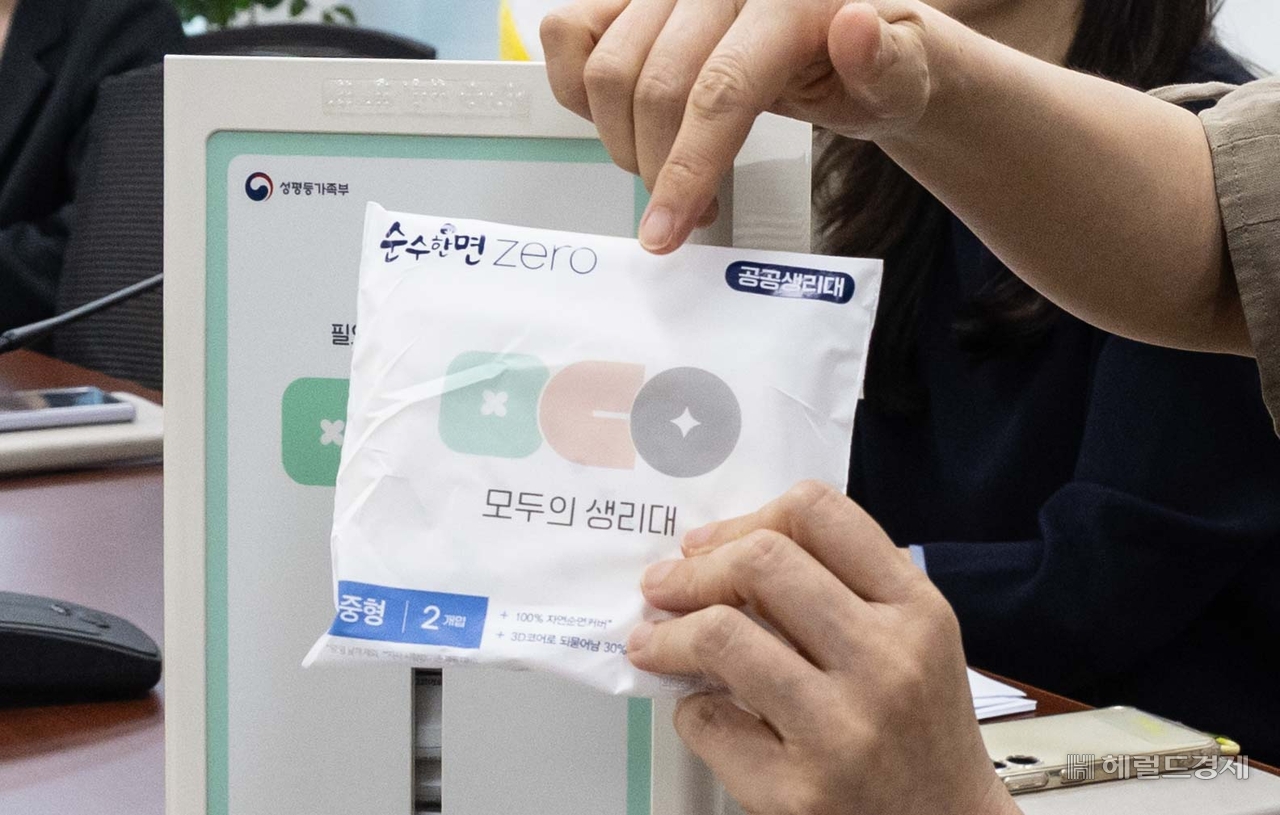
The public sanitary pads unveiled Thursday come in packaging bearing the phrase "Pads for Everyone," with each pack containing two standard-sized pads. All products are based on commercially available pads and are colorless and fragrance-free in accordance with Ministry of Food and Drug Safety standards.
Distribution will use both manual and automatic dispensers depending on each facility's conditions. Manual dispensers will be installed mainly inside women's restrooms or at small facilities with on-site staff. They require no power source and hold 18 packs per unit.
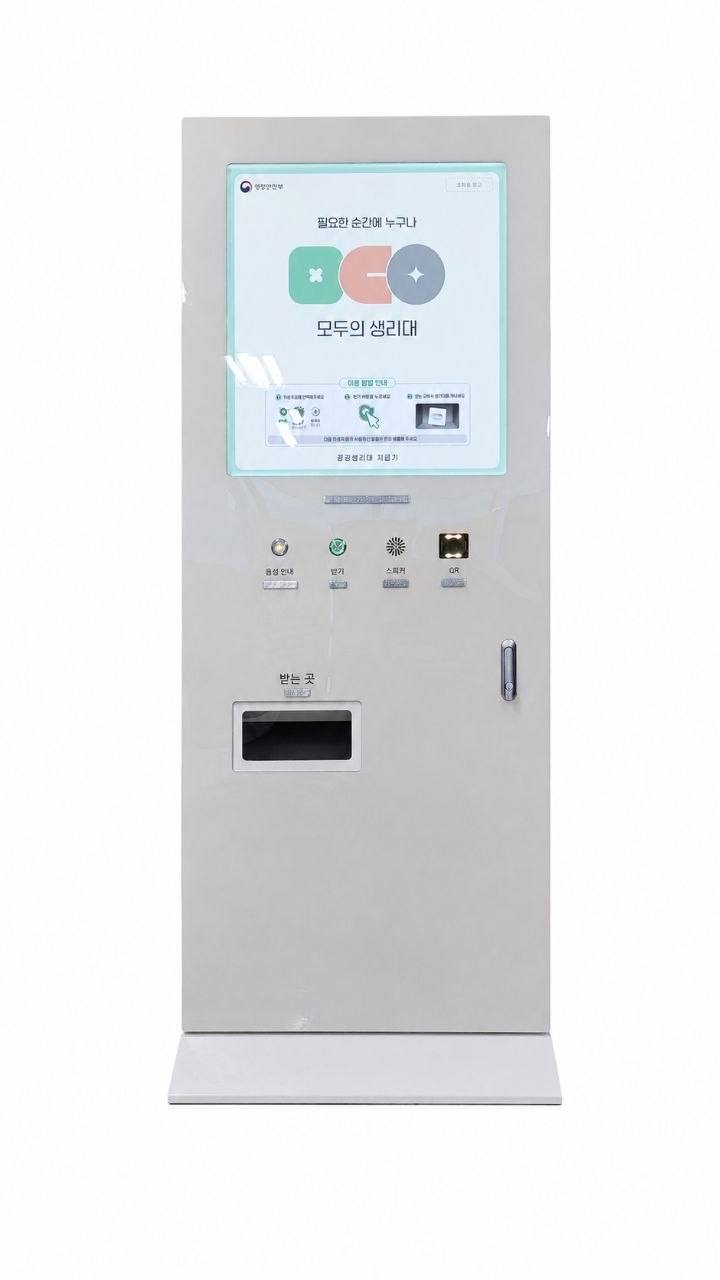
Automatic dispensers release a pack when a user presses a "receive" button on the front of the machine and can hold up to 170 packs per unit.
The automatic dispensers are equipped with Internet of Things technology for real-time inventory management. A 20-second cooldown between consecutive uses has been built in, and voice guidance and Braille functions have been added to ensure accessibility for visually impaired users.
The ministry said automatic dispensers will be installed at sites in stages from July 20, as the units require additional steps including product design, production and safety inspection.
A total of 700 dispensers will be installed — 300 manual and 400 automatic.
Safety was a central concern in preparing the program. "The most important factors we focused on from the start of preparations in March were safety and quality," a ministry official said. "We consulted with the Ministry of Food and Drug Safety from the product selection stage to verify safety standards, and considered both quality and price throughout the procurement process."
The government sees the program as filling gaps left by existing sanitary pad support schemes. Previous support took the form of vouchers targeted at low-income youth, but the new program removes age and income requirements, making pads available on an emergency basis to anyone at participating public facilities.
"We designed this to complement the blind spots that existing support programs could not cover, so that women can more easily access pads when they suddenly need them," a ministry official said. "During the pilot period, we will monitor usage volumes and patterns to refine the program."
No usage limits will be imposed for now. However, the automatic dispensers will enforce a 20-second cooldown between uses, and signage will ask users to "take only what you need." The ministry said it may consider additional restrictions if usage becomes excessive or misuse is observed during the pilot.
The program reflects a broader social awareness that has grown since the "insole pad" controversy of 2016 — when reports emerged of low-income girls using shoe insoles in place of sanitary pads — and the sanitary pad safety scare of 2017. Those episodes sparked serious public debate about whether access to safe sanitary products is a matter of women's rights, and a consensus formed that menstruation should be viewed not as a personal consumer issue but through the lens of universal human rights and health rights. The public sanitary pad program has been developed in that context.
Minister Won Min-kyung said the ministry would develop the program into "a convenient and stable community-level service," adding that she hopes diversifying the supply channels for sanitary pads will "indirectly contribute to price stability."
Information on participating facilities and dispenser locations is available on the ministry's website and the websites of the relevant local governments.
kido@heraldcorp.com