![The Kospi and other indexes are displayed on a screen at Hana Bank's dealing room in Jung-gu, Seoul, on Thursday. [Yonhap]](https://wimg.heraldcorp.com/news/cms/2026/07/03/rcv.YNA.20260703.PYH2026070301950001300_P1.jpg)
At 3:30 p.m. on Wednesday, real-time trading data showed foreign investors had net sold 5.49 trillion won ($3.53 billion) worth of shares, while institutional net selling stood at just 114.6 billion won.
But the numbers shifted dramatically the moment the market closed. As closing auction trades were reflected in the data, institutional net selling surged to a barely believable level — reaching 464.3 billion won by 3:31 p.m., then 2.07 trillion won by 3:33 p.m., and ultimately settling at 2.08 trillion won in the final tally. That was the mechanism behind a market that had been drifting lower on foreign selling suddenly turning into a 7%-plus freefall.
Heavy institutional net selling has been a fixture of every recent market crash. Foreigners have been dragging the market down with sustained net selling, but it is the addition of institutional selling on top of that which has been turning ordinary declines into sharp crashes.
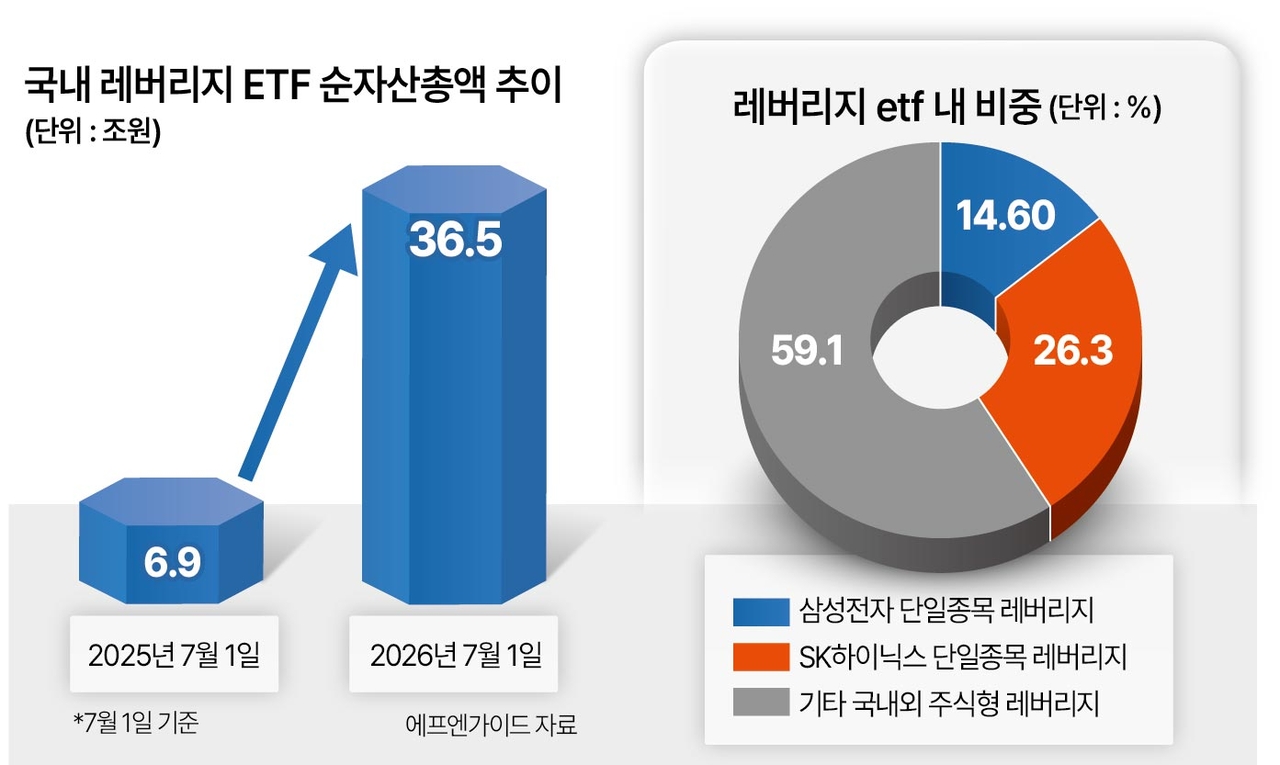
The breakdown of institutional selling tells the real story. The selling has been concentrated among investment trusts and financial investment firms. Industry observers point to single-stock leveraged products as the culprit, arguing that rebalancing flows from these instruments pile up late in the session and trigger the final-hour plunge. It is evidence that fears about single-stock leverage amplifying market volatility have now become reality.
According to Koscom, the Kospi closed Wednesday down 655.32 points, or 7.89 percent, at 7,648.09 — falling back to the 7,600 level just two weeks after closing above 9,000 for the first time, driven by a surge in large-cap semiconductor stocks.
The key to Wednesday's crash lies in how negative semiconductor news collided with a late-session supply imbalance. The timing is critical. Institutional net selling did not balloon to the 2 trillion won range over the course of the day — it happened in the three minutes immediately after closing auction trades were reflected. At exactly 3:30 p.m., institutional net selling stood at 114.6 billion won; by 3:33 p.m. it had jumped to over 2 trillion won. Leveraged ETF rebalancing and hedging flows concentrating near the close amplified selling pressure in the final minutes.
A closer look at the numbers makes clear who was actually selling. Of the 2.08 trillion won in institutional net selling that day, pension funds and similar entities accounted for just 2.4 percent. By contrast, financial investment firms — including brokerages — net sold 392.8 billion won, while investment trusts, which reflect asset management fund accounts, net sold 1.32 trillion won. Together, financial investment firms and investment trusts accounted for 82.3 percent of total institutional net selling — a wave of selling entirely unrelated to the national pension fund rebalancing issue that markets had been focused on.
Heavy institutional selling has acted as a persistent downward force on the Kospi since it broke above 9,000. Since the index closed above that level on June 18, there have been three sessions in which it fell more than 5 percent — and all three were accompanied by institutional net selling exceeding 2 trillion won. The largest came on June 23, when the Kospi plunged 9.99 percent and institutions net sold 4.48 trillion won. On June 26, when the index fell 5.81 percent, institutional net selling reached 4.12 trillion won, and on Wednesday, when it dropped 7.19 percent, the figure was 2.08 trillion won. Every major selloff since the Kospi crossed 9,000 has been accompanied by a flood of institutional supply.
A comparison with Japan's market makes the late-session shock in Korea even more striking. The Nikkei 225 also fell on Wednesday, dropping 2.47 percent to reflect weakness in US semiconductor stocks. But its additional decline from 2 p.m. to the close was limited to 0.81 percent. Over the same period, the Kospi fell 3.42 percent — roughly 4.2 times the Nikkei's late-session loss.
Industry observers attribute the outsized late-session drop to leveraged ETF rebalancing and hedging flows concentrating near the close. Because these products are designed to deliver a daily multiple of their underlying index's return, large moves in the underlying asset on a given day create a greater need to adjust exposure at the close. Single-stock leveraged products tied to Samsung Electronics and SK hynix are identified as a particular source of volatility, amplifying the vulnerability of Korea's semiconductor-heavy index structure.
"As money has poured into large-cap semiconductor stocks and single-stock leveraged products recently, a structure has emerged where buying pressure grows larger in rising markets and selling pressure grows larger in falling ones," a financial investment industry official said. "Wednesday's crash should be seen not simply as a reaction to concerns about the semiconductor industry, but as a process of unwinding supply-demand imbalances."
"Because leveraged products must continuously adjust their exposure in line with the underlying asset's moves, they can amplify pressure on both the buy and sell side in a volatile market," the official added.

kacew@heraldcorp.com