
Korea Development Bank Future Strategy Research Institute report
'US controls the brain, China controls the body' in humanoid robot sector
56% of companies entering humanoid market are Chinese
Manufacturing-heavy Korea has edge in large-scale data collection
By Park Hye-won, The Herald Business
South Korea is falling significantly behind the United States and China in the global physical AI market, and domestic companies have been slow to stake out a position, according to a new report. While the US holds an edge in software and China in hardware, the report also suggested that Korea could carve out a competitive niche in manufacturing-specialized AI, including autonomous factory systems.
Seo Ji-hun, a research fellow at the Korea Development Bank's KDB Future Strategy Research Institute, made the assessment in a recently published report titled "Analysis of the Physical AI Industry Ecosystem and Measures to Strengthen Competitiveness."
On the US market, Seo described it as a <style ref="s0">"brain-dominant ecosystem built on software hegemony."</style> "Tech giants such as Nvidia, Google and Tesla are leading 'brain' technologies through their capabilities in semiconductors, general-purpose AI models and cloud infrastructure," he said, adding that the US is setting global standards in training data and simulation environments. He also noted that massive capital flowing into startups specializing in robot foundation models is rapidly expanding the robot intelligence ecosystem.
China, meanwhile, has built an <style ref="s1">AI value-chain ecosystem</style> spanning semiconductors to finished robots. "AI platform companies such as Baidu and Alibaba have independently developed AI models, cloud services, robot operating systems and service platforms, growing on the strength of domestic demand," Seo said. "Companies including Unitree, UBTech, BYD and DJI have internalized the entire value chain through manufacturing-centered vertical integration, from core components to finished products."
China also dominates the global humanoid robot market, the report found. According to Morgan Stanley, 56 percent — or 52 companies — of all firms that have entered the global humanoid market are Chinese. Chinese companies account for 45 percent, or 22 firms, of integrators and finished-product manufacturers.
Seo said US companies are tightening their grip on the broader AI landscape. "In the global general-purpose AI market, US companies that have seized control of the 'brain' and 'platform' are strengthening their market dominance backed by enormous capital and technological prowess," he said. "There are structural limitations to domestic companies competing with independent models in terms of capital scale, data accumulation, AI infrastructure and global networks."
He said Korea's heavy reliance on foreign AI software stacks, AI semiconductors and platforms in the brain segment remains a key vulnerability, and that integrated ecosystem formation across physical AI sectors is still in its early stages. Domestic AI semiconductors are also only beginning to reach commercialization, he added. Seo identified the delayed localization of key components as a major weakness in humanoid robots and drones, the absence of a commercialized service platform in autonomous driving, and a poor industrial data platform in the AMR sector.
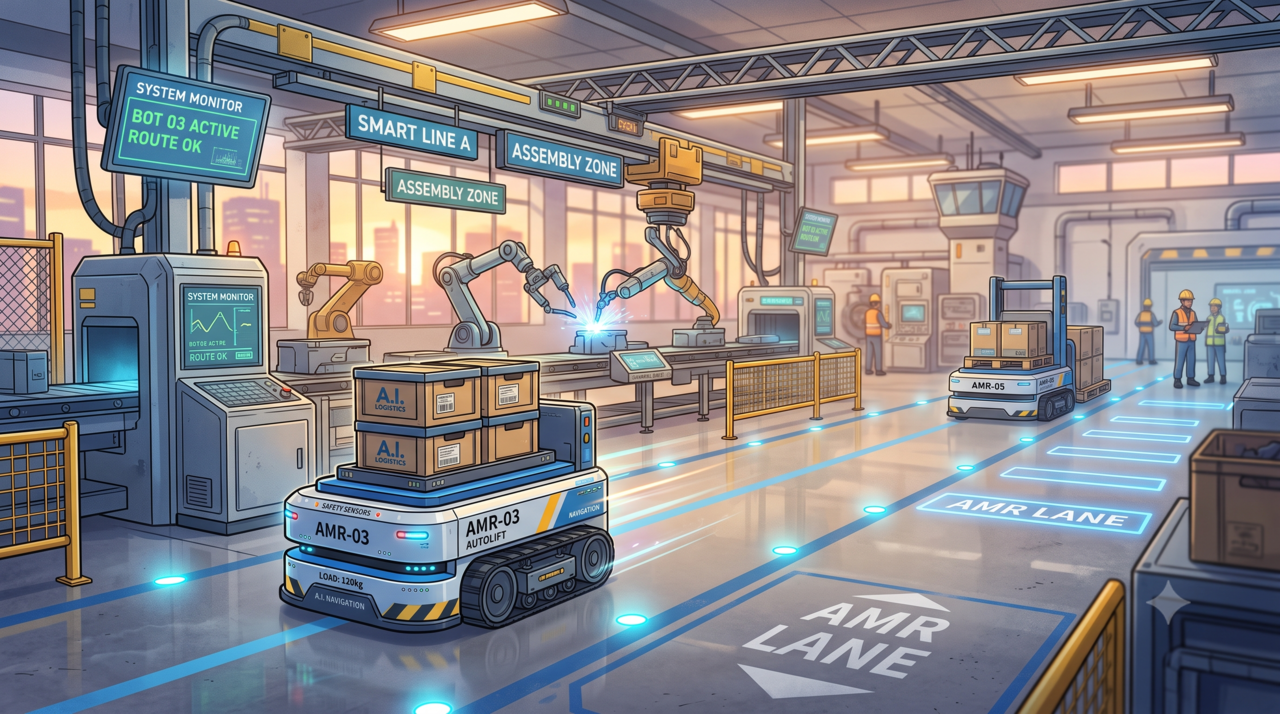
His prescription for securing an early foothold in the physical AI market is a <style ref="s2">manufacturing-specialized strategy.</style> Given Korea's manufacturing-centered industrial structure, the country is well positioned to get ahead in large-scale data collection, he argued. "A 'manufacturing-specialized physical AI strategy' using next-generation AMRs is more viable than pursuing general-purpose physical AI," Seo said. "Building an integrated ecosystem for high-level physical AI such as humanoid robots and self-driving cars requires considerable time and enormous capital, but the autonomous manufacturing market based on autonomous mobile robots, or AMRs, allows for early market entry by leveraging existing supply chains."
Seo said that "since on-site data is the core of competitiveness in manufacturing-specialized physical AI, it is necessary to resolve bottlenecks in the transition to autonomous manufacturing through systematic data asset-building on a data platform basis," and proposed forming industry-specific consortiums to build data collection and joint-learning platforms. The ultimate vision, he said, is to secure a proven model anchored by large conglomerates and then spread it to other industries.
klee@heraldcorp.com





