E-mart, Lotte Mart seen as potential beneficiaries as rivals eye 1.8 trillion won sales boost
E-commerce a wild card as every 1% rise in online spending cuts hypermarket sales by 0.264%
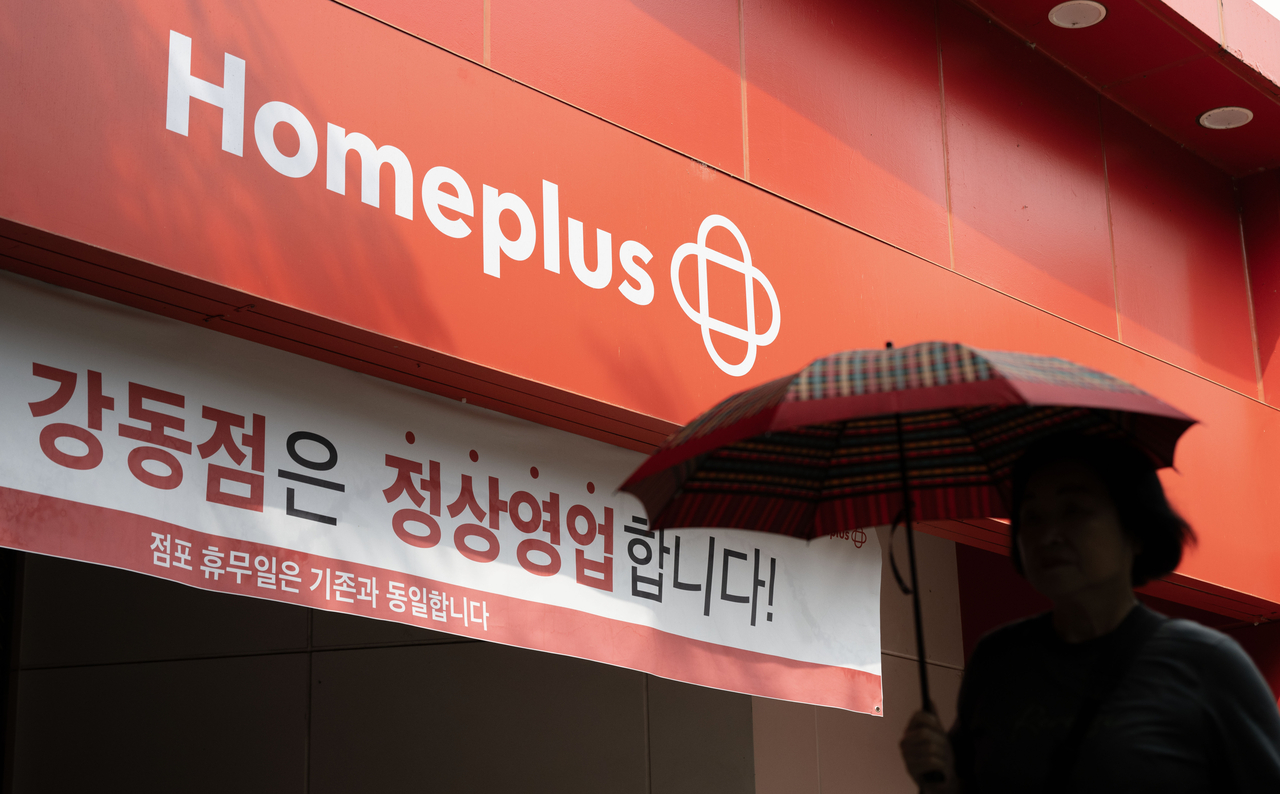
With Homeplus's court-led rehabilitation process terminated and the retailer now effectively heading toward bankruptcy, a two-horse race between E-mart and Lotte Mart appears set to define South Korea's hypermarket sector.
The Seoul Bankruptcy Court's Fourth Rehabilitation Division ruled Thursday to end Homeplus's rehabilitation proceedings — roughly 16 months after the company filed for court protection in March last year, according to legal sources. Homeplus has 14 days to file an immediate appeal. If it does not, the termination order becomes final and the company will proceed toward bankruptcy.
A Homeplus bankruptcy would further entrench the E-mart–Lotte Mart duopoly. E-mart currently operates the most stores nationwide with 133 locations, followed by Lotte Mart with 112. Lotte Mart climbed to second place after Homeplus trimmed its network from 126 stores to 67 core locations during the rehabilitation process.
Both rivals have already been posting strong results. E-mart's standalone first-quarter sales and operating profit came in at 4.72 trillion won ($3.03 billion) and 146.3 billion won, respectively — up 1.9 percent and 9.7 percent year on year. The operating profit was the highest for a first quarter in eight years. Lotte Mart also saw first-quarter sales rise 2.6 percent to 1.53 trillion won, with operating profit climbing 20.2 percent to 33.8 billion won.
A shift in consumer demand is already becoming visible. Since Homeplus began suspending operations at 37 stores on May 10, nearby E-mart and Lotte Mart locations have recorded higher sales. E-mart's Changdong and Mukdong stores, for instance, posted sales growth of 11.4 percent year on year in the June 10–31 period, outpacing the chain's overall same-store sales growth of 5.2 percent. Lotte Mart stores near shuttered Homeplus locations in Seoul also saw sales rise 9 percent year on year.
Lee Jin-hyeop, an analyst at Hanwha Investment Securities, estimated that Homeplus's combined offline and online hypermarket operations generate annual sales of around 6 trillion won. "If competitors absorb roughly 30 percent of that, the effect could be a sales increase of 1.8 trillion won and an operating profit gain in the 300 billion to 400 billion won range," he said.
Some analysts caution, however, that the windfall may be smaller than expected as the hypermarket sector stagnates and e-commerce continues to expand. Data from the Ministry of Trade, Industry and Energy showed hypermarket sales fell 5.1 percent year on year in May, while online sales rose 8.8 percent. A report published last month by the Korea Development Institute also found that every 1 percent increase in per-capita online spending reduces hypermarket sales by 0.264 percent.
![A petition from members of the retail industry union's Homeplus chapter is posted outside a Homeplus store in Seoul on Friday, as the retailer effectively headed toward bankruptcy after failing to find a buyer. [Yonhap]](https://wimg.heraldcorp.com/news/cms/2026/07/03/rcv.YNA.20260703.PYH2026070310870001300_P1.jpg)
korean@heraldcorp.com