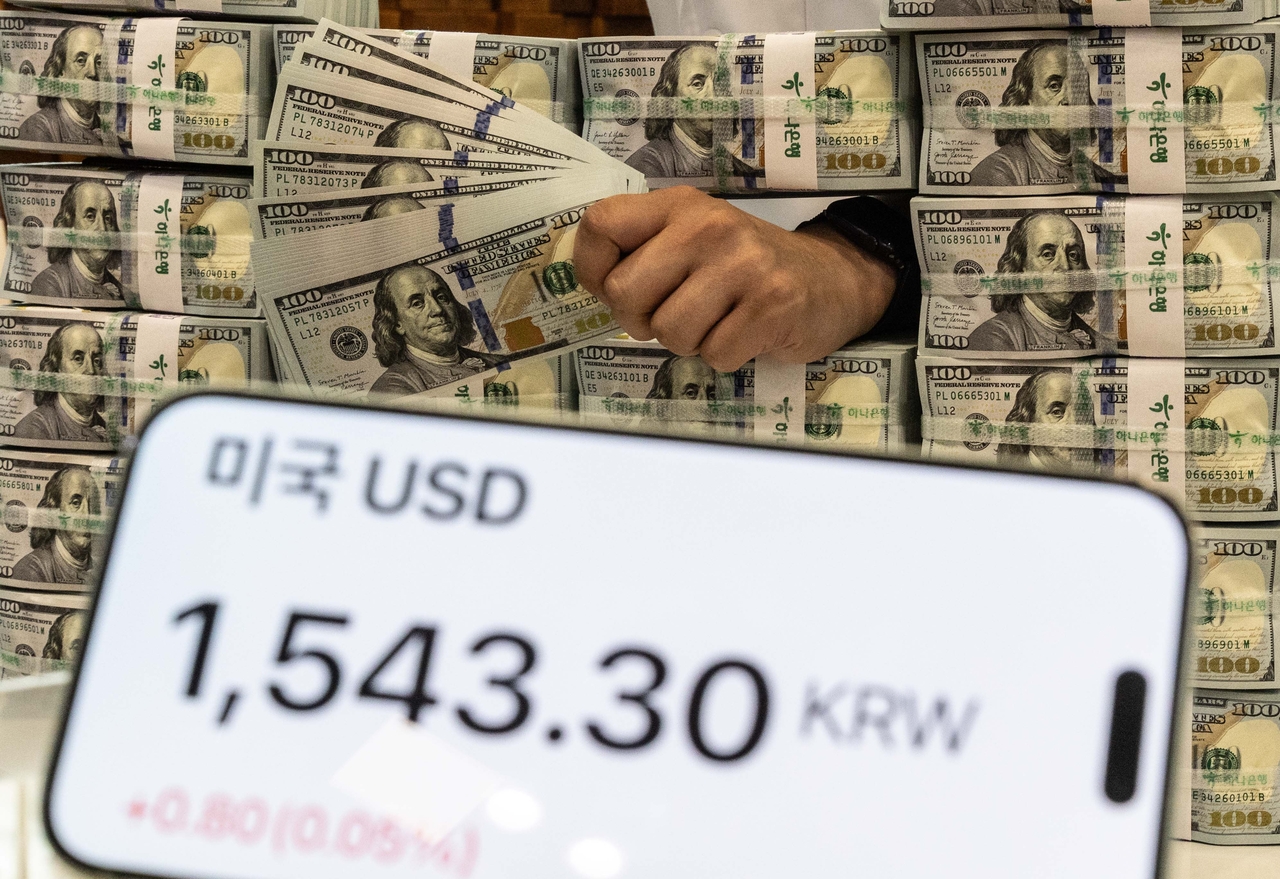
The won-dollar exchange rate has structurally shifted above the 1,400-won level since last year, and the high-rate environment is likely to persist for the foreseeable future, according to a new analysis.
A report by Korea Institute of Finance senior researcher Park Hae-sik, titled "Assessment of the Possibility of a Structural Upward Shift in the Won-Dollar Exchange Rate," found that the exchange rate is undergoing a structural change marked by a gradual rise and is unlikely to return to past levels in the near term. The report was based on data through April, when the weekly closing average for the won-dollar rate stood at 1,485.0 won.
Analyzing exchange rate movements from January 2015 through April this year, the report identified three structural breaks — in April 2019, April 2022 and March 2024 — after each of which the average rate rose in stages to 1,168.7 won, 1,312.4 won and 1,408.2 won, respectively.
Through the first half of 2024, the rate largely moved in the 1,200-to-1,300-won range, but from the second half of that year onward it has mostly held in the 1,400-to-1,500-won range, dipping briefly into the 1,300s only on occasion. The report attributed this to a combination of rising dollar demand driven by South Koreans' expanding overseas securities investment and a broader global strengthening of the dollar.
Park forecast that upward pressure on the exchange rate would continue through February next year.
"Absent additional external shocks, the exchange rate is more likely to remain near its current level than to quickly return to past levels," he said. "Domestic financial institutions need to closely examine the impact that a prolonged high exchange rate could have on their profitability and capital adequacy."
The upward trend has continued since the report was written. The won-dollar rate closed above 1,500 won for 34 consecutive trading days through Friday, and on Tuesday it surged as high as 1,559.2 won during trading, setting a new yearly high. Friday's weekly closing rate was at least the lowest since June 17, when it closed at 1,513.4 won.
forest@heraldcorp.com