
![A Homeplus store in Seoul on Sunday, as the retailer edges closer to bankruptcy after a court ordered the termination of its receivership proceedings. [Yonhap]](https://wimg.heraldcorp.com/news/cms/2026/07/07/news-p.v1.20260705.1642de53bc4647c0ae0c2112b3a029e3_P1.jpg)
With Homeplus effectively heading toward bankruptcy following a court order to terminate its receivership proceedings, the financial sector's chances of recovering its funds are narrowing. Domestic commercial banks have concluded that roughly 100 billion won ($65.3 million) in direct loans extended to Homeplus is unrecoverable and have completed the write-off process, while also exploring ways to recoup funds invested through store-acquisition vehicles. Card companies that prepaid suppliers on Homeplus's behalf are similarly focused on building up loss provisions.
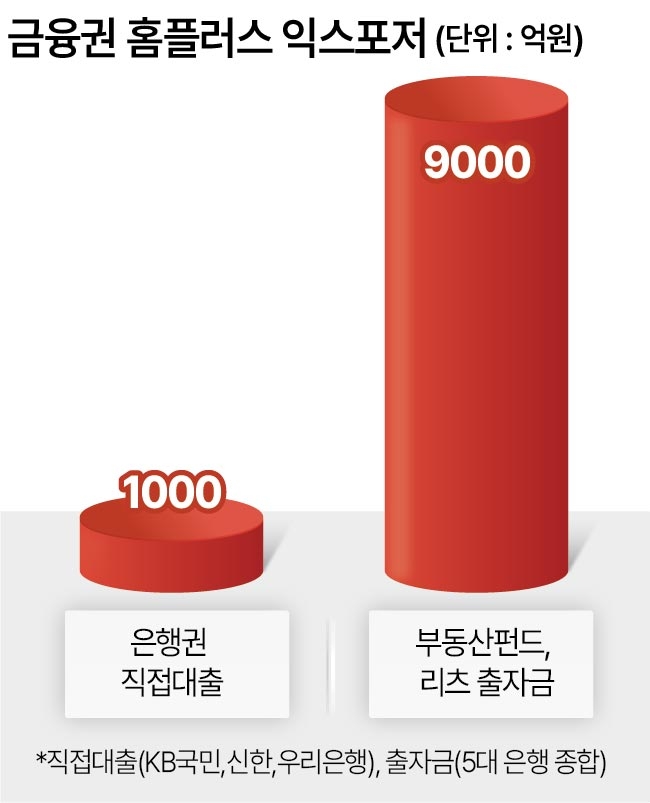
According to financial industry sources Tuesday, KB Kookmin Bank, Shinhan Bank and Woori Bank together hold 102.7 billion won in Homeplus loans — all extended directly to the retailer's headquarters. Of the remaining two among the five major banks, Hana Bank and NongHyup Bank had no direct loan exposure.
The three banks wrote off all of those receivables in June last year, shortly after Homeplus entered receivership, having determined that recovery was unlikely and booking the amounts as losses. "We had been consistently building up loan-loss provisions from the moment signs of trouble at Homeplus first emerged," a bank official said. "Since all the banks that extended direct loans are junior creditors, we concluded that even if asset sales proceed after a bankruptcy declaration, there would effectively be nothing left to recover."
Beyond direct loans, the banks also channeled funds into special-purpose vehicles and real estate investment trusts set up to acquire Homeplus store properties. The five major banks — KB, Shinhan, Hana, Woori and NH — have combined exposure of around 900 billion won through such vehicles. Across the broader financial sector, including card companies, the total is estimated at around 3 trillion won.
The financial industry's view is that an immediate deterioration is unlikely for these funds, since they were invested in special-purpose companies that acquired the store properties rather than in Homeplus directly. However, Homeplus as the tenant has been unable to pay even its rent, leaving the funds with virtually no prospect of generating returns. Some financial firms have begun reviewing options to exit their positions.
"One option is to find a new tenant since Homeplus can no longer pay rent," an official at one financial firm said. "As a financial institution, failing to properly manage these funds could expose us to breach-of-fiduciary-duty liability, so we have no choice but to find an exit strategy." Another official said "the scale and timing of any recovery will depend on the asset value and collateral of each property, the seniority of the claims, and how the process unfolds."
Card companies that supplied corporate purchasing cards to Homeplus are also grappling with deepening uncertainty. Under the arrangement, when Homeplus paid its suppliers by card, the card company would advance the funds and then collect from Homeplus — meaning the card company directly absorbed the retailer's credit risk.
Lotte Card has the largest exposure. Like Homeplus, Lotte Card counts MBK Partners as its largest shareholder. As of the end of last year, Lotte Card had classified its entire 79.33 billion won in Homeplus-related receivables as "estimated losses," setting aside 20.4 billion won as a bad-debt allowance and 58.9 billion won as a bad-debt reserve. The allowance counts as an accounting expense and flows through the income statement, while the reserve is carved out of retained earnings and does not directly affect profit or loss.
On whether to write off the receivables entirely, Lotte Card said it would "wait and see how the situation develops as the termination of receivership is confirmed and the case moves into bankruptcy proceedings before making a decision."
Asset-backed short-term bonds issued against card receivables — known as ABSTB — amount to around 401.9 billion won. Lotte Card and Hyundai Card account for roughly 200 billion won each, while Shinhan Card holds about 20 billion won. These instruments, however, do not translate into losses on the card companies' own assets.
"Because card companies have already settled the purchase payments, any losses on those ABSTB instruments do not become losses on the card companies' own assets," a card company official said. "Since we hold no direct purchasing-card receivables, the termination of Homeplus's receivership will not require us to set aside additional provisions or affect our earnings."
Financial regulators are focused on preventing the fallout from spreading to Homeplus's network of suppliers. On Monday, they convened representatives from the banking sector and the Korea Credit Guarantee Fund to discuss financial support measures aimed at limiting damage to small and mid-sized vendors. The fund said it would provide emergency liquidity through crisis-response special guarantees to small and mid-sized companies suffering direct or indirect losses, in anticipation of prolonged payment delays following the receivership termination. The support will reach up to 300 billion won.
hyuk@heraldcorp.com
ehkim@heraldcorp.com
forest@heraldcorp.com
won@heraldcorp.com





